

Course Lifecycle: 100% First-Pass IDCEC Approval in 4-6 Weeks

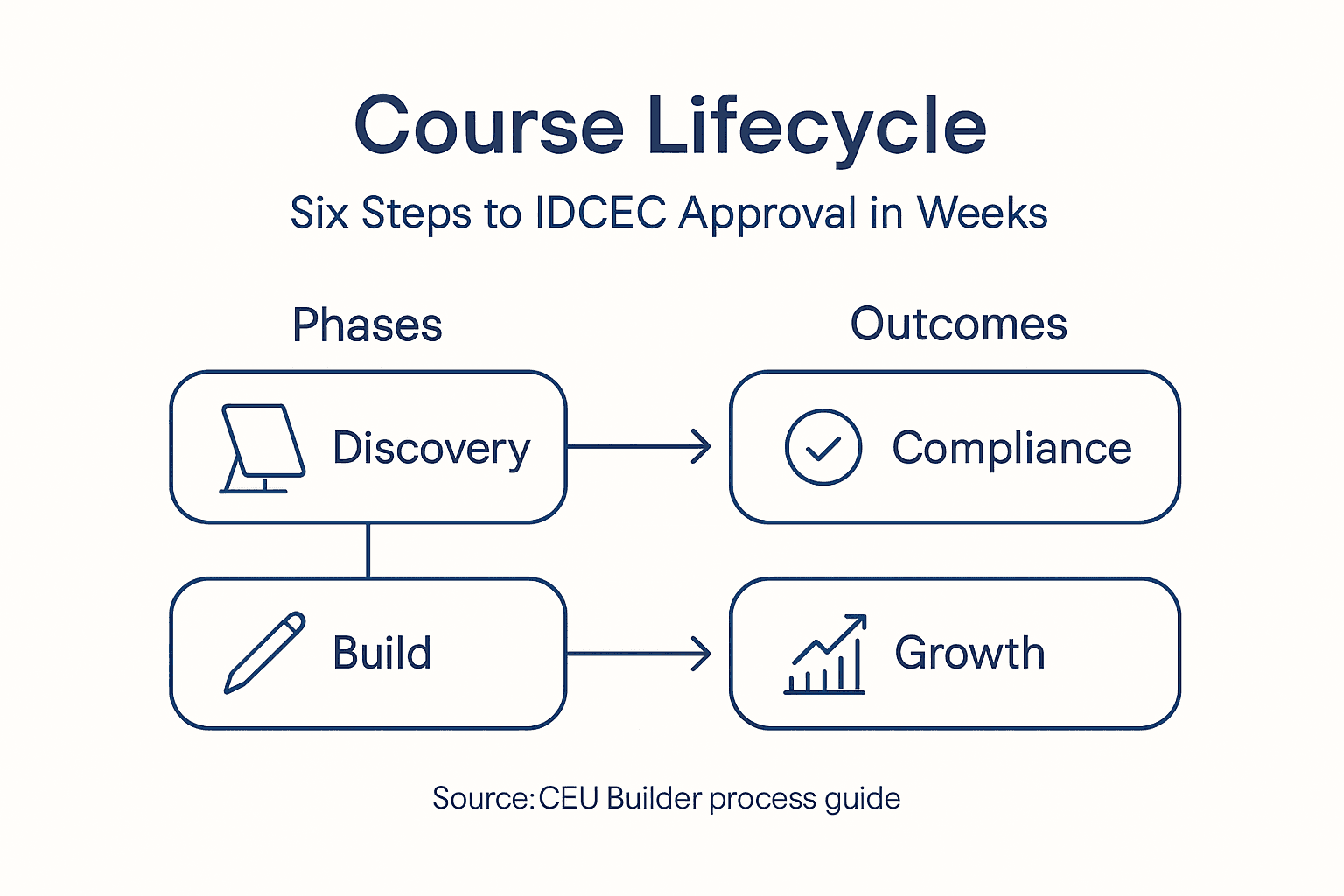
Most hospitality manufacturers spend 90 to 180 days developing IDCEC-accredited courses, only to face rejection and costly delays. A streamlined course lifecycle compresses this timeline to just 4 to 6 weeks while maintaining 100% first-pass approval rates. Understanding each phase of the IDCEC course lifecycle empowers marketing and product managers to create continuing education that influences architect specifications early in project cycles, driving measurable ROI.
Table of Contents
- Introduction to the IDCEC Course Lifecycle
- Discovery and Strategic Topic Selection
- Course Build Phase: Instructional Design and Content Creation
- Review, Revision, and Submission for Accreditation
- Course Launch and Post-Approval Delivery
- Scaling Education and Business Impact
- Common Misconceptions in the Course Lifecycle
- Accelerate Your IDCEC Course Approval with CEU Builder
- Frequently Asked Questions
Key Takeaways
| Point | Details |
|---|---|
| Six structured phases enable efficient IDCEC course development and approval | Strategic planning, content creation, compliance review, submission, launch, and scaling form the complete lifecycle |
| Topic selection aligned with architect needs ensures relevance and compliance | Research-driven course topics reduce rejection risk and accelerate accreditation timelines |
| Expert compliance management achieves 100% first-pass IDCEC accreditation | Systematic workflows eliminate rework, protecting timelines and budgets |
| Automated certification and tracking infrastructure sustain post-launch compliance | Systems for certificate issuance and completion monitoring ensure ongoing IDCEC standards adherence |
| Multi-course packages amplify ROI by influencing specifications early in design cycles | Strategic educational portfolios create competitive advantages and measurable business outcomes |
Introduction to the IDCEC Course Lifecycle
IDCEC accreditation is mandatory for architects and interior designers to earn continuing education credits required by professional licensing boards. Without accredited courses, your educational content cannot fulfill these requirements, rendering it ineffective for reaching design professionals.
Traditional course development spans 90 to 180 days. This extended timeline introduces risk. Market conditions shift, product launches delay, and competitors gain ground.
Complex compliance requirements create additional challenges. IDCEC accreditation requires alignment of learning objectives, content, assessment questions, and compliance auditing to meet strict adult education and regulatory standards. Missing any element triggers rejection.
A strategic lifecycle approach reduces these failures. By understanding the six phases from discovery through scaling, you can accelerate market entry while maintaining quality.
Mastering this lifecycle equips marketing and product managers to transform offering CEU courses from compliance tasks into specification drivers. Each phase builds on the previous, creating momentum toward approval and business impact.
Key phases include:
- Discovery and strategic topic selection aligned with architect search behavior
- Instructional design and content creation optimized for adult learning
- Review, revision, and compliance verification before submission
- IDCEC submission with systematic quality assurance
- Launch infrastructure including automated certificates and tracking
- Scaling strategies that amplify ROI through multi-course portfolios
The continuing education compliance workflow transforms from burden to competitive advantage when executed with precision.
Discovery and Strategic Topic Selection
Topic selection determines whether your course drives specifications or collects dust. Start by researching what architects and designers actively search for and need to learn.
Architects prefer tailored educational content aligned with their project needs and learning goals for better engagement and specification impact. Generic product pitches disguised as education fail to engage.
Audit existing content for reusability. Marketing decks, technical specifications, and installation guides often contain valuable material. Repurposing accelerates development while maintaining brand consistency.
Set learning objectives that comply with IDCEC alignment criteria. These objectives must be specific, measurable, and tied directly to course content and assessment questions. Vague objectives trigger rejection.
Strategic topic selection reduces revision risks later in the lifecycle. When topics address real architect challenges, content development flows naturally. When topics serve only manufacturer interests, forced connections weaken educational value.
Effective research reveals:
- Search terms architects use when seeking solutions to design problems
- Common specification challenges in hospitality projects
- Knowledge gaps that delay project timelines or increase costs
- Competitive educational offerings and differentiation opportunities
Pro Tip: Focus on topics where your product expertise solves genuine architect pain points rather than topics that simply showcase product features. Education that helps architects succeed in their projects naturally leads to specification consideration.
The discovery phase typically requires one week in a streamlined process. This time investment pays dividends by preventing false starts and ensuring creating CEU courses that architects actually want to take.
Course Build Phase: Instructional Design and Content Creation
Instructional design transforms subject matter expertise into engaging learning experiences. This phase converts approved topics and objectives into complete course materials ready for IDCEC review.

Develop speaker scripts that outline course flow and reinforce key messages. Scripts ensure consistent delivery whether courses are presented live or recorded. They also provide structure that keeps content focused and on time.
Course duration typically runs 45 to 60 minutes. This length maintains engagement while providing sufficient depth to meet IDCEC credit requirements. Shorter courses feel superficial. Longer courses lose attention.
Follow these steps for effective course builds:
- Draft the complete speaker script covering all learning objectives
- Design slide decks optimized for visual adult learning principles
- Create exam questions that measure comprehension and application
- Structure content flow to build knowledge progressively
- Include real project examples that demonstrate practical application
- Develop speaker notes that guide presentation delivery
Slide decks require careful visual design. Adult learners respond to clear graphics, minimal text, and logical information hierarchy. Dense slides packed with bullet points reduce engagement and retention.
IDCEC requires courses to have clearly defined assessments aligned with learning objectives to maintain credit validity and learner retention. Exam questions must test actual learning, not random product trivia.
Effective assessments include:
- Scenario-based questions that require applying course concepts
- Questions that test understanding of specification criteria
- Items that reinforce key differentiators without being promotional
- Distractors that reveal common misconceptions
Pro Tip: Write exam questions before finalizing course content. This reverse approach ensures your material actually teaches what you intend to assess, creating stronger alignment between objectives, content, and evaluation.
The build phase typically requires two weeks. Instructional designers handle script development, graphic designers create visual assets, and subject matter experts review for technical accuracy. This collaborative approach produces course development for specification influence that meets both educational and business goals.
Review, Revision, and Submission for Accreditation
Quality assurance separates successful accreditation from costly failures. This phase catches compliance gaps before IDCEC reviewers see your submission.
Include one round of revisions to address client feedback. Marketing and product teams review materials to ensure brand consistency, technical accuracy, and strategic positioning. Changes at this stage cost hours. Changes after IDCEC rejection cost months.
Compile bibliographies meeting IDCEC academic citation standards. Every factual claim, statistic, and expert opinion requires proper attribution. Missing citations trigger automatic rejection regardless of content quality.
Specialized teams manage the complex submission process. IDCEC’s provider portal requires specific file formats, naming conventions, and documentation. Technical errors in submission create delays even when content is perfect.
Systematized review and submission workflows combined with compliance auditing ensure first-pass IDCEC approval, eliminating rework and risk. These systems catch common mistakes:
- Learning objectives that don’t align with content or assessments
- Exam questions with multiple correct answers or no correct answers
- Bibliography entries missing required information
- Content that violates IDCEC promotional content restrictions
- File uploads that don’t meet technical specifications
Achieving 100% first-pass approval protects timelines and budgets. Failed submissions require complete rework and resubmission. The clock resets, often adding 60 to 90 days before approval.
The submission phase typically requires one week. This includes final compliance auditing, bibliography compilation, portal uploads, and confirmation that IDCEC received all materials correctly.
Following the detailed accreditation guide ensures nothing falls through cracks during this critical phase.
Course Launch and Post-Approval Delivery
IDCEC approval is a milestone, not a finish line. Launch infrastructure determines whether your course generates business impact or sits unused.
Set up automated certificate issuance upon completion. Architects need certificates proving they earned credits. Manual certificate processes create delays that frustrate learners and damage your brand reputation.
Deploy tracking systems to monitor completions and compliance status. You need to know who took your course, when they completed it, and whether they passed the assessment. This data drives follow-up and measures ROI.
Automated certificate generation and tracking infrastructure are essential for legal compliance, learner satisfaction, and long-term course success. These systems handle:
- Real-time certificate delivery via email after passing the exam
- Completion records stored for IDCEC audit requirements
- Learner data capture for CRM integration and sales follow-up
- Reporting dashboards showing engagement metrics and trends
Ensure platform access supports lifetime availability for learners. Architects may want to reference course materials months or years after initial completion. Permanent access adds value and reinforces your educational investment.
Data reporting measures engagement and impact on specifications. Track which architects from which firms completed which courses. Connect this data to specification requests and project wins. This closed-loop measurement validates ROI and guides future course development.
The launch phase happens in week four of the streamlined process. Upon IDCEC approval, certificates and automation are configured immediately. The course approval workflow includes technical setup so courses can be delivered the same day approval is granted.
Scaling Education and Business Impact
Single courses generate results. Course portfolios create competitive advantages. Scaling your educational offerings amplifies specification influence and ROI.
Offering two to three course packages extends educational reach and reinforces learning. Architects who complete multiple courses from one manufacturer develop stronger product familiarity and specification preference.
Strategically timed engagement stimulates product consideration early in project cycles. When an architect takes your course six months before a hotel project begins, your products become the reference point when specifications are written.
| Package | Investment | Timeline | Business Impact |
|---|---|---|---|
| Single Course | $10,000 | 4-6 weeks | Entry point testing CEU strategy, generates 150-200 annual completions |
| Two Course Series | $18,000 | 6-10 weeks | Most popular, creates multiple touchpoints across product lines |
| Three Course Series | $25,000 | 10-12 weeks | Comprehensive educational presence, maximizes specification opportunities |
Data-driven ROI measurement validates investment and guides development. A $10,000 accredited course can generate over 4 product specifications, illustrating a strong ROI for continuing education programs. In hospitality projects where product packages often exceed $100,000, a single specification returns 10x the course investment.
The math improves over time because courses have indefinite shelf lives. A course built in 2025 continues generating completions in 2026, 2027, and beyond with no additional development cost.
Scaling strategies include:
- Creating course series that progress from foundational to advanced topics
- Developing product-specific courses that address different application categories
- Building regulatory compliance courses that position your products as code-compliant solutions
- Launching installation and specification best practice courses that reduce architect risk
Manufacturers who invest in optimizing continuing education programs create data advantages. Course completion patterns reveal which architects are interested in which topics, enabling precise targeting and personalized sales approaches.
Common Misconceptions in the Course Lifecycle
Three myths prevent manufacturers from pursuing IDCEC accreditation. Understanding the reality helps you make informed decisions.
Accreditation is not unpredictable when you use systematized workflows and expertise. The perception of randomness comes from manufacturers attempting DIY development without understanding requirements. With expert-driven workflows, manufacturers can achieve 100% first-pass IDCEC accreditation success, shortening timelines dramatically.
Architects respond better to tailored, project-focused education than generic product pitches. The misconception that any content about your products will engage architects ignores their professional needs. They seek practical knowledge that helps them design better projects, not thinly veiled sales presentations.
Efficient course development can take as little as 4 to 6 weeks with proper tools and support. The belief that quality courses require six months or more comes from traditional processes lacking automation and systematization. Modern approaches compress timelines by 80 to 95% without sacrificing quality.
Common misconceptions include:
- “IDCEC reviewers are arbitrary and inconsistent.” Reality: IDCEC has clear standards. Failures result from not understanding requirements.
- “Architects will take any course if it’s free and offers credits.” Reality: Architects choose courses based on relevance and professional value.
- “Building courses internally is always cheaper.” Reality: Failed accreditation attempts waste tens of thousands in internal resources and delay market entry by a year.
- “One course is enough to generate specifications.” Reality: Multi-course portfolios create stronger positioning and higher conversion rates.
Understanding the actual CEU approval process eliminates these misconceptions and enables confident investment in continuing education strategy.
Accelerate Your IDCEC Course Approval with CEU Builder
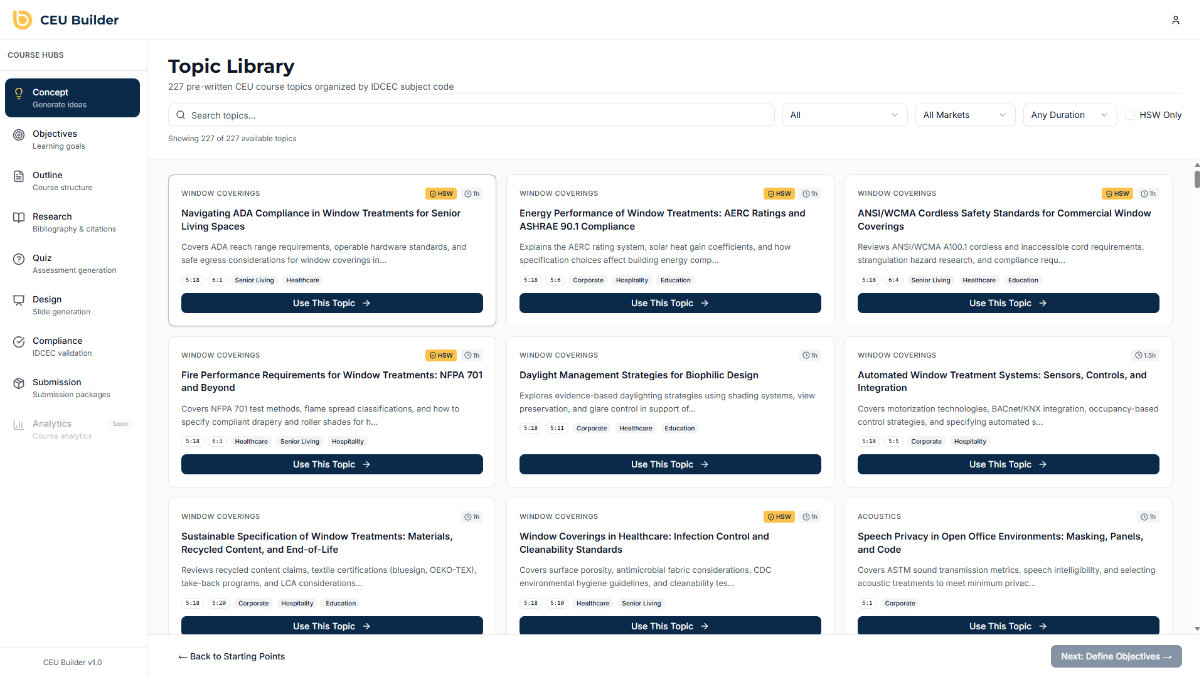
CEU Builder specializes in transforming hospitality manufacturers’ expertise into IDCEC-accredited courses that drive architect specifications. Our 100% first-pass approval rate eliminates accreditation risk while our 4 to 6 week timeline gets you to market faster than competitors.
We handle everything from strategic topic selection through launch infrastructure, including lifetime platform access for ongoing course delivery. Whether you need done-for-you service or platform access with training, we provide the tools and expertise to succeed.
Hospitality manufacturers including Tri-Tex Industries, Nassau Hospitality, and Woodcraft Hospitality trust CEU Builder to create educational content that generates measurable business outcomes. Our systematic approach ensures compliance while maintaining strategic focus on specification influence.
Ready to compress your course development timeline from months to weeks? Explore our complete accreditation guide, learn the details of getting IDCEC approval, or review our proven course approval process.
Frequently Asked Questions
What is the typical timeline to develop and launch an IDCEC accredited course?
With streamlined workflows and systematic processes, the timeline compresses to 4 to 6 weeks from kickoff to IDCEC approval. Traditional approaches span 90 to 180 days due to inefficient processes and lack of compliance expertise. The difference comes from reverse-engineered workflows, custom automation tools, and deep understanding of IDCEC requirements that eliminate common delays and rejection risks.
What steps ensure 100% first-pass IDCEC accreditation success?
A dedicated revision round, expert compliance auditing, and accurate submission management are essential for first-pass approval. Systematic quality assurance catches alignment gaps between learning objectives, content, and assessments before IDCEC reviewers see your materials. Proper bibliography compilation and portal submission technical requirements prevent administrative rejections that waste months.
How does topic selection impact course effectiveness?
Choosing architect-relevant, project-focused topics dramatically improves engagement and specification outcomes. Topics based on actual architect search behavior and design challenges create educational value that translates to product consideration. Generic topics serving only manufacturer interests generate low completion rates and minimal business impact regardless of accreditation status.
Can manufacturers with limited resources develop effective CEU courses internally?
Done-for-you services can reduce internal resource demands and accelerate accreditation while achieving superior results. Most manufacturers lack the instructional design expertise, IDCEC knowledge, and compliance tools needed for efficient development. Attempting internal development without these capabilities typically results in 6 to 12 month timelines and high rejection rates that waste tens of thousands in resource costs.
What infrastructure is needed after course launch to maintain compliance?
Automated certificate generation and completion tracking systems are essential for ongoing compliance management. These systems handle real-time certificate delivery, store completion records for IDCEC audit requirements, and provide reporting dashboards showing engagement metrics. Manual processes create delays that frustrate learners and introduce compliance risks through incomplete record keeping.
Recommended
