

Course Development for Manufacturers: Driving Specification

Finding ways to stand out with architects can feel like chasing moving targets for North American hospitality furniture manufacturers. Developing IDCEC-accredited courses builds deeper architect engagement and influences specification decisions while positioning your brand as a trusted industry expert. This guide explains how course development is a systematic process that goes beyond traditional training, offering practical strategies to connect learning outcomes with measurable business results.
Table of Contents
- Defining Course Development for Manufacturers
- What Makes It Different From Generic Training
- The Iterative Reality
- Core Development Components
- Why Timing Matters
- IDCEC Accreditation and Industry Standards
- The Three Core IDCEC Requirements
- Why Accreditation Matters for Your Business
- The Accreditation Process Reality
- Provider Status Requirements
- Strategic Course Design for Hospitality Impact
- Connecting Hospitality Challenges to Course Content
- Real-World Case Studies Over Theory
- Emotional Branding Through Education
- Key Design Elements
- Common Obstacles and How to Overcome Them
- The Budget Reality Check
- Architect Resistance and Skepticism
- Measuring Actual Impact
- Internal Alignment and Resource Constraints
- IDCEC Compliance Surprises
Key Takeaways
| Point | Details |
|---|---|
| Focus on External Audiences | Manufacturer course development should target architects and designers rather than internal employees, emphasizing industry principles and specifications essential for product recommendation. |
| Iterative Development Approach | Continuous feedback and refinement from course participants is crucial, enabling manufacturers to enhance course quality and relevance over time. |
| Importance of IDCEC Accreditation | Accreditation ensures courses are genuinely educational and meet rigorous standards, increasing credibility and engagement among architects seeking continuing education. |
| Strategic Alignment with Business Goals | Courses must generate measurable outcomes linked to specification requests, addressing real-world challenges architects face in hospitality projects. |
Defining Course Development for Manufacturers
Course development for manufacturers is creating structured educational content that bridges the gap between what architects need to learn and what your products can solve. It’s not just building training materials—it’s designing learning experiences that position your company as an industry authority while driving specification decisions.
For manufacturers in the hospitality sector, course development is a systematic process of designing, building, and deploying educational programs that meet both learning objectives and business goals. You’re creating content architects and designers actively want to complete, not content they’re forced to sit through.
The key distinction matters: course design outlines what the learning experience should accomplish, while course development actually executes it through instructional design, content creation, media production, and engagement strategies. Design is the blueprint. Development is the construction.
What Makes It Different from Generic Training
Traditional corporate training focuses on internal employee competency. Manufacturer course development focuses outward—targeting specification decision-makers outside your organization. The difference shapes everything from content selection to delivery method.
Your course isn’t teaching hospitality designers how to use internal systems or follow company procedures. It’s teaching them design principles, specification criteria, and problem-solving approaches that naturally lead them to recommend your products.
This requires:
Here’s a comparison of traditional corporate training and manufacturer course development for architects:
| Aspect | Traditional Corporate Training | Manufacturer Course Development |
|---|---|---|
| Audience | Internal employees | External architects/designers |
| Content Focus | Company policies and skills | Industry principles and specifications |
| Business Goal | Internal efficiency | Drive product specification |
| Measurability | Performance metrics | Specification requests generated |
- Architect-centric topics selected based on what design professionals actually search for and care about
- Specification-focused content that teaches decision criteria favoring your products
- IDCEC accreditation so the course counts toward required continuing education credits
- Professional presentation reflecting industry credibility and quality standards
- Measurable outcomes connecting course completions to actual specification requests
The Iterative Reality
Course development is iterative by nature, meaning you plan, build, gather feedback, and refine continuously. For manufacturers, this means your first course isn’t perfect—and that’s intentional. You launch, measure what works, and improve.

Architects will complete your course and provide data on which topics engaged them most. Which sections they skipped. Which exam questions confused them. Which product categories generated specification interest. This feedback becomes your roadmap for future course development and refinement.
The iterative approach also means you’re not betting everything on one perfect course. You’re building a library of courses over time, each one informed by real architect behavior and specification outcomes.
Core Development Components
Every manufacturer course development project includes these non-negotiable elements:
- Learning objectives defining exactly what architects will be able to do after completion
- Content structure organizing information logically and maintaining engagement
- Assessments measuring comprehension and retention through exams
- Visual design presenting content professionally and supporting learning
- IDCEC compliance ensuring accreditation standards are met throughout
- Platform infrastructure enabling delivery, tracking, and certification
Why Timing Matters
Manufacturers often delay course development, thinking they’ll start “when they have more resources” or “next quarter.” The reality: competitors who develop courses first capture architect attention and establish specification preference before you enter the market.
An architect who completed a competitor’s course about acoustic performance in hospitality environments already has specification criteria shaped by that course. Your product faces an uphill battle regardless of quality.
Course development isn’t a luxury initiative. It’s a competitive timing issue.
Course development is your opportunity to shape specification criteria in your favor before competitors do.
Pro tip: Start with your single strongest product category or the topic generating the most architect questions. Launch one quality course that drives real specifications rather than waiting to develop a perfect five-course library.
IDCEC Accreditation and Industry Standards
IDCEC accreditation separates legitimate manufacturer courses from marketing disguised as education. When architects see the IDCEC logo, they know the course meets professional standards and counts toward their required continuing education credits.
The International Design Continuing Education Council (IDCEC) establishes accreditation standards that ensure courses meet rigorous quality and professional relevance criteria. For manufacturers, this means your course cannot be a product brochure masquerading as education. It must be genuinely instructional, generic enough that it teaches principles rather than just selling features, and relevant to how architects actually work.
This distinction matters enormously. Architects are trained professionals with licensing requirements. They’re skeptical of obvious sales pitches. But they actively seek accredited education that teaches them something valuable.
The Three Core IDCEC Requirements
Accreditation isn’t arbitrary. IDCEC evaluates courses against specific criteria that manufacturers must understand before development begins.
- Generic, not proprietary content means teaching design principles and specification criteria that happen to favor your products, not only your products
- Instructional focus requires learning objectives, assessments, and measurable outcomes rather than promotional messaging
- Professional relevance demands the course addresses real challenges architects face on hospitality projects
When manufacturers try to sneak product promotion into educational content, IDCEC reviewers catch it. Courses get rejected during the accreditation process, wasting months and requiring complete rebuilds.
Why Accreditation Matters for Your Business
Unaccredited courses might seem easier to launch faster. They’re not. Architects ignore them because they don’t count toward continuing education requirements. You’ve invested in course development that generates zero completion traction.
IDCEC accreditation creates a competitive moat. Once your course is accredited, competitors cannot easily replicate it. They’d have to develop their own course, wait for accreditation, and hope architects prefer their version over yours.
Accreditation also signals credibility. Design professionals trust IDCEC-accredited content because the council’s vetting process is rigorous and well-respected in the industry.
The Accreditation Process Reality
Manufacturers often underestimate accreditation complexity. The process involves detailed documentation, compliance verification, and technical requirements that most marketing teams have never encountered.
Common mistakes include:
- Missing IDCEC’s specific learning objective language requirements
- Including promotional content that violates “generic, not proprietary” standards
- Failing to include proper assessment questions that measure learning
- Incomplete bibliography or improperly formatted references
- Unclear connection between content and stated learning outcomes
Each mistake triggers rejection. You fix the issue, resubmit, and wait again. The process stretches from 4-6 weeks to 6-12 months.
Provider Status Requirements
Before your course can even be submitted for accreditation, you need provider status with IDCEC. This involves initial registration, provider agreement acceptance, and technical setup in IDCEC’s system.
Provider types include individual providers, corporate providers, and conference organizers. Each has different responsibilities and approval timelines. Most manufacturers pursue corporate provider status since they’re developing courses as a business function.
The provider registration step often surprises manufacturers who assume they can just submit a course. Registration comes first. Course submission comes second.
IDCEC accreditation means your course is genuinely educational, not just clever marketing dressed up as learning.
Pro tip: Don’t start course development until you understand IDCEC’s specific requirements and formatting standards. Many manufacturers waste time building content that fails accreditation because they didn’t align development with IDCEC criteria from the beginning.
Strategic Course Design for Hospitality Impact
Strategic course design for hospitality manufacturers goes beyond teaching generic principles. It connects architectural and design challenges specific to hotels, restaurants, and senior living facilities directly to your product solutions.
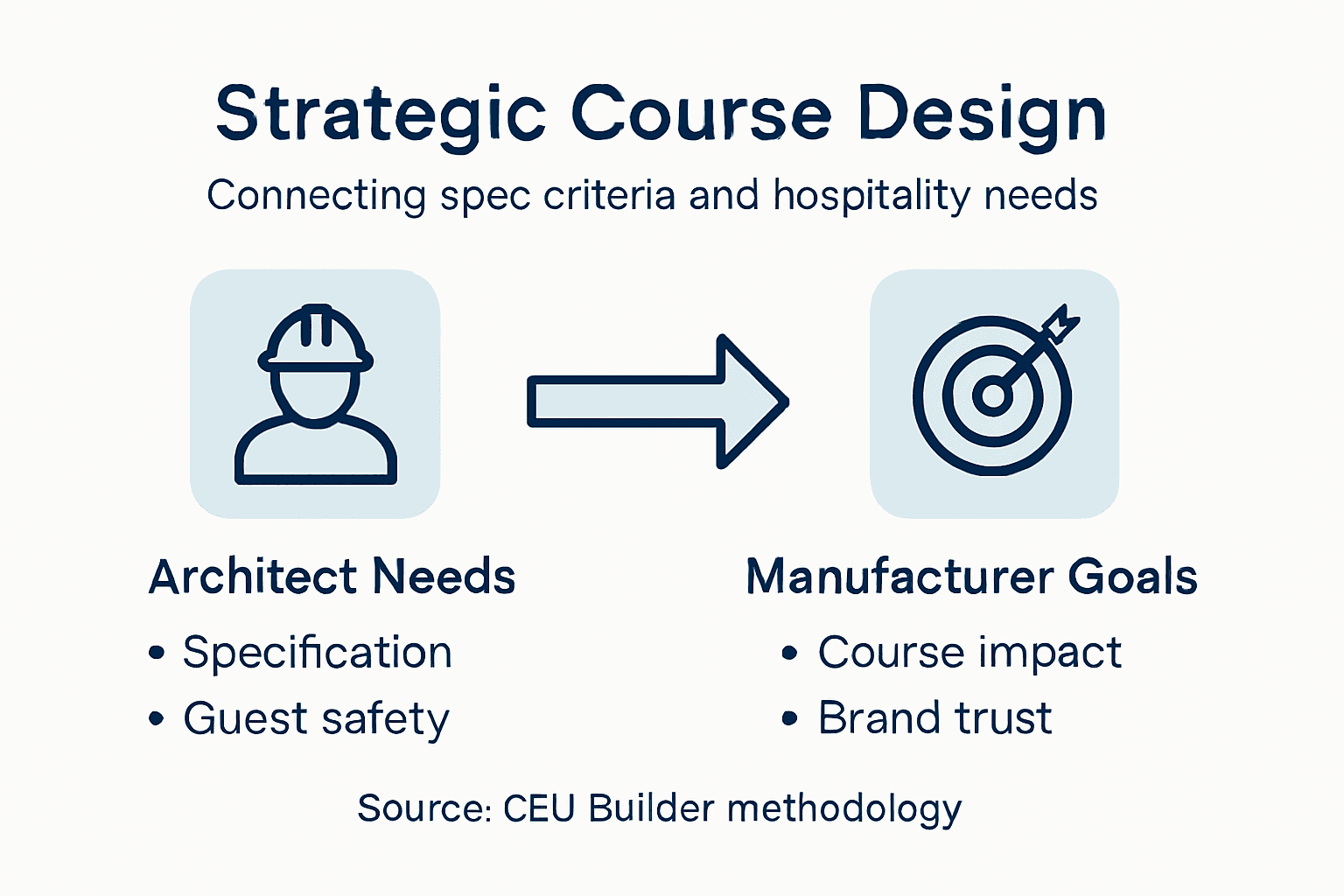
The difference between generic and strategic design is intentionality. Generic courses teach broad concepts that could apply anywhere. Strategic courses teach concepts that architects need for hospitality projects, positioning your products as the natural solution to their specific challenges.
For hospitality manufacturers, strategic course design integrates operational and guest experience leadership to build courses that resonate with design professionals working on hospitality projects. Your course should address real pressures architects face: budget constraints, durability requirements, cleaning protocols, guest comfort, and design consistency across multiple rooms.
Connecting Hospitality Challenges to Course Content
Every hospitality project has unique constraints that drive specification decisions. Strategic course design maps these constraints to your product strengths.
Consider a hotel renovation where architects must balance:
- Budget limitations requiring durable products that reduce replacement frequency
- Cleaning demands from housekeeping teams working quickly between guests
- Comfort expectations from guests experiencing the space for days or weeks
- Brand consistency across dozens or hundreds of rooms
- Code compliance for fire safety, accessibility, and emergency egress
Your course should teach specification criteria addressing these constraints. Not by name-dropping your products, but by teaching decision frameworks that architects naturally apply when they encounter your offerings.
Real-World Case Studies Over Theory
Architects learn by seeing how principles work in practice. Strategic design incorporates real-world case studies and practical engagement showing how other designers solved hospitality challenges.
Instead of abstract lectures about durability, show how a specific hotel renovated 200 rooms with product selections that reduced maintenance costs by 40% while improving guest satisfaction scores. Let architects see the problem, the solution, and the measurable outcomes.
Case studies also build confidence. Architects see that other designers faced similar constraints and found solutions. Your course becomes a resource they reference when they encounter comparable projects.
Emotional Branding Through Education
Hospitality design is emotional. Guests form impressions in seconds based on how a space feels, looks, and functions. Strategic courses teach architects how to design experiences, not just select products.
This approach positions your brand differently. You’re not the vendor with the cheapest price or most features. You’re the educator helping architects create better experiences for guests. That positioning shifts specification decisions in your favor.
Key Design Elements
Strategic hospitality courses must include:
- Hospitality-specific scenarios based on actual project types and constraints
- Measurable outcomes connecting design decisions to guest satisfaction or operational efficiency
- Cross-functional perspectives addressing architecture, interior design, engineering, and operations
- Emerging trends in hospitality like sustainability, wellness, and technology integration
- Specification frameworks teaching decision criteria that naturally favor your products
Strategic course design teaches architects how to think about hospitality challenges, not just what to specify.
Pro tip: Start with your most common hospitality project type—hotels, restaurants, or senior living—and design your course specifically for those constraints rather than trying to appeal to all hospitality segments at once.
Common Obstacles and How to Overcome Them
Manufacturers developing courses for architects face obstacles that don’t exist in traditional employee training. Your audience is external, independent, and skeptical. They’re not required to take your course. You must convince them it’s worth their time.
Understanding common obstacles and practical solutions prevents wasted development effort and failed launches. Most manufacturers encounter the same challenges. Knowing how to address them separates successful course programs from unsuccessful ones.
The Budget Reality Check
Many manufacturers underestimate course development costs. They assume building slides and recording video is the work. It’s not. The actual work is instructional design, compliance verification, accreditation management, and continuous refinement.
Course development faces budget constraints requiring clear communication of training value and alignment with organizational performance goals. For manufacturers, this means calculating ROI before development begins.
One accredited course generating 200 architect completions creates 200 touchpoints with specification decision-makers. If 2% of those architects specify your products into projects, that’s 4 specifications. In hospitality projects, a single specification often returns 10 times the course investment.
The budget obstacle dissolves when you frame courses as specification-generation infrastructure, not marketing expense.
Architect Resistance and Skepticism
Design professionals are trained to evaluate critically. When they see educational content from a manufacturer, their first instinct is suspicion. “Is this genuinely educational or a product brochure disguised as learning?”
Overcome this by making your course genuinely educational. Teach principles that apply broadly, not just your products. Use case studies featuring multiple manufacturers and design approaches. Address architect concerns directly rather than avoiding them.
Architects also resist content that wastes their time. Keep courses focused and relevant. Remove filler. Respect that they’re busy professionals with limited time for continuing education.
Measuring Actual Impact
Many manufacturers struggle connecting course completions to business outcomes. They track attendance but can’t prove courses drive specifications.
Solve this by building tracking infrastructure from the start:
- Require architect contact information at enrollment
- Add questions in course exams linking to your products and specification criteria
- Follow up with architects who complete the course
- Document which courses preceded specification requests
- Calculate cost per specification generated
Without this tracking, you’re running blind. You know courses launched but can’t prove they work.
Internal Alignment and Resource Constraints
Course development requires coordination between marketing, product, sales, and sometimes engineering teams. Different departments have conflicting priorities. Product teams want to showcase features. Sales teams want to emphasize benefits. Marketing teams want brand consistency.
Secure leadership buy-in early by presenting the business case clearly. Show how courses generate specifications that sales teams can close. Demonstrate ROI potential. Get written commitment for internal resource time.
Without alignment, development stalls. You’re waiting for approvals, dealing with conflicting feedback, and missing deadlines.
IDCEC Compliance Surprises
Many manufacturers start development without understanding IDCEC requirements. Halfway through, they discover their content violates accreditation standards. They rebuild. They resubmit. They wait months more.
Avoid this by building IDCEC compliance into development from day one. Understand the requirements before you create content. Use compliance checklists. Have someone familiar with IDCEC review drafts before you finalize them.
Successful course development anticipates obstacles early rather than discovering them late.
Pro tip: Before committing significant resources, validate your course topic with 3-5 target architects and ask if they’d complete it for continuing education credit. If they won’t, your topic needs refinement before you invest in full development.
Below is a summary of common obstacles manufacturers face and practical solutions for each:
| Obstacle | Why It Happens | Practical Solution |
|---|---|---|
| Underestimating Costs | Costs beyond content creation | Calculate ROI up front |
| Architect Skepticism | Perceived as sales pitch | Use peer case studies |
| Impact Measurement | Lack of tracking tools | Set up outcome tracking from start |
| Internal Misalignment | Conflicting team priorities | Secure leadership buy-in early |
| Accreditation Surprises | Missed IDCEC standards | Align development with requirements |
Unlock Specification Growth with Strategic CEU Course Development
Struggling to transform your course development efforts into measurable specification outcomes? This article highlights critical obstacles like architect skepticism, IDCEC accreditation complexity, and the need for architect-focused, specification-driving education. If your goal is to convert continuing education courses into powerful demand-generation engines rather than mere compliance content, you need a partner who understands both accreditation requirements and architect motivations.
CEU Builder’s proven methodology offers exactly that. With a perfect first-pass IDCEC approval rate and deep expertise in hospitality specification dynamics, we craft courses that position your brand as an industry authority while driving real pipeline growth. Ready to stop guessing and start winning? Discover how aligning your course strategy with architect search behavior and continuing education demands creates competitive moats that last.
Pipeline & Revenue Growth – CEU Builder
CEU Strategy & Best Practices – CEU Builder
CEU Builder
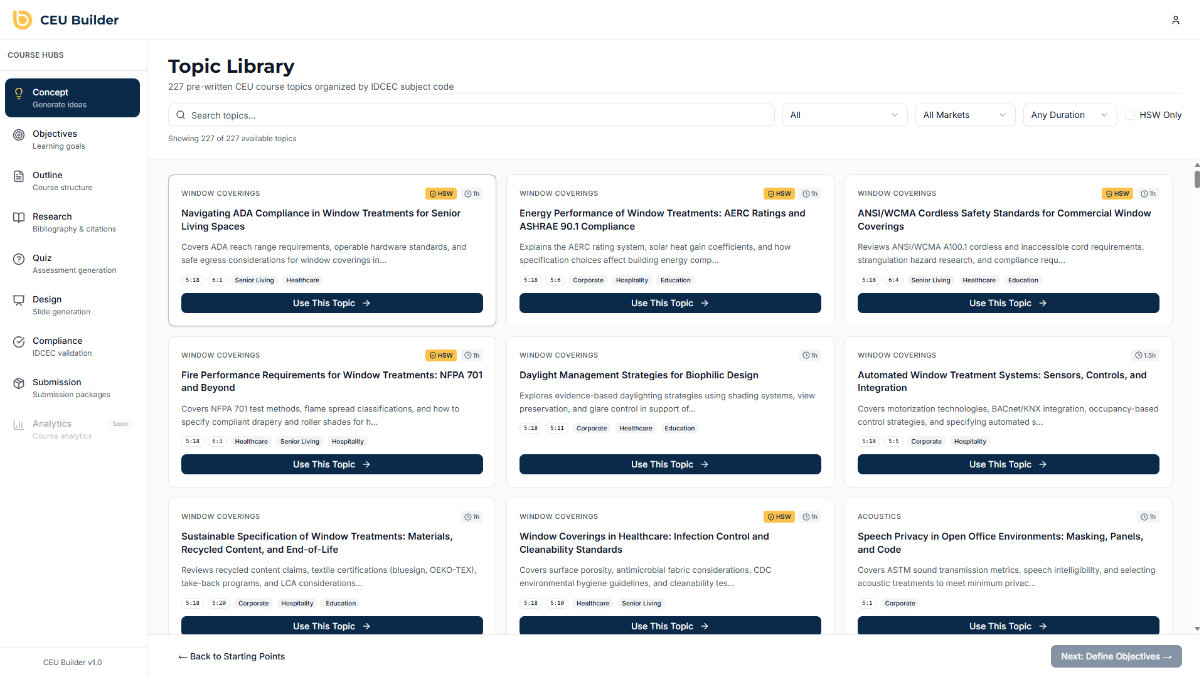
Take control of your specification influence today by partnering with CEU Builder. Visit CEU Builder to explore done-for-you courses or our powerful platform options designed to accelerate your CEU development and start converting architectural education into high-value specifications now.
Frequently Asked Questions
What is course development for manufacturers?
Course development for manufacturers involves creating structured educational content aimed at teaching architects and designers about industry principles and specification criteria relevant to the manufacturer’s products. It goes beyond traditional training to influence specification decisions.
How does course development differ from traditional corporate training?
Course development for manufacturers targets external architects and designers, focusing on industry-specific content and principles rather than internal company policies. Its goal is to drive product specifications rather than improve internal efficiency.
Why is IDCEC accreditation important for manufacturer courses?
IDCEC accreditation ensures that a course meets professional standards and counts toward continuing education credits for architects. It distinguishes genuine educational content from marketing material and builds trust among design professionals.
What are common obstacles in developing courses for architects, and how can they be overcome?
Common obstacles include underestimating costs, architect skepticism, difficulty measuring impact, internal misalignment, and surprises with accreditation requirements. To overcome these, manufacturers should calculate ROI, use real-world case studies, set up tracking systems, secure leadership buy-in, and ensure compliance with IDCEC standards from the beginning.
Recommended
