

Build IDCEC education programs that drive specs: 10x ROI

Getting architects and designers to genuinely engage with your brand is one of the hardest challenges in hospitality manufacturing. Traditional sales calls get screened out. Trade show conversations last five minutes. But a well-built, IDCEC-accredited continuing education unit (CEU) course gives you 45 to 60 minutes of focused attention from the exact decision-makers who control specifications. The catch? Over 50% of first-time in-house IDCEC submissions are rejected due to commercial bias, incomplete applications, or poorly written objectives. This guide walks you through every stage of building a sales-focused, accredited program that clears approval on the first attempt and generates measurable revenue.
Table of Contents
- What makes an education program sales-focused (and IDCEC ready)?
- Preparation: What you need before you start
- Step-by-step: Designing and submitting your program
- Troubleshooting: Common mistakes and how to avoid them
- Verification and follow-through: Tracking results and maximizing ROI
- Why most sales-focused CEU programs fail—and what actually works
- Ready to accelerate your specs and revenue with accredited courses?
- Frequently asked questions
Key Takeaways
| Point | Details |
|---|---|
| Accreditation boosts sales | Properly built CEU courses double trust and deliver 10x+ ROI versus traditional marketing. |
| Compliance is critical | Avoid any product/brand bias and focus on educational value for IDCEC acceptance. |
| Outsource for speed | Expert partners can secure first-pass approval in 4-6 weeks, bypassing costly delays. |
| Tracking ensures ROI | Integrating course completion with CRM systems enables effective sales follow-up and long-term revenue. |
What makes an education program sales-focused (and IDCEC ready)?
Most manufacturers assume “sales-focused” means loading a course with product features and brand messaging. That assumption is exactly what triggers rejection. A truly sales-focused CEU program achieves two things at once: it meets every IDCEC (Interior Design Continuing Education Council) accreditation standard, and it positions your brand as the technical authority architects trust when specifying products.
IDCEC evaluates objectives alignment, content rigor, and exam quality, not product promotion. Courses that teach genuine skills and solve real specifier problems pass. Courses that read like product brochures fail. Understanding this distinction is the foundation of every successful program.
Here is how the two approaches compare:
| Feature | Sales pitch course | Education-first course |
|---|---|---|
| Content focus | Product features and pricing | Technical problem-solving |
| IDCEC acceptance rate | Very low | High (up to 100% first-pass) |
| Architect engagement | Low, skipped quickly | High, 45-60 min completion |
| Specification impact | Minimal | Direct and measurable |
| Lead quality score | ~6.2/10 | ~8.7/10 |
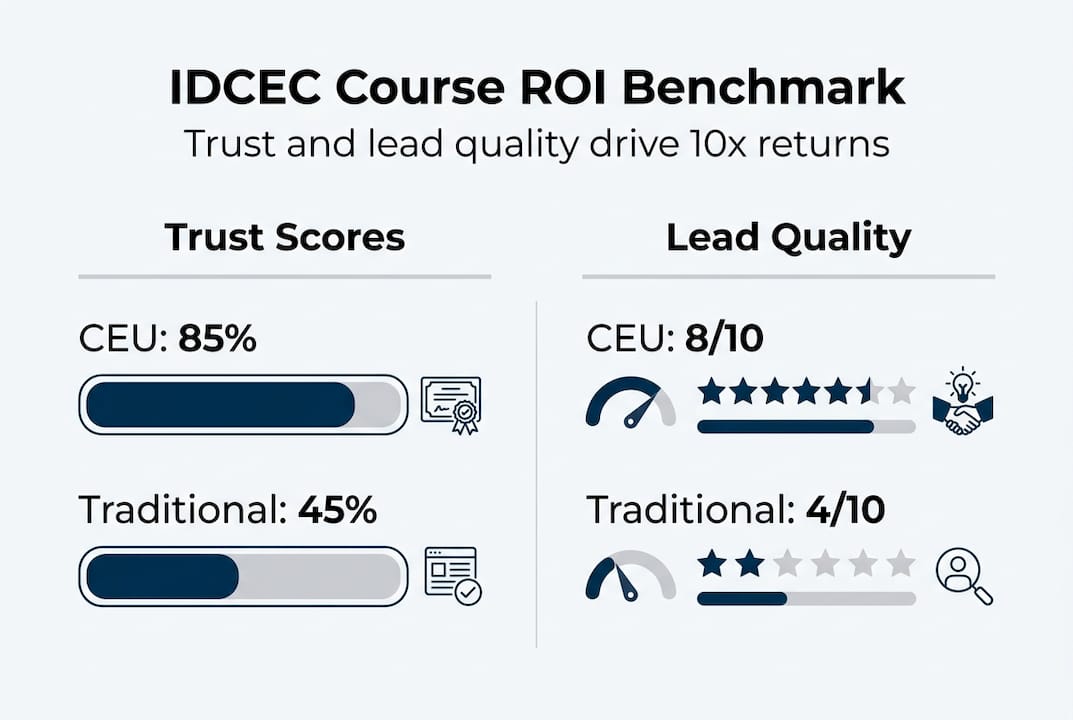
The business case for getting this right is strong. Empirical benchmarks show trust scores of 85% for CEU-educated architects versus 45% for those reached through traditional marketing, with lead quality nearly 40% higher and a 10x-plus return on investment from resulting specifications.
To build a program that clears IDCEC review, every course needs these core elements:
- Measurable learning objectives written in action-verb format (analyze, evaluate, apply)
- Academic references from peer-reviewed or industry-recognized sources
- Unbiased content with no product names or proprietary claims in the body
- Exam questions that test comprehension, not brand recall
- Instructional design that follows adult learning principles
“Over 50% of in-house first-time IDCEC submissions are rejected due to commercial bias, incomplete applications, or poor objectives.” Avoiding these three failure points is not optional. It is the entire game.
Pro Tip: Pick course topics that solve a technical challenge specifiers actually face on projects, such as acoustic performance in open-plan hospitality spaces or fire-rating compliance for contract textiles. That framing passes IDCEC review and makes your brand the go-to reference when those challenges appear on real jobs. See the effective branded coursework guide for topic selection frameworks, and review IDCEC approval steps before you start writing a single slide. For broader context on technical education best practices, that resource covers instructional design principles worth studying early.
Preparation: What you need before you start
Now that you understand the dual focus, here is how to gather what you need before beginning your course build. Skipping preparation is the second most common reason programs stall or fail after submission.
IDCEC submissions require a detailed outline, a complete slide deck, academic references, written learning objectives, exam questions, and evidence of adult learning principle adherence. Assembling these without a clear plan wastes weeks.

Use this checklist before writing a single word of content:
| Preparation item | Who owns it | Notes |
|---|---|---|
| Subject matter expert | Product or engineering team | Must be available for 3-4 review sessions |
| Instructional designer | Internal or outsourced | Converts expertise into structured learning |
| Course topic and outline | Marketing lead | Validated against architect search behavior |
| Learning objectives (3-5) | Instructional designer | Action-verb format required |
| Academic reference list | Subject matter expert | Minimum 5 credible sources |
| Slide deck draft | Designer | 30-50 slides typical for 1-hour course |
| Sample exam questions (10+) | Instructional designer | Must test application, not memorization |
Beyond the paperwork, there are strict content rules you need to build into your process from day one:
- Product names and model numbers are prohibited in the main course body
- Proprietary logos may appear only at the introduction and closing slides
- Pricing, availability, and sales contact information cannot appear anywhere
- Claims must be supported by cited references, not manufacturer assertions
- Content must apply broadly to the category, not exclusively to your product line
Pro Tip: Pull two or three examples of rejected courses and one approved course before you start writing. Seeing the contrast between a pure sales pitch and an accepted program recalibrates your team’s instincts faster than any style guide. The IDCEC provider accreditation guide includes annotated examples worth reviewing. You can also browse hospitality CEU topic examples to see how approved providers frame technical subjects.
Step-by-step: Designing and submitting your program
With all materials and requirements gathered, you are ready to build and submit your program. Follow these steps in order. Skipping ahead creates compliance gaps that surface during review.
- Write learning objectives first. Define three to five measurable outcomes using action verbs. Objectives anchor every content decision that follows.
- Build a detailed course outline. Map each section to a specific learning objective. This structure is what IDCEC reviewers evaluate before they read a single slide.
- Assemble your slide deck. Design for visual learning. Each slide should support one concept. Avoid text-heavy slides that read like documents.
- Compile your academic reference list. Every factual claim needs a citation. Aim for a minimum of five sources from recognized industry or research bodies.
- Write exam questions. Create at least ten questions that test application and analysis, not simple recall. IDCEC reviewers flag exams that only ask “What is our product made of?”
- Run a compliance review. Check every slide for brand names, product numbers, pricing, and sales language. Remove anything that could be read as commercial promotion.
- Submit through the IDCEC portal. Complete the application form, upload all materials, and pay the submission fee. Incomplete applications are rejected automatically.
Accredited CEUs provide 45 to 60 minutes of focused attention, genuine trust-building, and technical authority that enables future specifications. That engagement window is simply unavailable through any other marketing channel.
The numbers back this up clearly. Trust scores reach 85% among architects educated through CEUs versus 45% through traditional marketing, with lead quality scores of 8.7 out of 10 compared to 6.2, and a 10x-plus ROI from resulting specifications.
For a proven workflow that achieves 100% first-pass approval, review the IDCEC course approval process and the first-pass IDCEC approval workflow. Real-world CEU ROI examples from hospitality manufacturers show exactly how specifications translate to revenue.
Troubleshooting: Common mistakes and how to avoid them
Even well-built programs can get tripped up at submission. Here is how to sidestep the most frequent issues before they cost you weeks of rework.
The most common rejection triggers are:
- Commercial bias in slide content, including subtle phrases like “our solution” or “industry-leading”
- Incomplete applications missing references, exam questions, or a detailed outline
- Weak learning objectives that describe topics instead of measurable outcomes
- Exam questions that test brand knowledge instead of professional application
- Missing or insufficient references that fail IDCEC’s academic rigor standard
No brand names, specific product numbers, or proprietary logos are allowed in the educational portion of the course. Focus on the category, the technical challenge, and the design solution. Your brand appears at the beginning and end. That boundary is non-negotiable.
For each mistake above, the fix is the same: build compliance into every review stage, not just the final check. Assign one person to own a compliance audit at the outline stage, the draft stage, and the final stage before submission. Three checkpoints catch 95% of issues before they reach IDCEC reviewers.
Pro Tip: If your team lacks experience with IDCEC submissions, outsourcing to a specialist with a verified 100% first-pass approval record compresses the entire process to four to six weeks and eliminates rejection risk entirely. Review the IDCEC approval checklist to understand exactly what reviewers look for at each stage.
Verification and follow-through: Tracking results and maximizing ROI
Once your course is live, do not let the value slip. Systematic tracking closes the loop between education and revenue. Most manufacturers skip this step and lose the specification opportunities their course already generated.
Here is how to set up a tracking system that actually drives sales outcomes:
- Export completions weekly. Pull a list of every architect or designer who completed your course, including their firm, location, and contact information.
- Import into your CRM immediately. Track completers in CRM for targeted sales follow-up on the exact topics they just studied. Tag each contact with the course name and completion date.
- Assign to regional sales reps within 48 hours. Speed matters. An architect who just completed your acoustic performance course is actively thinking about that topic right now.
- Build a follow-up sequence. Send a value-add email referencing the course topic within three days. Offer a related resource, a project consultation, or a sample request. Keep it educational, not transactional.
- Track specification activity by cohort. Compare specification rates among architects who completed your course versus those who did not. This data justifies future course investment and reveals which topics drive the most downstream revenue.
- Review and refresh annually. IDCEC requires periodic content updates. Use your completion and specification data to identify which sections generate the most engagement and prioritize those for expansion.
Integrating CEU completions with your CRM transforms a passive education asset into an active lead generation system. The CEU compliance guide covers the administrative side of tracking completions and issuing certificates correctly.
Why most sales-focused CEU programs fail—and what actually works
Here is an honest take: most manufacturers build CEU courses the wrong way, and the failure is predictable. They treat the course as a product brochure with a quiz attached. The commercial bias gets flagged, the submission gets rejected, and the team concludes that CEUs are too complicated to be worth the effort. That conclusion is wrong, but the experience that led to it is entirely avoidable.
The manufacturers who see real specification lift from effective CEU creation do one thing differently: they lead with genuine technical value. They teach architects something they actually need to know. The brand association comes from being the company that solved a real professional problem, not from repeating a logo thirty times.
CEUs are not a shortcut to instant sales. They are a pipeline-building tool. The architect who takes your course today may specify your product eight months from now on a hotel project you do not even know exists yet. That delayed return makes manufacturers impatient, but it is exactly how specification cycles work. Outsourcing to experienced developers is often the fastest path to getting this right the first time.
Ready to accelerate your specs and revenue with accredited courses?
Building a sales-focused IDCEC CEU program is entirely achievable, but the process rewards preparation and penalizes shortcuts. If you want to skip the trial-and-error and get directly to a course that earns first-pass approval and generates real specification activity, CEU Builder is built for exactly that.
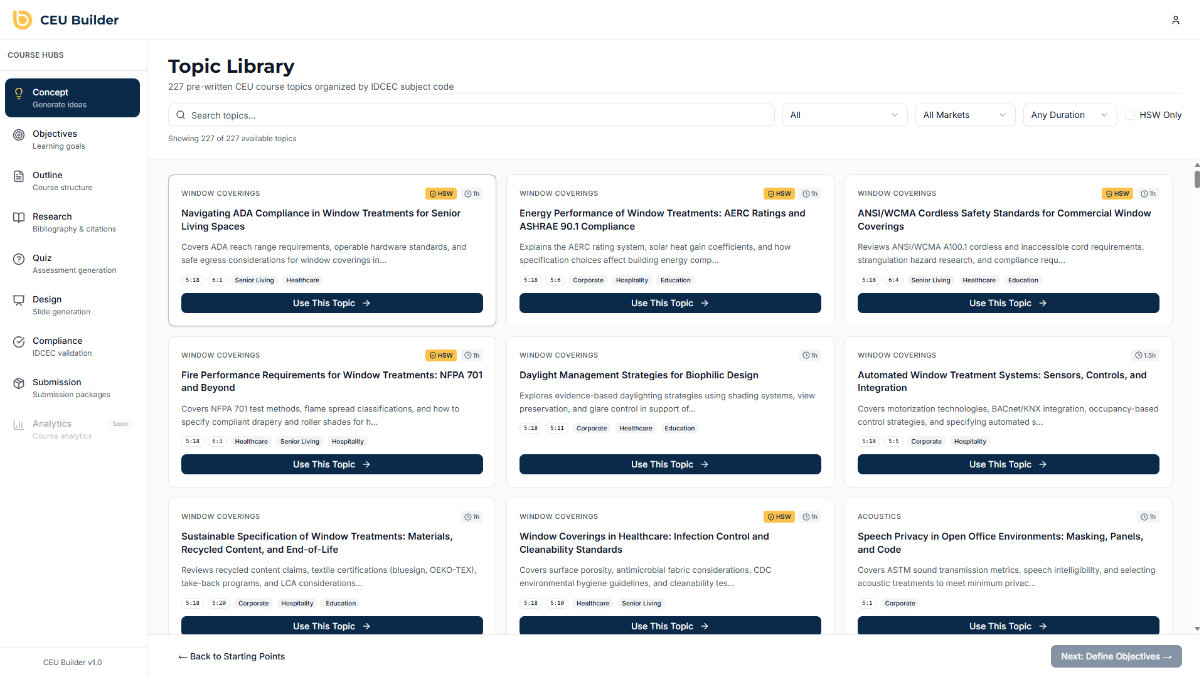
CEU Builder maintains a 100% first-pass IDCEC accreditation rate and delivers completed courses in as little as 45 days. Every engagement includes full strategy, instructional design, compliance review, and submission management. Explore the course development process to see how the workflow operates, or go straight to IDCEC approval help to start a conversation about your specific program goals. Your next specification opportunity is already in a classroom somewhere.
Frequently asked questions
What is the main reason IDCEC CEU courses get rejected?
Over 50% of first-time submissions are rejected for commercial bias, such as product names or sales language in the course body, along with incomplete applications missing required elements like references or exam questions.
How long does it take to get a course accredited if outsourced?
Expert-developed programs achieve 100% first-pass approval in as little as four to six weeks, compared to six to twelve months for most in-house attempts that still risk rejection.
What ROI can hospitality manufacturers expect from IDCEC CEU courses?
Benchmarks show 10x-plus ROI with trust scores of 85% versus 45% for traditional marketing and lead quality scores of 8.7 out of 10, leading to measurable increases in specifications and revenue.
Can I mention my products in the course content?
Product names and proprietary logos are prohibited in the main educational content. They may only appear during the introduction and closing sections to maintain the neutrality IDCEC requires for accreditation.
How do I follow up with architects and designers who complete our course?
Track completers in your CRM immediately after each completion and assign them to regional reps within 48 hours, using topic-specific outreach that references what they just learned for maximum relevance and engagement.
Recommended
