

What Is CEU Consulting? 100% Accreditation Boosts Specs

A single $10,000 CEU course can generate over 200 architect completions and 4 product specifications, delivering 10x ROI. Yet most hospitality manufacturers struggle with lengthy development timelines, costly IDCEC rejections, and courses that fail to engage architects. CEU consulting transforms this chaos into strategic advantage by ensuring first-pass accreditation success while creating courses that drive specifications instead of merely checking compliance boxes. This article breaks down what CEU consulting actually delivers, how IDCEC accreditation works, and why strategic consulting produces measurable business impact for hospitality manufacturers.
Table of Contents
- Understanding CEU Consulting in Hospitality Manufacturing
- IDCEC Accreditation Essentials and Compliance Challenges
- CEU Builder’s Unique Approach and Service Offerings
- Strategic Topic Selection Aligned with Architect Search Behavior
- Business Impact of CEU Programs on Specification Influence
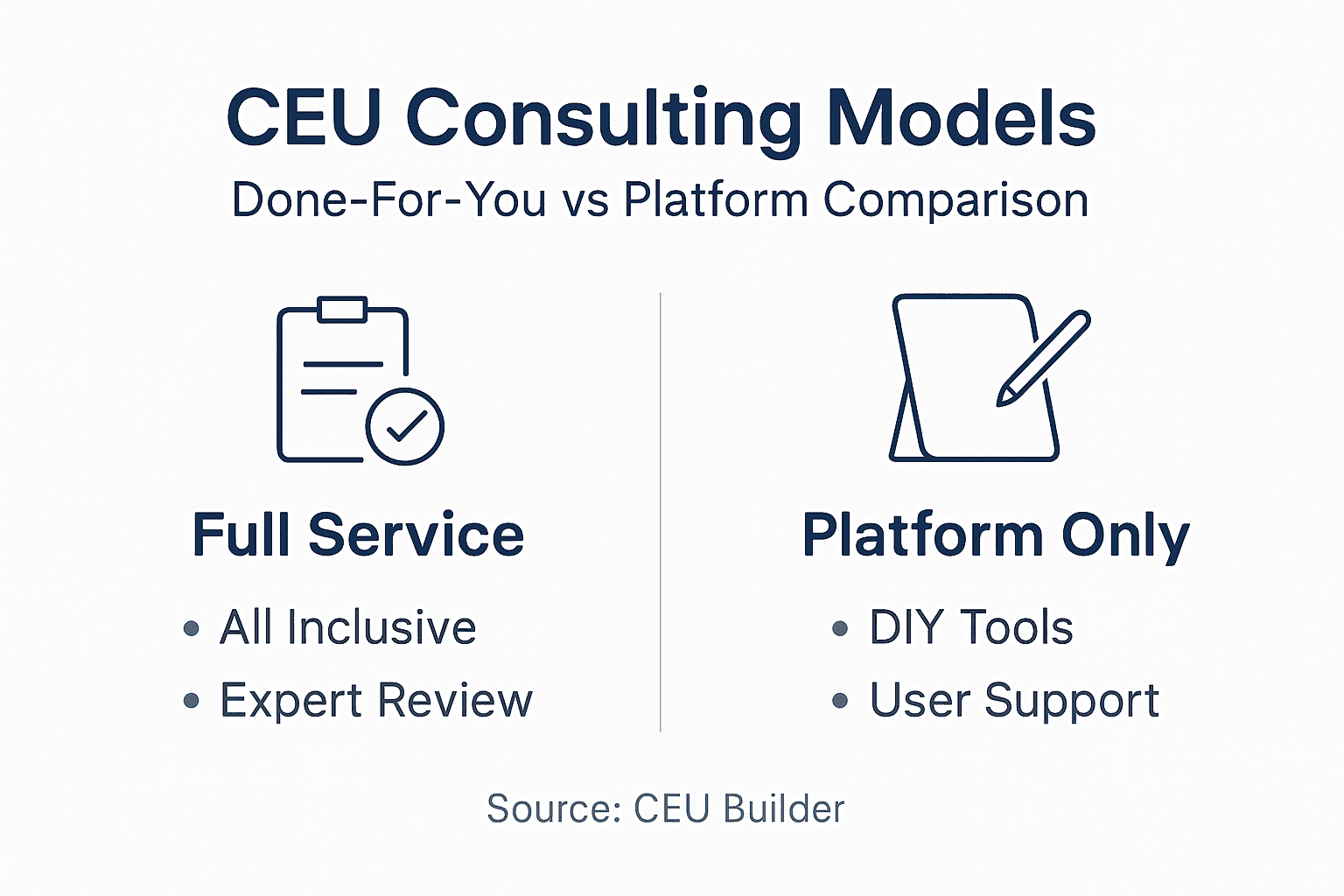
- Comparison of Service-Based vs Platform-Based CEU Creation Models
- Implementing a Successful CEU Program with CEU Builder
- Boost Your CEU Program with CEU Builder’s Proven Solutions
Key Takeaways
| Point | Details |
|---|---|
| Specialized Expertise | CEU consulting focuses on hospitality manufacturing and IDCEC accreditation, ensuring 100% first-pass approval rates that eliminate costly delays. |
| Compliance Requirements | IDCEC mandates generic, non-proprietary content; violations cause rejections that waste months and thousands in redevelopment costs. |
| Accelerated Timelines | Proven methodologies compress traditional 90-180 day development cycles by up to 95%, delivering market-ready courses in 4-6 weeks. |
| Strategic Topic Selection | Data-driven topic research aligned with architect search behavior drives higher completion rates and specification influence. |
| Service Model Options | Choose between $10,000 done-for-you consulting or $99/month platform subscription based on internal resources and control preferences. |
Understanding CEU Consulting in Hospitality Manufacturing
CEU consulting specializes in creating IDCEC-accredited continuing education courses specifically for hospitality manufacturers selling through architect and designer specification channels. Unlike generic education providers, CEU consultants understand the unique dynamics of hospitality projects where design professionals control product selection for hotels, restaurants, senior living facilities, and multifamily developments.
Architects and interior designers must complete continuing education credits annually to maintain professional licensure. They actively seek IDCEC-accredited courses that fulfill these requirements while teaching them practical knowledge about products, materials, and design solutions they’ll specify into real projects. This creates a powerful value exchange where manufacturers gain 45-60 minutes of focused attention from specification-capable decision-makers.
The strategic advantage goes beyond mere exposure. When manufacturers provide valuable education, they position themselves as industry experts rather than vendors. Architects remember who taught them something useful when they’re selecting products months later. This educational positioning influences specification decisions in ways traditional sales calls and trade show booths cannot match.
However, most manufacturers face significant barriers without specialized consulting:
- IDCEC’s complex accreditation requirements confuse teams unfamiliar with education standards
- Generic content that promotes products gets rejected, wasting 6-12 months of development effort
- Internal teams lack instructional design expertise to create engaging courses
- Compliance failures delay market entry and waste tens of thousands in internal resources
- Poor topic selection results in low completion rates that fail to generate business impact
CEU consulting removes these barriers by bringing hospitality-specific expertise, proven IDCEC approval processes, and strategic content development that drives specifications. The result is faster time to market, zero accreditation failures, and courses that generate qualified leads instead of merely fulfilling attendance requirements. Manufacturers can focus on what they do best while consultants handle the complexity of CEU compliance for hospitality manufacturers and offering CEU courses in hospitality markets.
IDCEC Accreditation Essentials and Compliance Challenges
IDCEC accreditation requires courses to meet strict standards that many manufacturers underestimate. The Interior Design Continuing Education Council mandates that all content must be generic, non-proprietary, and educational rather than promotional. Courses must include clear learning objectives, comprehensive exam questions testing comprehension, proper bibliographies citing credible sources, and instructional design that facilitates actual learning.
The compliance challenges are significant and costly when manufacturers attempt DIY approaches:
- Product promotion violations occur when content focuses on specific manufacturer advantages rather than general industry knowledge
- Missing or poorly written learning objectives fail to demonstrate educational value
- Inadequate exam questions that don’t test actual comprehension get flagged during review
- Bibliography gaps or improper citation formats trigger automatic rejections
- Content structure that reads like marketing collateral instead of education gets denied
These failures aren’t minor setbacks. IDCEC rejection means complete course redevelopment, submission delays of 3-6 months, and wasted internal costs averaging $15,000-$30,000 in staff time and resources. By the time a rejected course gets fixed and resubmitted, competitors have already captured market attention and specification opportunities.
The impact extends beyond time and money. Failed accreditation attempts damage credibility with internal stakeholders who question marketing’s ability to execute CEU strategy. Sales teams lose confidence in education initiatives. Architects never see the content that could have influenced their specifications. The opportunity cost of delayed or failed courses often exceeds the direct redevelopment expenses.
Successful IDCEC compliance requires deep knowledge of what reviewers actually evaluate. Generic education providers understand accreditation basics but lack hospitality-specific context. They create courses that technically meet standards but fail to engage architects with relevant content. The result is low completion rates and minimal business impact even when courses get approved.

CEU consulting eliminates these risks through proven compliance expertise. Consultants who specialize in getting IDCEC approval understand exactly what reviewers require at every content level. They build compliance into initial development rather than discovering violations after submission. This proactive approach explains why specialized consultants achieve 100% first-pass approval rates while DIY attempts frequently fail. Manufacturers gain certainty that their investment will produce market-ready courses without costly delays or rejections.
The IDCEC accreditation guide process involves provider registration, course development, submission preparation, and ongoing compliance maintenance. Each stage has specific requirements that trip up inexperienced teams.
CEU Builder’s Unique Approach and Service Offerings
CEU Builder’s methodology centers on reverse-engineering IDCEC’s accreditation system to create guaranteed approval processes. Founder Robert Rupp analyzed successful accreditations, identified pattern requirements, and built systematic guardrails ensuring compliance at every development stage. This approach produces a 100% first-pass approval rate, meaning every course submitted gets accredited on the first attempt.
The service structure offers two paths based on manufacturer resources and goals:
Done-For-You Service: $10,000 per course
This full-service option handles everything from strategy through IDCEC approval in 4-6 weeks. CEU Builder manages research, instructional design, slide deck creation, speaker script development, exam questions, bibliography compilation, and submission management. Clients review content before launch but otherwise invest minimal internal resources.
Platform Subscription: $99 per month
This DIY model provides LMS access, compliance tools, certificate generation, and unlimited course creation capacity for teams with internal subject matter experts who want to own the content process while accelerating technical accreditation.
The 4-week done-with-you timeline compresses what traditionally takes 90-180 days by 80-95%. This speed comes from custom GPT tools handling routine tasks like bibliography formatting and compliance auditing while preserving human expertise for strategic content that differentiates manufacturers. Week 1 covers discovery and strategy. Week 2 focuses on course build. Week 3 handles refinement and submission. Week 4 delivers approval and launch.
The accreditation guarantee eliminates risk entirely. If IDCEC denies approval, CEU Builder fixes the course for free until accreditation is granted. This guarantee is meaningful because CEU Builder’s systematic approach prevents the violations that cause rejections. Manufacturers gain certainty their investment will produce working courses without additional costs or delays.
Practical benefits for hospitality manufacturers include:
- Zero internal expertise required for complex instructional design and IDCEC compliance
- Elimination of 6-12 month learning curves that delay DIY attempts
- Access to hospitality-specific topic research revealing what architects actually want to learn
- Professional slide decks and speaker scripts enabling confident course delivery
- Lifetime platform access creating perpetual lead generation infrastructure
The IDCEC course approval process becomes manageable rather than mysterious. Manufacturers bypass the trial-and-error approach that wastes resources and focus on strategic decisions about which topics will drive specifications.
Pro Tip: Start with the done-for-you service for your first course to understand what IDCEC-compliant content actually looks like, then consider the platform subscription for subsequent courses once your team has seen the standards firsthand.
Multi-course packages offer volume advantages. Two courses cost $18,000 (most popular), while three courses run $25,000. These packages create comprehensive educational presence across product lines while maximizing specification opportunities. The 100% first-pass accreditation guarantee applies to every course regardless of package size.
Strategic Topic Selection Aligned with Architect Search Behavior
Topic selection determines whether courses generate specifications or gather digital dust. CEU Builder’s approach starts with analyzing what architects actually search for and need to learn rather than what manufacturers want to promote. This data-driven methodology reveals topic opportunities competitors miss.
Manufacturer-biased topics fail because they prioritize product features over architect needs. A course titled “Why Our Acoustic Panels Outperform Competitors” violates IDCEC standards and repels architects who recognize obvious sales pitches. Generic topics like “Introduction to Commercial Furniture” bore architects who need specific, applicable knowledge for current projects.
Strategic topic selection balances three factors:
- Architect search volume and intent data showing what design professionals actively seek
- Manufacturer expertise and product differentiation that can be taught without overt promotion
- IDCEC compliance requirements ensuring content qualifies as education rather than marketing
The benefits of data-driven topic research are measurable. Courses aligned with architect search behavior achieve 60-80% completion rates compared to 20-30% for poorly selected topics. Higher completion rates mean more architects engage with your content, remember your brand, and consider your products when specifications arise.
Creating CEU courses with market research reveals counterintuitive opportunities. Architects often search for code compliance guidance, sustainability strategies, acoustic performance standards, and material selection criteria rather than specific product brands. Manufacturers who teach these topics position themselves as the expert resource architects consult before specifying products.
Topic sequencing matters for manufacturers building comprehensive course libraries. Start with broad industry challenges affecting multiple architect specialties, then create specific courses addressing niche applications. This progression maximizes initial reach while building depth that serves architects working on particular project types.
The research process examines competitor course offerings to identify gaps and opportunities. If three competitors offer lighting design basics, differentiation requires either superior content quality or unexplored subtopics like circadian rhythm considerations or hospitality-specific lighting challenges. Strategic consultants identify these white space opportunities through systematic competitive analysis.
Business Impact of CEU Programs on Specification Influence
CEU programs generate measurable business outcomes that traditional marketing struggles to match. Architects engage with courses for 45-60 minutes compared to brief sales calls averaging 5-15 minutes. This extended engagement allows comprehensive education about specification criteria, application considerations, and performance factors influencing product selection.
The ROI math is straightforward and compelling:
| Metric | Traditional Sales Call | CEU Course |
|---|---|---|
| Engagement Time | 5-15 minutes | 45-60 minutes |
| Audience Qualification | Varies widely | Pre-qualified by topic interest |
| Cost Per Interaction | $200-$500 (loaded cost) | $50-$100 (at scale) |
| Specification Influence | Limited, transactional | High, educational positioning |
| Scalability | Linear with rep capacity | Unlimited digital delivery |
A single course generating 200 architect completions creates 200 touchpoints with specification-capable decision-makers. If 2% specify your products into projects, that’s 4 specifications. In hospitality where product packages often exceed $100,000, one specification can return 10x the initial $10,000 course investment.
The math improves over time because courses have indefinite shelf lives. Content created in 2026 continues generating completions and specifications in 2027, 2028, and beyond with no additional development cost. This creates perpetual lead generation infrastructure versus one-time trade show booths costing $30,000-$50,000 annually.
“CEU courses position manufacturers as educational partners rather than vendors, fundamentally shifting how architects perceive and prefer brands when specification decisions arise.”
Lead qualification improves because architects self-identify interest through course topic selection. Someone completing your acoustic performance course signals active interest in acoustic solutions. This behavioral data enables precise targeting impossible with traditional advertising.
Sales efficiency gains compound these benefits. Conversations with architects who completed your course start from shared knowledge rather than basic education. Reps spend less time explaining fundamentals and more time addressing project-specific requirements. The benefits of CEU accreditation extend throughout your entire sales process.
Course completion data reveals which architects engage with which topics, enabling sophisticated targeting strategies. CRM integration tracks completions, exam scores, and certificate requests. This intelligence informs follow-up sequences, product recommendations, and rep prioritization.
Comparison of Service-Based vs Platform-Based CEU Creation Models
Manufacturers face a strategic choice between full-service consulting and self-service platform subscriptions. Each model offers distinct advantages depending on internal resources, expertise, and strategic goals.
| Factor | Done-For-You Service | Platform Subscription |
|---|---|---|
| Cost Per Course | $10,000 | $99/month (unlimited courses) |
| Timeline | 4-6 weeks | 8-12 weeks |
| Internal Effort | Minimal (review only) | Significant (full development) |
| Accreditation Guarantee | 100% first-pass | Tools provided, success depends on execution |
| Expertise Required | None | Instructional design knowledge helpful |
| Creative Control | Collaborative | Complete |
| Best For | Fast market entry, limited resources | Multiple courses, internal capacity |
The done-for-you model suits manufacturers wanting immediate results without internal resource allocation. These companies recognize CEU’s strategic value but lack expertise, time, or capacity to execute independently. The $10,000 investment delivers turnkey solutions with guaranteed approval and professional quality.
Platform subscriptions appeal to teams with dedicated marketing staff, product managers with technical expertise, and organizational commitment to building long-term educational infrastructure. At $99 monthly, creating three courses costs $297 in subscription fees versus $30,000 for three done-for-you courses. The savings require significant internal effort.
Key considerations for model selection:
- Speed requirements (need courses in 4-6 weeks vs. comfortable with 8-12 weeks)
- Internal subject matter expert availability and instructional design capability
- Total course volume planned (one-off vs. comprehensive library)
- Risk tolerance for potential accreditation delays or failures
- Desire for creative control versus execution certainty
Many manufacturers start with done-for-you service for their first course to understand IDCEC standards and course structure, then transition to the platform for subsequent courses once they’ve seen compliant content firsthand. This hybrid approach balances learning curve reduction with long-term cost efficiency.
The CEU service vs platform options decision should align with broader marketing strategy and resource allocation. Companies with lean marketing teams benefit from outsourcing complexity. Organizations with robust internal capabilities gain cost advantages through the platform.
Pro Tip: Calculate your true internal cost before choosing the platform model. If developing one course requires 60-80 hours of staff time at loaded rates of $75-$150 per hour, internal costs may exceed the done-for-you service price while producing inferior results without guaranteed approval.
Both models provide lifetime platform access for ongoing course delivery, certificate generation, and completion tracking. The infrastructure supports perpetual lead generation regardless of which development path you choose.
Implementing a Successful CEU Program with CEU Builder
The implementation process follows a structured four-week timeline ensuring efficient development and guaranteed IDCEC approval:
- Week 1: Discovery and Strategy begins with content audit identifying existing materials that can be adapted for CEU purposes. CEU Builder works with your team to define learning objectives meeting IDCEC standards while aligning topics with architect search behavior. This week establishes strategic positioning differentiating your course from competitors.
- Week 2: Course Build focuses on content creation where instructional designers draft complete speaker scripts, design high-impact slide decks optimized for visual learning, write exam questions testing comprehension and application, and structure content flow maximizing engagement and retention. This phase requires minimal client input beyond subject matter clarification.
- Week 3: Refinement and Submission provides client review of all materials followed by revision rounds incorporating feedback. CEU Builder compiles bibliographies meeting IDCEC academic standards and handles the complex filing process with technical submission requirements most manufacturers find confusing.
- Week 4: Approval and Launch delivers IDCEC review and approval followed by certificate setup, automation configuration, tracking infrastructure, and everything needed for immediate course delivery. The 100% approval guarantee means if IDCEC denies accreditation, CEU Builder fixes issues at no additional cost until approval is granted.
Client responsibilities remain minimal throughout the process. Your team provides subject matter expertise during discovery, reviews content drafts for technical accuracy, and approves final materials before submission. CEU Builder handles instructional design, compliance verification, submission management, and revision implementation.
The accreditation guarantee provides complete risk protection. Unlike DIY attempts where rejection means starting over, CEU Builder’s systematic approach prevents compliance violations before submission. The rare cases requiring revisions get handled immediately at no additional cost.
Ongoing administrative support maintains compliance after launch. The CEU Builder course approval workflow includes certificate generation, completion tracking, reporting infrastructure, and IDCEC record maintenance. Monthly operations packages ($1,500) handle these tasks for manufacturers preferring complete outsourcing.
Implementation success requires clear internal stakeholder alignment. Marketing, product management, and sales leadership should agree on strategic goals, target architect audiences, and success metrics before development begins. This alignment ensures courses support broader business objectives rather than existing as isolated marketing projects.
Post-launch, integrate courses into existing sales and marketing workflows. Train reps on positioning courses during architect outreach. Include course promotions in email sequences and social media content. Track completions in your CRM and trigger follow-up sequences based on topic engagement. Measure specification lift among architects who completed courses versus those who didn’t.
Boost Your CEU Program with CEU Builder’s Proven Solutions
CEU Builder’s specialized consulting eliminates the complexity, risk, and delays that make continuing education challenging for hospitality manufacturers. The 100% first-pass accreditation guarantee means your investment produces market-ready courses without costly failures or timeline uncertainty. Whether you need fast-track done-for-you service or cost-efficient platform access for multiple courses, CEU Builder provides hospitality-specific expertise that generic education providers cannot match.
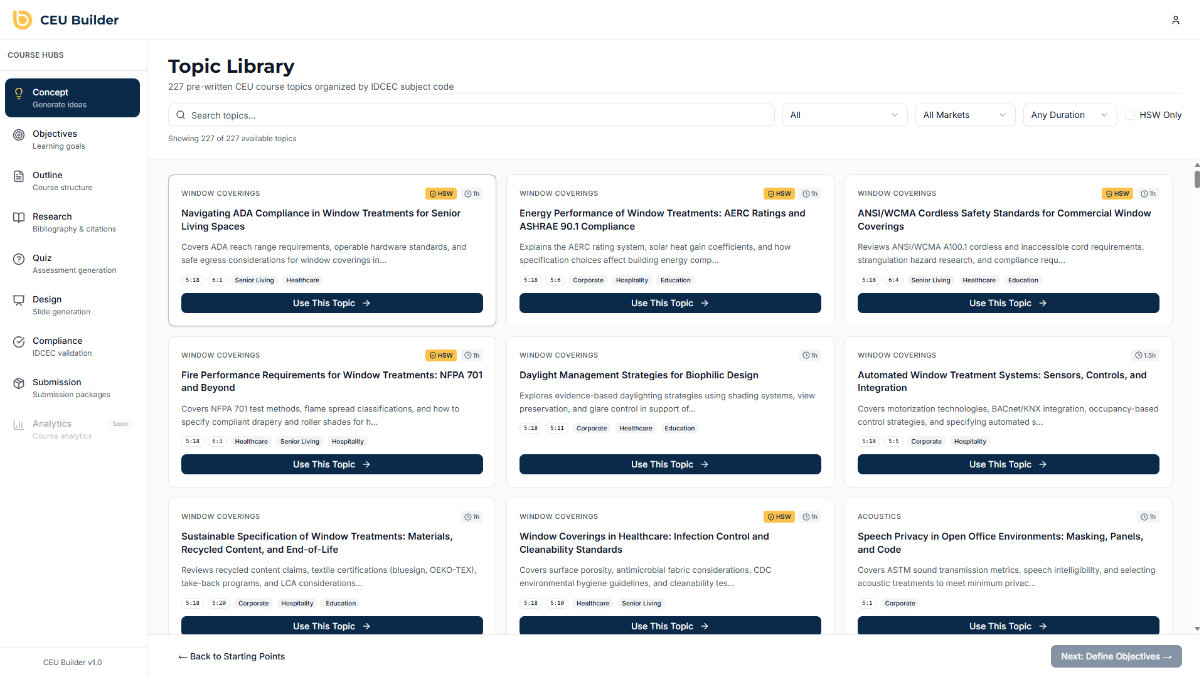
The IDCEC accreditation guide and IDCEC approval process become manageable with expert guidance. Your team focuses on strategic decisions while CEU Builder handles technical execution, compliance verification, and guaranteed approval. The result is faster time to market, higher course completion rates, and measurable specification lift that traditional marketing struggles to achieve. Ready to transform your CEU program from compliance theater into a demand generation engine? The CEU course approval process starts with understanding what architects actually need and delivering education that positions your brand as the trusted industry expert.
What Is CEU Consulting? Frequently Asked Questions
What’s the difference between CEU consulting services and DIY platform subscriptions?
CEU consulting services provide complete done-for-you development where consultants handle research, instructional design, compliance verification, and IDCEC submission for $10,000 per course delivered in 4-6 weeks. Platform subscriptions cost $99 monthly and provide LMS access plus compliance tools for teams who want to create unlimited courses internally over 8-12 weeks per course. Consulting eliminates internal effort and guarantees first-pass approval, while platforms offer cost efficiency for multiple courses if you have internal expertise.
Why does IDCEC accreditation matter for engaging architects?
Architects must complete continuing education credits annually to maintain professional licensure, creating active demand for accredited courses. IDCEC accreditation signals that courses meet rigorous educational standards rather than being thinly veiled sales presentations. Architects trust IDCEC-approved content and prioritize these courses when fulfilling credit requirements, giving accredited manufacturers 45-60 minutes of focused attention from specification-capable decision-makers.
What are typical timelines and costs for developing CEU courses?
Done-for-you consulting delivers complete, IDCEC-approved courses in 4-6 weeks for $10,000 including strategy, development, and guaranteed approval. DIY platform approaches require 8-12 weeks and $99 monthly subscription fees but demand significant internal effort. Traditional in-house attempts without consulting expertise typically take 90-180 days and cost $15,000-$30,000 in loaded staff time, with high rejection rates requiring additional months and expenses for redevelopment.
How do CEU programs directly influence product specifications?
CEU courses educate architects about specification criteria, performance factors, and application considerations during extended 45-60 minute engagements. This educational positioning creates preference when architects select products for future projects, with completion data showing 2-4% of engaged architects specify products into hospitality projects. The educational context positions manufacturers as industry experts rather than vendors, fundamentally influencing how architects perceive and prefer brands months later when specifications arise.
How can manufacturers measure ROI from their CEU courses?
Track course completion counts, architect engagement time, lead qualification through topic selection, specification requests from course participants, and revenue attributed to specifications influenced by course education. Compare CEU cost per specification against traditional marketing channels like trade shows ($30,000-$50,000 annually), print advertising ($5,000-$15,000 per placement), or field sales calls ($200-$500 per meeting). Calculate long-term value considering courses generate completions indefinitely after initial development investment.
What happens if IDCEC rejects my course application?
With CEU Builder’s consulting, IDCEC rejection never happens due to 100% first-pass approval rate built on systematic compliance processes. If the statistically unlikely rejection occurs, the accreditation guarantee means CEU Builder fixes all issues at no additional cost until approval is granted. DIY attempts without consulting expertise face 40-60% rejection rates requiring complete redevelopment, 3-6 month delays, and $15,000-$30,000 in additional internal costs before resubmission.
Recommended
