

CEU Compliance: How It Impacts Hospitality Manufacturers

Product managers often face the challenge of making their brand stand out to architects, but many overlook an avenue that directly influences specification decisions. For North American hospitality manufacturers, CEU compliance is more than just a regulatory hurdle—it is the difference between a course architects trust for licensing and one they dismiss as marketing noise. Knowing what compliance truly means allows your team to offer accredited education that boosts your credibility with architectural decision-makers.
Table of Contents
- CEU Compliance Defined for Manufacturers
- Types of CEU Programs and Accreditation Bodies
- IDCEC Accreditation Requirements and Process
- Obligations and Risks in Noncompliance
- Best Practices to Maximize Specification Impact
Key Takeaways
| Point | Details |
|---|---|
| Understanding CEU Compliance | CEU compliance is essential for manufacturers, as it ensures that continuing education courses satisfy licensing requirements for architects and designers. |
| Importance of Accreditation | Courses must be accredited by recognized bodies like IDCEC to be valuable for architects, transforming educational content into necessary training. |
| Choosing the Right Accreditor | Selecting the appropriate accreditation body is crucial, as it influences architects’ acceptance of the course toward their licensing requirements. |
| Consequences of Noncompliance | Noncompliance with CEU standards can lead to wasted investments, damaged credibility, and lost opportunities with architects who require accredited education. |
CEU Compliance Defined for Manufacturers
CEU compliance refers to meeting continuing education requirements set by accreditation bodies like IDCEC (International Distance Education Certification Council). For hospitality manufacturers, this means understanding what makes education count toward architect and designer licensing requirements.
Licensed architects and designers must complete a specific number of continuing education credits annually. These aren’t optional—they’re regulatory requirements tied to professional licensing renewal. When your course carries accreditation, it fulfills these mandatory hours.
What CEU Compliance Actually Means
CEU compliance breaks down into several core requirements:
- Accreditation status: Your course must be approved by an accrediting body like IDCEC before it qualifies
- Learning objectives: Clearly defined outcomes that match what participants will actually learn
- Assessment mechanisms: Exams or quizzes proving participants retained the material
- Instructor qualifications: Presenters must meet minimum expertise standards
- Documentation: Complete records of who completed what, when, and for how long
- Content standards: Material must be substantive, relevant, and professionally sound
Compliance isn’t about checking boxes—it’s about proving your course actually teaches something valuable that architects need to know.
Why This Matters for Manufacturers
Undertanding the strategic value of CEUs for manufacturers shifts how you think about education programs. An accredited course becomes a tool that architects seek out because they need the credits anyway.
Without accreditation, your education content is just marketing material. With it, you’re offering something design professionals actually need. That transforms the entire relationship between your brand and the specification decision-makers.
The Compliance Difference
Non-accredited courses create a barrier. Architects see them and think: “This is vendor training, not professional development.” Accredited courses create an invitation. They think: “I need these credits anyway—let me see what this manufacturer teaches.”
That’s the compliance advantage. You’re not asking architects to attend marketing. You’re providing required education that happens to be about your products.
See how accredited vs. non-accredited CEU courses impact business outcomes:
| Course Type | Architect Response | Business Value | Brand Impact |
|---|---|---|---|
| Accredited Course | Fulfills licensing needs | Drives specifications | Builds credibility |
| Non-Accredited | Perceived as marketing | No regulatory value | Damages reputation |
Pro tip: Ensure your course learning objectives clearly match what architects actually search for and need to know—not just what you want to teach about your products.
Types of CEU Programs and Accreditation Bodies
Not all continuing education carries the same weight. The accreditation body backing your course determines whether architects actually accept it toward their licensing requirements. Understanding the difference between accreditors matters when you’re choosing where to invest in your education program.
CEU programs come in various formats, all designed to meet different learning preferences and delivery models. Your choice depends on what works best for your target audience and internal capacity.
CEU Program Types
Hospitality manufacturers typically offer these program formats:
- Live webinars: Real-time instruction with instructor interaction and Q&A sessions
- Self-paced online courses: Pre-recorded content participants complete on their schedule
- Hybrid programs: Combination of live and self-paced components for flexibility
- In-person workshops: Face-to-face training at conferences or dedicated venues
- On-demand video courses: Professional recordings available 24/7 without live scheduling
- Case study modules: Scenario-based learning focused on real-world application
The best program format depends on where architects prefer to learn, not where you prefer to teach.
Major Accreditation Bodies
IDCEC (International Distance Education Certification Council) dominates for hospitality and design professionals. This is the accreditor most architects recognize and need for licensing renewal.
IACET (International Association for Continuing Education and Training) provides rigorous continuing education standards recognized across multiple industries worldwide. IACET accreditation guarantees structured learning frameworks, qualified instructors, and ongoing quality improvements.
Institute of Hospitality operates accredited continuing professional development programs specifically relevant to hospitality careers. Their validation focuses on quality and relevance within hospitality management.
Here’s a quick comparison of major CEU accreditation bodies for hospitality manufacturers:
| Accreditation Body | Recognition Scope | Review Timeline | Key Strength |
|---|---|---|---|
| IDCEC | US architects/designers | 3 weeks (typical) | Broad industry acceptance |
| IACET | Multinational, cross-industry | 4-6 weeks (avg.) | Rigorous, structured standards |
| Institute of Hospitality | Hospitality management only | 2-4 weeks (avg.) | Focused on hospitality careers |
Why Accreditation Body Matters
Architects check which body accredited your course before enrolling. Some state licensing boards accept only specific accreditors. An IDCEC-accredited course opens doors with specification decision-makers nationwide.
Choosing the wrong accreditor wastes your development investment. The course might be excellent, but if architects can’t apply it toward their licensing requirements, they won’t take it.
Selecting Your Accreditor
Your decision should consider three factors:
- Target audience acceptance: Which accreditor do your architects actually need?
- Approval timeline: How quickly does the accreditor review and approve courses?
- Accreditation cost: What are submission fees and renewal requirements?
IDCEC works best for most hospitality manufacturers because architects actively seek IDCEC-accredited content. The recognition is immediate and transfers across all licensing jurisdictions.
Pro tip: Verify which accreditor your target architects actually need before building your course—this single decision prevents months of wasted development.
IDCEC Accreditation Requirements and Process
IDCEC accreditation isn’t complicated, but it requires understanding specific content standards before you submit. Missing these requirements on the first try costs months and forces complete rebuilds.

The approval process moves fast once your submission is complete. IDCEC typically reviews courses in about three weeks. That speed only happens when you submit correctly the first time.
Core Content Requirements
IDCEC won’t approve courses that look like product brochures. Your content must meet these standards:
- Relevance to design professionals: Material must serve architects and interior designers, not just promote products
- Limited proprietary content: Your company name and products can appear, but non-proprietary material should dominate
- Health, Safety, and Welfare focus: Courses must address design topics that impact occupant health, safety, or wellness
- Educational substance: Content must teach genuine knowledge, not disguise marketing as education
- Clear learning objectives: Participants must know exactly what they’ll learn before enrolling
- Assessment mechanisms: Exams or quizzes must test comprehension of actual content
The single reason courses get rejected is mixing sales messaging with educational content. Keep product mentions minimal and educational value maximum.
Provider Registration
Before submitting any course, you must register as an IDCEC provider. This one-time step happens through IDCEC’s online portal and takes approximately two weeks to complete.
Registration requires basic information about your organization, your contact details, and confirmation that you understand IDCEC requirements. This isn’t complicated, but it must happen before you can submit courses.
The Submission Process
Once registered, the anatomy of an IDCEC submission involves uploading several documents through their portal:
- Course outline: Complete breakdown of topics covered
- Learning objectives: Specific outcomes participants will achieve
- Speaker biography: Instructor credentials and expertise
- Exam questions: Assessment items testing comprehension
- Bibliography: Academic sources supporting course content
- Course materials: Slides, scripts, or videos
- Compliance attestation: Your declaration that content meets standards
Each document serves a specific purpose in IDCEC’s review process. Missing or incomplete documents trigger rejection.
What IDCEC Reviews
IDCEC evaluators assess whether your course actually teaches something architects need. They check:
- Content accuracy and relevance
- Alignment between learning objectives and actual content
- Instructor qualifications for the topic
- Assessment quality and fairness
- Appropriate credit hour recommendations
They’re not judging your production quality or marketing approach. They’re verifying educational substance.
Timeline Expectations
Submission to approval typically takes three weeks if everything is complete. Incomplete submissions get rejected, requiring corrections and resubmission, which extends the timeline significantly.
Plan for 4-6 weeks total from registration through final approval to account for initial setup time and any clarification requests.
Pro tip: Submit your course with complete, polished materials the first time—incomplete submissions cause two-week delays while you fix basic issues.
Obligations and Risks in Noncompliance
Noncompliance with CEU requirements creates real business consequences. Architects who complete noncompliant CEUs lose credit toward their licensing renewal. Your manufacturer loses credibility when participants discover their course doesn’t count.
The risks extend beyond disappointed architects. Noncompliance damages your brand positioning as an education provider and wastes development investment on courses that generate zero business value.
Direct Business Impact
When a course fails accreditation or operates without proper accreditation, the damage is immediate:
- Wasted development costs: Your investment in course creation generates no architectural engagement
- Lost specification opportunities: Architects won’t take your course if it doesn’t count toward licensing requirements
- Damaged credibility: Offering noncompliant education signals carelessness or inexperience
- Competitive disadvantage: Competitors with accredited courses capture the attention you lose
- Extended timeline: Rejected courses require rebuilds costing additional months and money
Noncompliant CEUs aren’t just ineffective—they actively damage your brand authority with the architects who matter most.
Architect Consequences
Architects face real penalties for relying on noncompliant continuing education. If they complete your course thinking it counts toward licensing renewal but it doesn’t, they fall behind on required credits.
Some licensing boards audit CEU compliance randomly. Architects caught with noncompliant credits risk license suspension or forced re-certification. They blame the course provider—your company.
Provider Liability and Accreditation Loss
Noncompliance in manufacturing industries results in extensive legal penalties, lost certifications, and operational disruptions. For CEU providers, repeated noncompliance can lead to accreditation suspension or revocation by IDCEC.
Lose your provider status and you can’t submit new courses for years. All your educational infrastructure becomes unusable.
Operational and Reputational Risks
Word spreads fast in design communities. One bad course experience travels through professional networks. Architects warn colleagues: “This manufacturer’s CEU doesn’t count—don’t waste your time.”
That reputation damage affects all your education efforts, not just the failed course. Architects approach future offerings with skepticism instead of trust.
Long-Term Viability Threats
Hospitality manufacturers failing to maintain compliance frameworks face financial losses that threaten business viability. For education programs, this means:
- Inability to market education as a specification driver
- Lost competitive advantage in architect positioning
- Reduced ROI on marketing spend targeting design professionals
- Declining influence over specification decisions
Preventing Noncompliance
The solution is straightforward: understand requirements before submitting. Incomplete or inaccurate submissions cause most rejections.
Work with accreditation specialists who understand IDCEC requirements thoroughly. Their expertise prevents costly mistakes that delay approval and damage your credibility.
Pro tip: Submit courses only when you’re certain they meet all IDCEC requirements—rejected courses damage your provider reputation with accreditation bodies.
Best Practices to Maximize Specification Impact
Accredited education only drives specifications when architects actually take your courses and apply what they learn to real projects. The accreditation is just the foundation. Maximizing impact requires intentional strategy around content selection, delivery, and architect engagement.
Courses that generate specifications share common characteristics. They teach architects something genuinely useful while positioning your products as the natural solution to the problems they solve.
Focus Content on Architect Challenges
The strongest courses address real design problems architects face on hospitality projects. Instead of teaching your product features, teach how to solve design challenges that your products address.
For example, if you manufacture seating, don’t teach about your seating. Teach about ergonomic requirements in hospitality environments, specification criteria architects should consider, and how to evaluate seating options against those criteria. Your products naturally emerge as the solution.
Align Topics with Actual Search Behavior
Architects search for solutions to specific problems. When you teach what architects actively search for, you capture attention at the moment they need it most.
Research what architects and designers actually search for in your product category. Build courses around those topics. This ensures high enrollment because you’re offering education architects genuinely want to complete.
Integrate with Sales Strategies
Best practices for hospitality continuing professional development involve aligning education with broader industry initiatives and supply chain engagement. Your CEU program works best when integrated with sales activities.
Train your sales team to reference course content in conversations. When a sales rep mentions course material architects already completed, it creates credibility and common reference points. This connection drives specifications because architects remember manufacturers who taught them something valuable.
Build Multi-Course Programs
Single courses generate interest. Program series create authority. When you offer multiple accredited courses across related topics, architects perceive you as the comprehensive educational resource in your category.
Multi-course programs also increase architect touchpoints. One course touches an architect once. Three courses in a series touch them three times, building deeper familiarity and preference.
Measure the Right Outcomes
Collaborative approaches in hospitality specification emphasize stakeholder engagement and demonstrable impact. Track specification outcomes, not just completions.
Monitor which architects take your courses and whether they specify your products into projects afterward. This data reveals what course topics actually drive specifications and which ones don’t. Use it to refine your program strategy.
Create Clear Learning Pathways
Architects need to understand why they should take your specific course. Clear learning objectives that explain real-world application matter more than generic descriptions.
Explain what architects will learn and how they’ll apply it to projects. This clarity drives enrollment and completion rates from architects most likely to specify your products.
Pro tip: Build courses around architect problems, not product features—this approach increases both enrollment and specification conversions by making learning immediately applicable to real projects.
Transform CEU Compliance Challenges Into Specification Opportunities
Meeting CEU compliance is more than a regulatory hurdle for hospitality manufacturers. It is a gateway to building credibility with architects and designers who control billion-dollar specification decisions. The key pain points include navigating complex IDCEC requirements, avoiding costly accreditation failures, and delivering education that architects actually seek and value. This article highlights how mastering CEU compliance empowers manufacturers to shift from mere marketing to authoritative education that drives real business impact.
CEU Builder specializes in turning these compliance challenges into strategic advantages. Our proven methodology guarantees 100% first-pass IDCEC accreditation success, eliminating delays and wasted investment. Whether you need a done-for-you solution or a powerful platform with AI-assisted tools, we help you create accredited CEU courses that resonate with architects’ learning needs and promote your products through educational value. Explore how our compliance expertise and business intelligence can accelerate your path to specification influence. Learn more about our approach to Compliance & Accreditation – CEU Builder and discover how data-driven insights enhance course effectiveness at Data & Analytics in CEUs – CEU Builder.
Don’t let accreditation complexities stall your education program. Visit CEU Builder now.
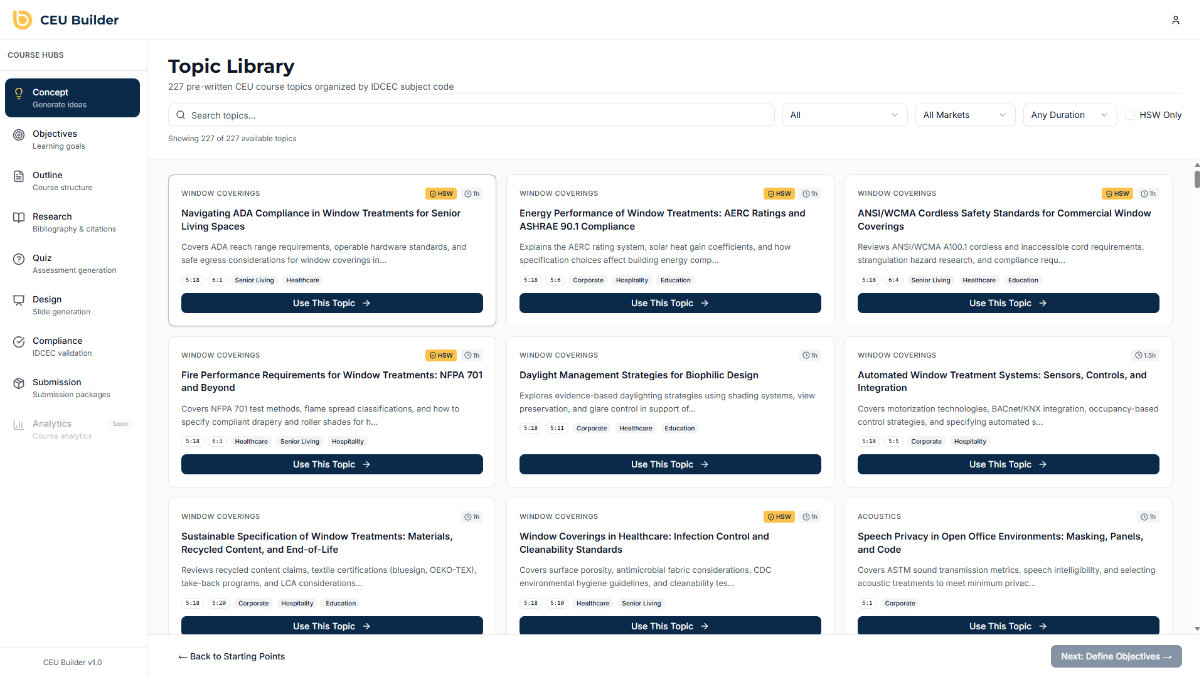
Ready to convert CEU compliance into a competitive edge? Contact CEU Builder today to start building IDCEC-accredited courses that open doors with architects and accelerate your specification success.
Frequently Asked Questions
What is CEU compliance and why is it important for hospitality manufacturers?
CEU compliance refers to meeting continuing education requirements set by accreditation bodies like IDCEC, essential for licensed architects and designers. For hospitality manufacturers, offering accredited courses is crucial as it positions their educational programs as valuable resources that professionals need for licensing renewal.
How do I ensure my CEU courses meet compliance requirements?
To ensure compliance, your CEU courses must be accredited, have clear learning objectives, include assessment mechanisms, and provide thorough documentation. It’s important that the content is relevant and not solely promotional.
What types of CEU programs can hospitality manufacturers offer?
Hospitality manufacturers can offer various CEU programs including live webinars, self-paced online courses, hybrid programs, in-person workshops, on-demand video courses, and case study modules. Choosing the right format depends on your target audience’s preferences.
Why is the accreditation body important for CEU courses?
The accreditation body is vital as it influences whether architects will recognize your courses for their licensing requirements. Courses accredited by recognized bodies (like IDCEC) are more sought after by professionals, enhancing your brand credibility and engagement.
Recommended
- How to Offer CEU Courses for Hospitality Manufacturers
- How to Create CEU Courses for Hospitality Brands
- 7 Key Benefits of CEU Accreditation for Hospitality Brands
- Continuing Education Compliance Workflow for Hospitality Brands
- 7 uudistavaa ravintolan sisustusideaa 2025 – ammattilaisilta – Dekoja.net
