

How to Manage CEU Approvals: 100% IDCEC First-Pass Success

Marketing directors at hospitality product manufacturers face a persistent challenge: IDCEC accreditation failures waste months of effort and thousands of dollars while competitors capture architect attention. Most teams underestimate the complexity of CEU approval management, leading to repeated rejections and delayed market entry. This guide provides a systematic approach to achieving first-pass approval within 4-6 weeks, eliminating costly revision cycles and accelerating specification opportunities with design professionals.
Table of Contents
- Introduction To CEU Approvals And IDCEC Accreditation
- Prerequisites: What You Need Before Submitting A CEU Course
- Step-By-Step CEU Approval Process With IDCEC
- Common Mistakes And How To Avoid Them In CEU Approvals
- Managing Revisions And Resubmissions Efficiently
- Expected Outcomes And Benefits Of Effective CEU Approval Management
- Streamline Your CEU Approval Process With CEU Builder
- Frequently Asked Questions
Key Takeaways
| Point | Details |
|---|---|
| Provider registration required | IDCEC requires provider registration plus per-course fees before submission. |
| Review timelines average 3 weeks | Typical review takes approximately three weeks with potential revision rounds. |
| Top rejection causes identified | Proprietary content and missing bibliographies cause most denials. |
| Systematic management delivers results | Effective process management achieves 100% first-pass approval in 4-6 weeks. |
| Strategic content drives specifications | Aligned course topics boost architect engagement and product selection. |
Introduction to CEU Approvals and IDCEC Accreditation
IDCEC is the primary accreditor for interior design CEU courses in North America. This accreditation allows architects and designers to earn continuing education credits required for maintaining professional licensure. For hospitality product manufacturers, IDCEC-accredited courses create a strategic advantage by positioning your brand as an educational resource rather than a vendor.
Accreditation directly influences specification decisions. When architects complete your CEU course, they spend 45-60 minutes learning about design challenges your products solve. This extended engagement creates preference structures that shape product selection months later when they specify materials for hotel, restaurant, or senior living projects.
Marketing directors must understand IDCEC requirements to create compliant, engaging courses that drive business outcomes. The accreditation process involves specific prerequisites, content standards, and submission protocols. Missing even one requirement triggers rejection and restart cycles that delay market entry by 90-180 days.
Successful CEU approval management requires three core elements:
- Understanding mandatory registration and fee structures before course development begins
- Building content that meets strict non-promotional standards while maintaining strategic value
- Navigating the submission process with precision to avoid technical disqualifications
Manufacturers who master these elements gain competitive positioning that generic providers cannot replicate. Learning how to get IDCEC approval transforms continuing education from compliance theater into demand generation infrastructure. The IDCEC CEU provider guidelines outline technical requirements, but strategic execution requires deeper expertise.
Prerequisites: What You Need Before Submitting a CEU Course
Registration as an IDCEC provider is mandatory before submitting any course content. The annual registration fee is prorated in the first year and renews every January. This provider status establishes your organization’s credibility and grants access to the submission portal.
Separate per-course submission fees apply beyond the initial registration cost. Each course you submit requires its own fee, regardless of whether it’s approved on the first attempt or requires revisions. Budget for these costs before beginning content development to avoid project delays when invoices arrive.
Content must be strictly non-promotional throughout the main course body. Product names, logos, and brand-specific claims violate IDCEC standards and trigger immediate rejection. You can mention your company in speaker introductions and closing slides, but the educational content must focus on design principles, performance criteria, and application knowledge rather than product marketing.
Course files must meet specific upload size limits within the IDCEC portal. Files exceeding 5MB require downloadable links rather than direct uploads. Test your file sizes early in development to avoid last-minute technical scrambles during submission deadlines.
A comprehensive bibliography citing all factual claims is mandatory for accreditation approval. IDCEC reviewers verify that course content draws from credible sources rather than unsubstantiated marketing claims. Your bibliography must follow academic citation formats and include publication dates, author credentials, and source URLs where applicable.
The justification statement explains why architects need this specific course and how it addresses real design challenges. This document demonstrates strategic thinking beyond compliance requirements. Weak justifications signal product-focused courses that fail to serve architect learning needs.
Key preparation requirements include:
- Completing provider registration and understanding fee structures
- Auditing all content to remove proprietary branding and promotional language
- Compiling source materials with full citation details before writing begins
- Preparing file management systems that accommodate size restrictions
- Drafting justification statements that connect course topics to architect pain points
The IDCEC provider registration process involves paperwork and technical configuration that takes 2-3 weeks for first-time providers. Start this process before content development to avoid compressing timelines later. Review IDCEC registration and fees documentation thoroughly to understand all financial commitments upfront.
Step-by-Step CEU Approval Process with IDCEC
The approval process follows six sequential phases from registration through final accreditation. Each phase builds on the previous one, so rushing early stages creates problems in later submissions.
- Register as an IDCEC provider and pay required annual fees before developing any course content. This registration grants portal access and establishes your organization’s credibility with reviewers.
- Align course topics strategically with architect search behavior and learning needs. Research what design professionals actually want to learn rather than what you want to promote. Topics that solve real specification challenges generate higher completion rates and stronger business outcomes.
- Develop content adhering to strict non-promotional and academic standards throughout the course body. Every claim requires citation support. Every design principle must connect to broader industry knowledge rather than proprietary product features.
- Prepare materials within file size limits or create downloadable links for larger presentations. Test all links to ensure they work correctly and lead to the intended files without requiring passwords or special permissions.
- Submit via the IDCEC online portal following all technical specifications for file formats and naming conventions. The review process typically takes about 3 weeks after submission, though revision requests extend this timeline.
- Monitor submission status carefully through the portal and respond immediately to any revision requests. IDCEC reviewers may request clarifications, additional citations, or content modifications. Prompt responses demonstrate professionalism and accelerate final approval.
Pro Tip: Build your bibliography as you create content rather than compiling it afterward. This approach ensures you can actually cite every claim you make and prevents scrambling to find sources during submission deadlines.
| Phase | Timeline | Key Deliverables |
|---|---|---|
| Provider Registration | 2-3 weeks | Completed application, fee payment, portal access |
| Course Development | 2-3 weeks | Complete script, slide deck, exam questions, bibliography |
| Internal Review | 1 week | Client approval, compliance verification, file preparation |
| IDCEC Submission | 1 day | Portal upload, fee payment, confirmation receipt |
| IDCEC Review | 3 weeks | Reviewer evaluation, revision requests if needed |
| Final Approval | 1-3 days | Accreditation certificate, course number assignment |
The IDCEC course approval process requires attention to detail at every stage. Small oversights like missing page numbers in citations or inconsistent learning objectives cause rejection. Following the step-by-step CEU approval methodology eliminates these preventable failures. Reference the IDCEC course submission overview for technical requirements specific to your course format.

Common Mistakes and How to Avoid Them in CEU Approvals
Including proprietary product names or logos in the main presentation violates non-promotional standards and guarantees rejection. Reviewers scan every slide for brand mentions. Even subtle product placement like case study photos showing your logo triggers denial. Keep all branding confined to speaker introduction and closing slides where IDCEC permits company identification.
Failure to provide complete bibliography or justification statements leads to immediate rejection. IDCEC reviewers verify that every factual claim has source support. Missing even one citation or providing incomplete source details disqualifies the entire submission. Your justification must explain why architects need this specific knowledge and how it addresses real design challenges they face.
Oversized files without proper download links cause technical disqualification before reviewers even evaluate content. The IDCEC portal has strict file size limits. Uploading files that exceed these limits without providing alternative download links means your submission never reaches the review queue. Test all file sizes and links before final submission.
Delayed or ignored IDCEC feedback extends approval timelines and risks repeated rejection. When reviewers request revisions, they expect prompt responses with complete corrections. Waiting weeks to address feedback signals lack of professionalism and may result in submission expiration requiring full resubmission with additional fees.
Repeated non-compliance damages your provider reputation and delays market entry by 6-12 months. Each rejection cycle wastes 3-4 weeks minimum. After multiple failures, IDCEC reviewers scrutinize your submissions more carefully, making approval progressively harder to achieve.
Pro Tip: Create a compliance checklist covering all IDCEC requirements and verify every item before submission. This simple step catches 90% of preventable rejection causes. Include items like bibliography completeness, file size verification, promotional content audit, and justification statement strength.
Common pitfalls to avoid:
- Assuming IDCEC standards match other CE providers like AIA or USGBC
- Rushing content development without thorough compliance auditing
- Treating bibliography compilation as an afterthought rather than ongoing process
- Ignoring file size limits until submission day when fixes require major rework
- Viewing revision requests as optional suggestions rather than mandatory corrections
Understanding these CEU rejection mistakes before submission saves months of wasted effort. Review IDCEC rejection causes documentation to see real examples of failed submissions and why they were denied.
Managing Revisions and Resubmissions Efficiently
Most accreditation packages include revision rounds as standard practice. IDCEC reviewers rarely approve courses without requesting at least minor clarifications or formatting adjustments. Plan for one revision cycle in your timeline rather than assuming immediate approval.
Prompt client review and feedback accelerate approval timelines and reduce overall project costs. When IDCEC requests revisions, gather internal stakeholder input within 48 hours rather than waiting weeks for review meetings. Fast turnaround demonstrates professionalism and keeps your submission active in the review queue.
Internal compliance audits catch issues before IDCEC reviewers see them. Assign someone outside the content development team to verify bibliography completeness, check for promotional language, and confirm file formats meet specifications. Fresh eyes find problems that content creators overlook after weeks of intensive development.
Maintain close communication with IDCEC review staff when questions arise about requirements or feedback. Reviewers appreciate proactive clarification requests rather than assumptions that lead to incorrect revisions. Most rejection causes stem from misunderstanding reviewer feedback rather than unwillingness to make changes.
Systematic tracking tools manage submission statuses and deadlines effectively. Spreadsheets or project management software should track submission dates, reviewer feedback received, revision completion dates, and resubmission deadlines. This documentation prevents missed deadlines that force complete resubmissions with additional fees.
Best practices for revision management:
- Respond to all IDCEC feedback within 5 business days maximum
- Make requested changes exactly as specified rather than interpreting loosely
- Document all modifications in a revision log shared with reviewers
- Test all corrected files and links before resubmission
- Request confirmation from IDCEC that revisions address their concerns before final submission
The CEU revisions and resubmissions workflow requires coordination between content creators, compliance reviewers, and client stakeholders. Delays at any stage extend overall approval timelines. Establish clear roles and response timeframes before beginning the submission process.
Expected Outcomes and Benefits of Effective CEU Approval Management
With systematic management, most courses gain approval on first submission. This eliminates costly revision cycles that waste 6-12 weeks and require additional submission fees. First-pass approval demonstrates professional competence and builds positive relationships with IDCEC reviewers for future submissions.
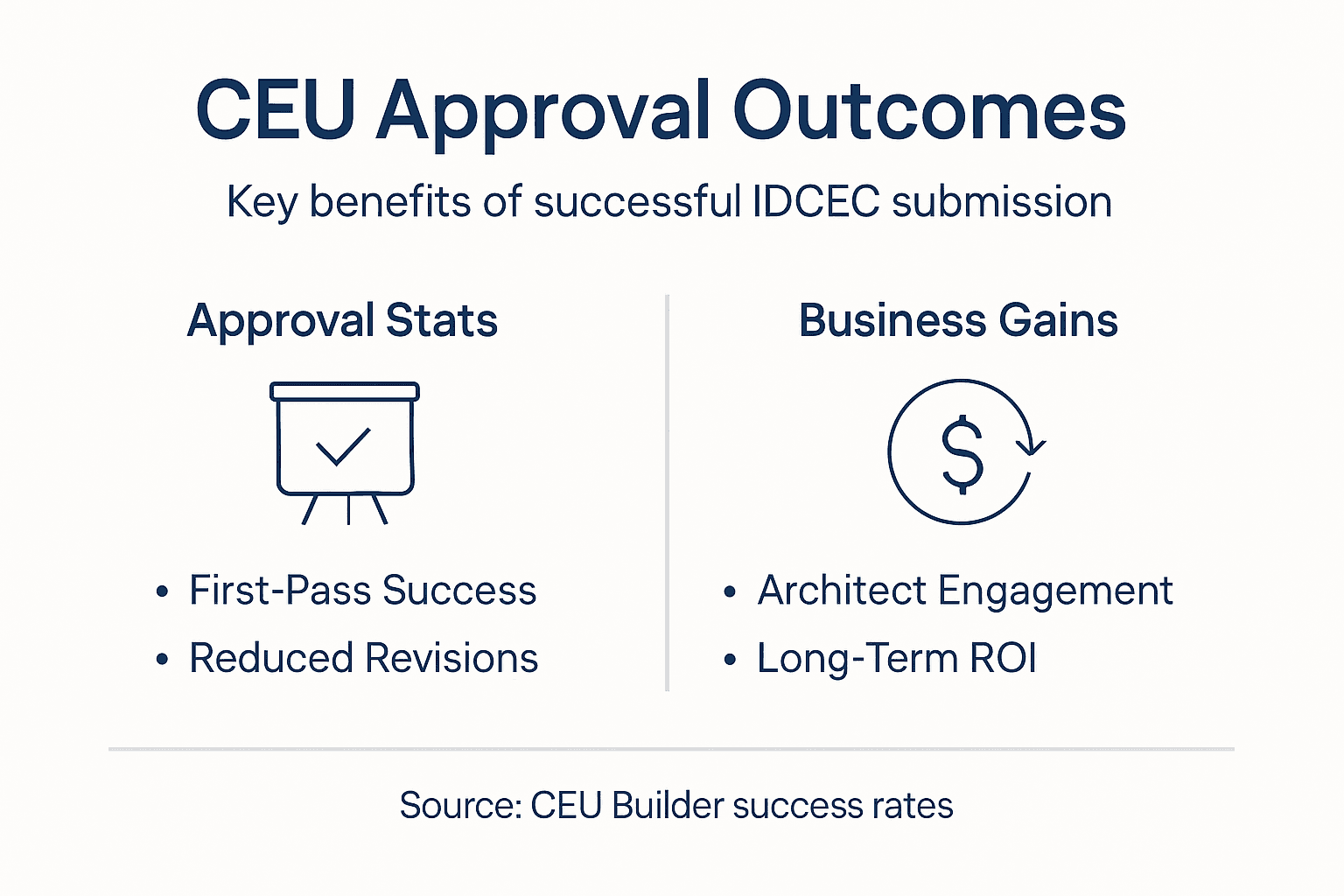
CEU Builder’s done-for-you service achieves 100% first-pass approval and completes courses in 4-6 weeks from kickoff to final accreditation. This timeline compresses the traditional 90-180 day development cycle by 80-95%, delivering market entry advantages that generic providers cannot match.
Accredited courses drive stronger architect engagement than traditional marketing channels. Design professionals spend 45-60 minutes learning from your course compared to 30-second glances at print ads or 5-minute trade show conversations. This extended attention creates preference structures that influence specification decisions months later.
Long-term ROI comes from evergreen CEU assets providing ongoing specification influence. A course built in 2026 continues generating completions and architect touchpoints in 2027, 2028, and beyond with no additional development costs. Platform access is lifetime, so initial investment creates perpetual lead generation infrastructure.
Using expert services balances costs with guaranteed compliance advantages. A $10,000 investment in professional CEU development costs less than one failed in-house attempt requiring 6-12 months of internal resource allocation. The speed and reliability advantages justify the expense for manufacturers serious about specification growth.
| Approach | Timeline | First-Pass Rate | Total Cost | Business Impact |
|---|---|---|---|---|
| In-House Development | 90-180 days | 30-40% | $15,000-$25,000 | Delayed, uncertain |
| Generic CE Provider | 60-90 days | 60-70% | $8,000-$12,000 | Limited strategic value |
| CEU Builder Done-For-You | 28-42 days | 100% | $10,000 | Immediate, measurable |
| Platform DIY | 56-84 days | 85-95% | $99/month | High control, moderate speed |
The first-pass approval statistics demonstrate how methodology and expertise impact success rates. Manufacturers who attempt DIY development without understanding IDCEC requirements waste months on rejected submissions. Professional guidance eliminates this risk entirely.
Streamline Your CEU Approval Process with CEU Builder
Managing IDCEC CEU approvals requires expertise most hospitality manufacturers lack internally. CEU Builder’s done-for-you service handles registration, content development, compliance auditing, and submission management while guaranteeing first-pass approval within 4-6 weeks. Our process aligns course topics with architect search behavior rather than generic compliance requirements, creating educational assets that drive specifications and revenue.
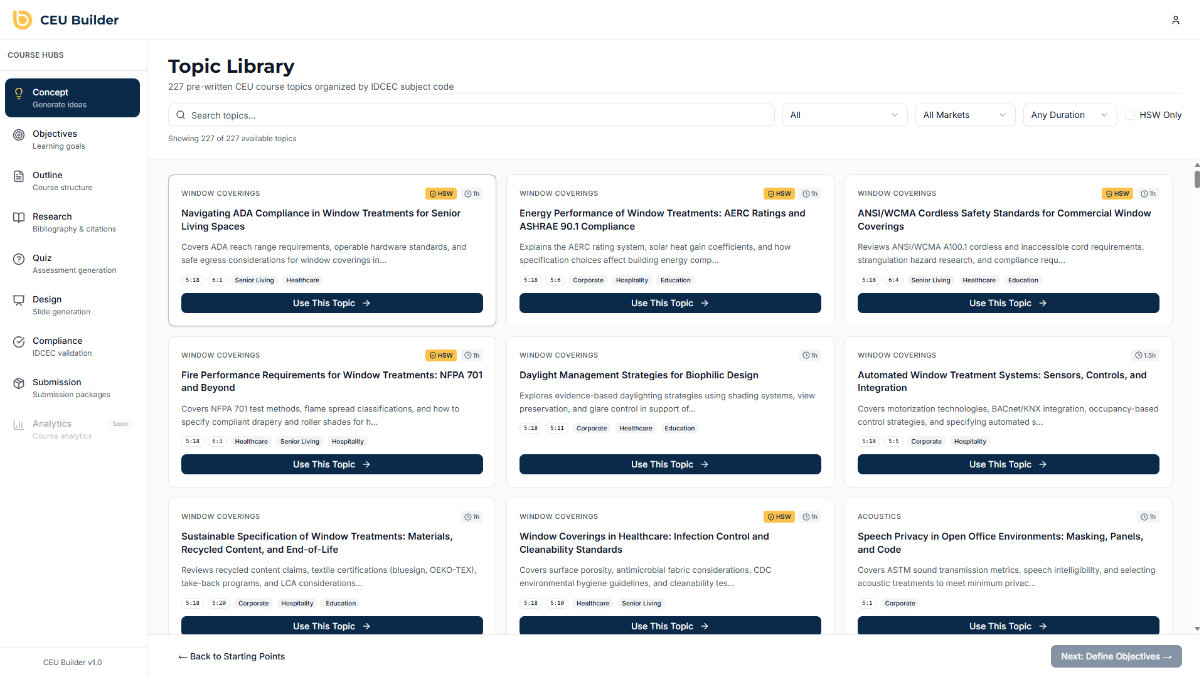
We’ve helped hospitality furniture, lighting, and material manufacturers secure IDCEC accreditation without the costly failures that plague internal development efforts. Our systematic approach achieves first-pass IDCEC approval in 4-6 weeks, compressing traditional timelines by 80% while eliminating revision risk. Marketing directors who want to get IDCEC approval without internal resource drain choose our proven methodology and guaranteed results.
Frequently Asked Questions
What are the key IDCEC fees required before submitting a CEU course?
Providers pay an annual registration fee plus separate per-course submission fees. The first year registration fee is prorated based on when you join. All providers must renew each January. Per-course fees are billed individually each time you submit new content for accreditation review, regardless of whether the course approves on first submission or requires revisions.
How long does the IDCEC CEU approval process typically take?
Standard review time is approximately 3 weeks after you submit your course through the online portal. This timeline assumes your submission is complete and meets all technical requirements. Revision requests add 1-3 weeks per cycle depending on how quickly you respond to reviewer feedback. Total timeline from initial submission to final approval typically ranges from 3-8 weeks for first-time providers.
What are the most common reasons CEU courses get rejected by IDCEC?
Frequent causes for rejection include proprietary product content like brand names or logos in the main course body. Missing bibliography or justification statements also trigger denial. Other common issues include incomplete citations, oversized files without download links, and learning objectives that don’t align with course content. Most rejections stem from misunderstanding non-promotional standards rather than poor content quality.
How can marketing directors align CEU course topics with architect needs?
Research what architects actively search for and struggle with in their daily work. Use keyword tools to identify design challenges related to your product category. Interview architects about specification criteria they use when selecting materials. Avoid creating courses that simply describe your products. Instead, teach design principles and application knowledge that naturally position your solutions as preferred options when architects face relevant challenges.
What strategies help manage CEU submission revisions effectively?
Monitor the IDCEC portal daily for reviewer feedback notifications. Respond to all revision requests within 5 business days maximum to maintain momentum. Create detailed revision logs documenting every change you make based on reviewer feedback. Use internal compliance audits before resubmission to catch any new issues your revisions may have introduced. Maintain open communication with IDCEC staff to clarify ambiguous feedback rather than guessing at what they want.
Recommended
