

Course Approval Workflow for Fast IDCEC Accreditation

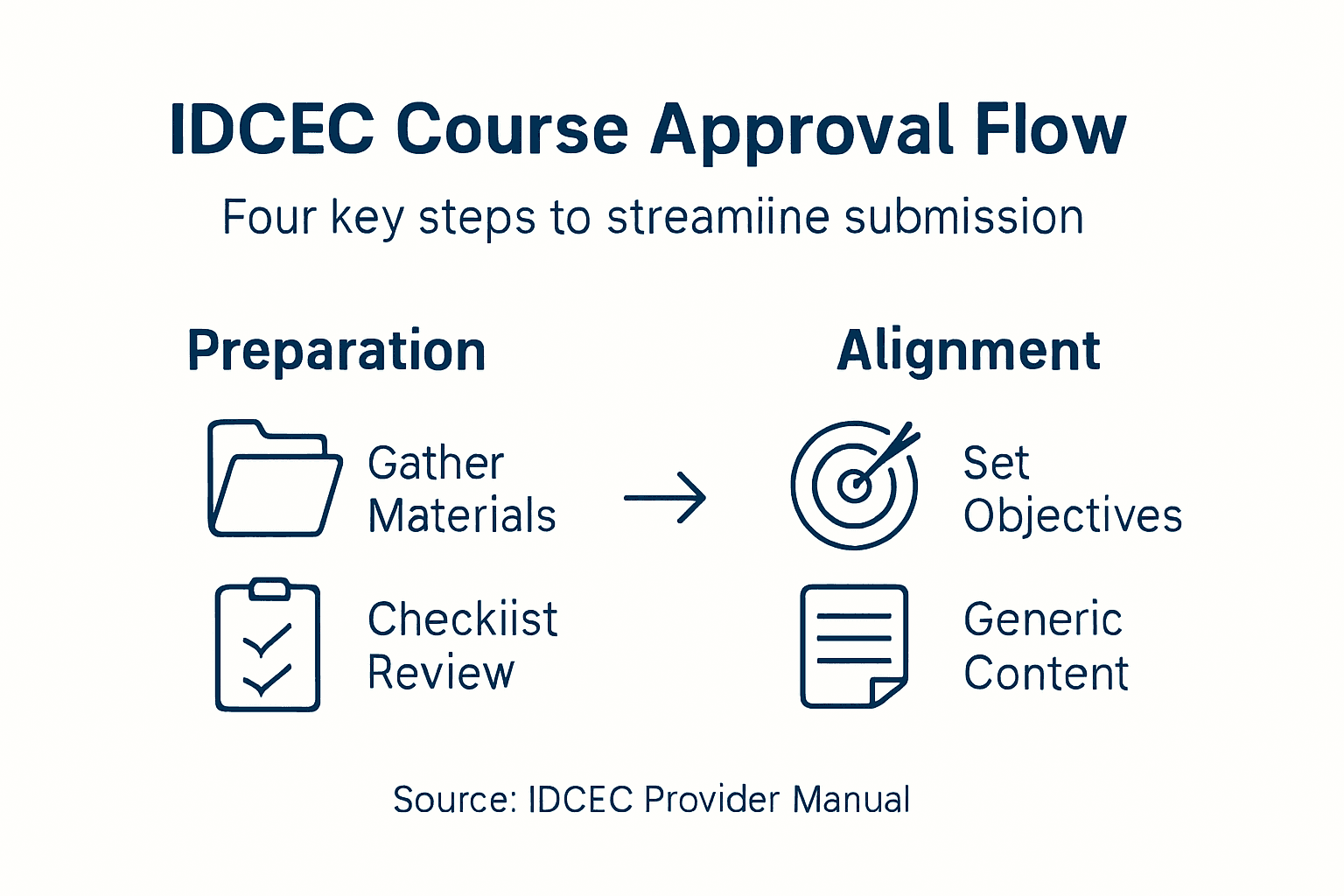
Submitting an IDCEC-approved CEU course often feels like navigating a maze of detailed requirements and strict content guidelines. For Marketing Directors at North American hospitality furniture manufacturers, each missed detail can mean frustrating delays that hold back product specification opportunities. This guide demystifies the step-by-step workflow, highlighting how a focus on generic, non-proprietary content and methodical documentation can help you meet reviewer expectations and move your courses swiftly toward approval.
Table of Contents
- Step 1: Gather Required Documentation and Materials
- Step 2: Align Course Content With IDCEC Standards
- Step 3: Submit Course for Initial Review and Adjust
- Step 4: Verify Compliance and Track Approval Status
Quick Summary
| Key Point | Explanation |
|---|---|
| 1. Gather all required materials | Ensure you have a PowerPoint, detailed speaking notes, a bibliography, and a course description to prevent submission delays. |
| 2. Define clear learning objectives | Specify measurable outcomes directly tied to your course content to meet IDCEC standards and avoid rejections. |
| 3. Monitor your submission dashboard | Regularly check your IDCEC dashboard for revision requests and updates to expedite the approval process. |
| 4. Limit proprietary content | Use generic, non-branded content in your materials to prevent immediate rejections during the review process. |
| 5. Organize files and documents | Ensure proper formatting and clear organization of your documents to simplify the submission process and avoid technical issues. |
Step 1: Gather Required Documentation and Materials
You’re now ready to assemble everything IDCEC needs to evaluate your course. This step determines whether your submission moves forward smoothly or gets rejected for missing pieces. Getting it right the first time saves weeks of back-and-forth corrections.
Start by collecting your core course materials. You’ll need a completed PowerPoint presentation, detailed speaking notes that accompany each slide, a comprehensive bibliography, and a formal course description. These four elements form the foundation of every IDCEC submission.
Your presentation slides should follow specific guidelines. The IDCEC Provider Instruction Manual allows product names and logos only on your opening and closing slides. Every other slide must contain generic, non-proprietary content that educates without promoting specific brands. This distinction is critical—reviewers specifically check for hidden marketing disguised as education.
Speaking notes require special attention. These aren’t optional extras but detailed scripts that explain what you’ll say during delivery. They provide context for every learning objective and help reviewers verify that your content actually teaches what your course description promises. Many submissions fail because speaking notes are either missing entirely or too vague to demonstrate substance.
Your bibliography must be complete and properly formatted. This isn’t busywork—it proves your content rests on legitimate sources and industry research. Incomplete or poorly documented sources signal weak course development and often trigger rejections.
Here’s a summary of critical elements and their roles in a successful IDCEC course submission:
| Submission Component | Main Purpose | How Reviewers Use It |
|---|---|---|
| PowerPoint Presentation | Provides structured educational visuals | Checks adherence to content guidelines |
| Detailed Speaking Notes | Explains in-depth what will be taught | Verifies objectives match delivery |
| Bibliography | Documents credible references and research | Assesses academic rigor and validity |
| Course Description | Summarizes course scope and intent | Evaluates fit with accreditation aims |
File management matters more than you might think. According to CEU provider FAQs, files must typically be under 5MB or accessible through external links if larger. Organize everything clearly before submission to avoid technical issues that delay approval.
Gather everything before submission. Incomplete material packages are among the most common reasons for denial, and fixing errors after review wastes months of time.
Pro tip: Create a master checklist of all required materials and verify each item is complete before moving to the next step—this single habit prevents costly submission delays.
The table below compares typical reasons for IDCEC course denial and recommended preventive actions:
| Common Reason for Denial | Preventive Action | Impact on Approval Timeline |
|---|---|---|
| Incomplete material package | Use a master checklist | Avoids multi-week delays |
| Missing/weak learning objectives | Map objectives to slide content | Streamlines reviewer assessment |
| Proprietary content in slides | Limit brand mentions to bookends | Prevents immediate rejection |
| Incomplete bibliography | Ensure all sources are cited | Avoids re-submission cycles |
Step 2: Align Course Content With IDCEC Standards
Your content must meet specific IDCEC requirements to pass review. This step ensures your course materials align with accreditation standards before submission, preventing rejections that waste time and resources.

Start by defining clear learning objectives. These aren’t vague goals but measurable outcomes that specify exactly what participants will know or be able to do after completing your course. IDCEC reviewers examine objectives closely to verify they’re specific, achievable, and directly connected to your course content. Weak objectives trigger denials faster than almost any other issue.
Next, ensure your content is generic and non-proprietary. This is the most misunderstood requirement. Your course can discuss your products and their features, but the educational content itself must teach principles, methodologies, or industry knowledge that applies broadly. The distinction matters. You’re educating architects about acoustic design principles, not selling them your acoustic panels. Once they understand the principles, your products become the obvious solution.
If you’re pursuing HSW (Health, Safety, and Welfare) designation, learning objectives must align with health, safety, and welfare criteria, requiring 75 percent of your content to focus on these topics. This isn’t flexible. If you want HSW credits, the math must work.
Your bibliography or justification statement proves your content rests on legitimate sources. Include published research, industry standards, technical references, or expert sources that support your educational claims. This demonstrates academic rigor and differentiates your course from marketing disguised as education.
Organize your content logically. Reviewers expect a clear flow from introduction through learning objectives to detailed content to conclusion. Disjointed or poorly structured material signals rushed development and invites closer scrutiny.
Content alignment determines approval outcomes. Courses that clearly meet IDCEC standards move through review smoothly, while those with questionable content face extended review or rejection.
Pro tip: Map each learning objective directly to specific slide content and speaking notes—this visual alignment prevents content gaps and makes reviewer assessment faster.
Step 3: Submit Course for Initial Review and Adjust
You’re ready to submit your course into IDCEC’s review system. This step moves your materials from preparation into active evaluation, where trained reviewers assess whether your course meets accreditation standards.
Log into your IDCEC provider account and navigate to course submission. You’ll complete three sequential stages: general course information, detailed course content, and instructor details. Each stage builds on the previous one, so accuracy matters. Missing or incomplete information at any stage will delay your submission.
General course information includes basics like your course title, subject code, delivery method, and intended learning outcomes. Be specific here. Vague course descriptions trigger reviewer questions that slow approval timelines.
The detailed content stage is where you upload your presentation slides, speaking notes, bibliography, and course description. Ensure all files are properly formatted and under size limits. According to IDCEC submission procedures, course review typically takes three weeks after you submit everything.
Instructor information includes your credentials and background. This verifies you have legitimate expertise to teach the subject matter. Reviewers use this to assess course credibility.
Once submitted, your course enters active review. You can monitor progress through your dashboard. Check your account regularly for messages from IDCEC reviewers. When they request adjustments, respond quickly. Speed here directly impacts your approval timeline.
Revisions typically address content clarity, bibliography completeness, or alignment with learning objectives. These aren’t rejections—they’re normal refinements. Make adjustments, resubmit, and your course moves forward.
Dashboard monitoring prevents approval delays. Courses sitting unreviewed because providers missed revision requests waste weeks unnecessarily.
Pro tip: Set a calendar reminder to check your IDCEC dashboard every three business days, ensuring you catch revision requests immediately and maintain momentum toward approval.
Step 4: Verify Compliance and Track Approval Status
Approval isn’t automatic once you submit. This step keeps your course moving through IDCEC’s review process by actively monitoring status and addressing any issues that arise.
Log into your IDCEC provider account regularly. Your dashboard displays real-time information about your course’s approval state, submission completeness, and any pending reviewer feedback. This visibility prevents surprises and keeps you informed about next actions.
Your dashboard shows several key metrics. You’ll see the number of courses you’ve submitted, their current approval status, and attendance records once your course launches. Bookmark this page and check it weekly to catch reviewer messages immediately.
When reviewers identify issues, they post messages in your account. These typically request clarifications on content, updates to your bibliography, or adjustments to learning objectives. Respond promptly to these requests. The faster you make revisions, the faster your course moves toward approval.
Common revision requests include strengthening non-proprietary content claims, improving bibliography citations, or clarifying how learning objectives connect to course material. These aren’t deal breakers. Most courses approved on first submission had minor adjustments requested. Make the changes, resubmit your materials, and your course advances.
Once you receive official approval, your course is ready for delivery. Don’t publish your course until you have written approval from IDCEC. Publishing before approval violates accreditation rules and can jeopardize your provider status.
After approval, you’ll need to manage ongoing compliance. The IDCEC provider dashboard tracks attendance reporting and requires you to report learner completions promptly so participants receive their CEU credits.
Dashboard diligence prevents approval delays. Providers who miss revision requests or fail to respond promptly extend their approval timeline unnecessarily.
Pro tip: Enable email notifications in your IDCEC account settings so you receive alerts when reviewers post messages, eliminating any chance of missing important revision requests.
Accelerate Your IDCEC Course Approval with Proven Solutions
Navigating the intricate requirements and strict documentation standards of the IDCEC accreditation process can be daunting. This article highlights common challenges such as incomplete material packages, non-aligned learning objectives, and prolonged review cycles that delay approval and drain internal resources. If you find yourself aiming for a faster, foolproof accreditation process without sacrificing content quality or compliance, our services are designed specifically to solve these pain points.
At CEU Builder, we specialize in simplifying and streamlining course approval workflows. Our 100% first-pass IDCEC accreditation rate guarantees your course moves through review smoothly because we carefully manage each critical element you learned about: from precise learning objective alignment to bibliography accuracy and proprietary content restrictions. Whether you need a full done-for-you solution or powerful tools and training to own the process yourself, we empower you to transform accreditation from a barrier into a growth engine.
Explore our tailored support to eliminate wasted submission cycles and accelerate your go-to-market timeline. Visit Compliance & Accreditation – CEU Builder to learn how we tackle exact IDCEC requirements. Discover strategic growth through education with insights on Pipeline & Revenue Growth – CEU Builder. Start your journey to stress-free accreditation and increased specification influence today at CEU Builder.
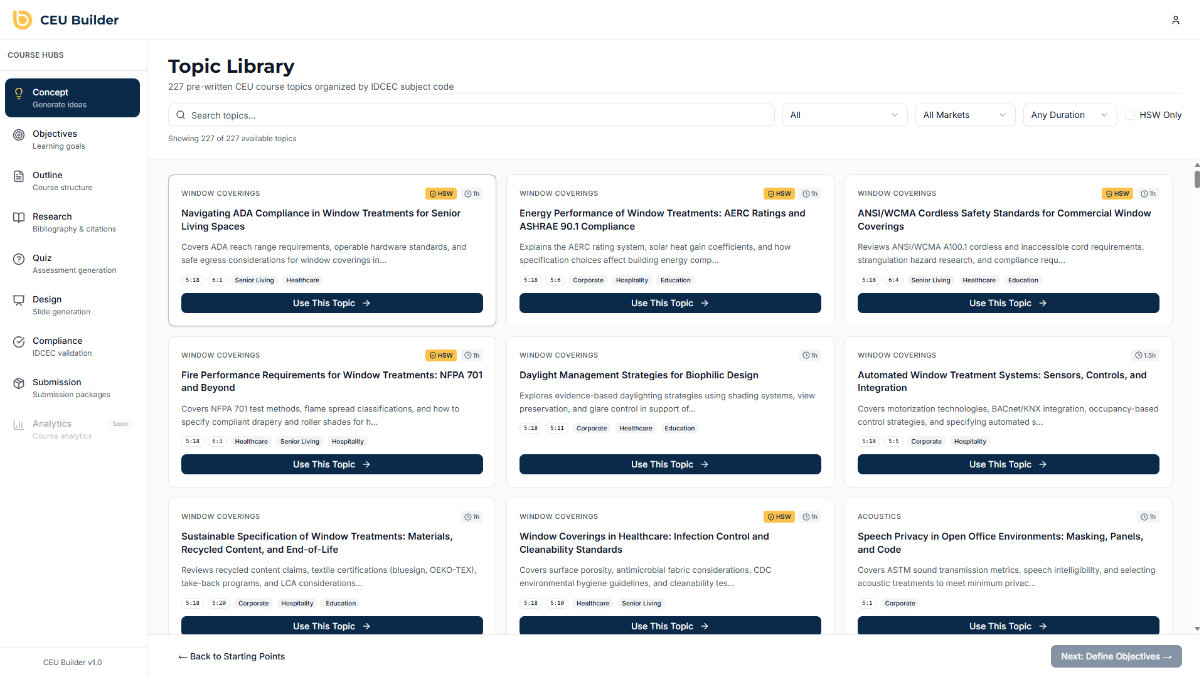
Ready to stop battling IDCEC roadblocks and start converting education into lasting revenue impact? Connect with CEU Builder now for expert guidance and industry-leading support that keeps your courses ahead on approval timelines and market relevance.
Frequently Asked Questions
What key documents do I need to gather for IDCEC course approval?
To get your course approved, you must collect a completed PowerPoint presentation, detailed speaking notes, a comprehensive bibliography, and a formal course description. Start by preparing these core materials to ensure a smooth review process and minimize delays.
How can I ensure my learning objectives meet IDCEC standards?
Make sure your learning objectives are specific, measurable, and directly connected to your course content. Clearly outline what participants will learn and be able to do after completing the course; this alignment is crucial for approval.
What should I do if my course submission is denied?
Review the feedback provided by IDCEC to understand the reasons for denial, often related to incomplete materials or weak content. Address the specific concerns and make revisions before resubmitting your course for evaluation.
How often should I check my IDCEC dashboard after submission?
Log into your IDCEC account regularly to monitor your course’s approval status, ideally every three business days. This diligent monitoring helps you catch any requests for revisions quickly and keeps your course moving forward.
What are common reasons for IDCEC course denial?
Common reasons for denial include incomplete material packages, unclear learning objectives, and the use of proprietary content. To prevent denials, utilize a master checklist to ensure all materials are complete and well-structured before submitting.
Recommended
