

Course Registration Process: Steps for Efficiency and Impact
Frustrated by architect engagement that stalls before your product becomes specified? Course registration is more than paperwork for Marketing Directors in the North American hospitality furniture industry—it is a gateway to fostering deeper professional connections and driving better project outcomes. Understanding the systematic steps in course registration will help you transform enrollment into a powerful strategic process that captures critical data, elevates participant experience, and advances your competitive position.
Table of Contents
- Defining The Course Registration Process
- Key Steps In Course Registration Systems
- Technology Tools For Registration Management
- Common Pitfalls And How To Avoid Them
- Maximizing Registration Outcomes For Product Specification
Key Takeaways
| Point | Details |
|---|---|
| Streamlined Registration Processes | Modern course registration systems leverage technology to enhance efficiency and user experience, reducing processing times and errors. |
| Dynamic Data Management | Organizations must implement comprehensive data collection and reporting mechanisms to support decision-making and compliance. |
| User-Centric Design | Registration interfaces should prioritize user experience, offering intuitive navigation and support to facilitate smoother enrollment. |
| Continuous Improvement Strategies | A focus on adaptive processes and participant feedback is crucial for refining registration systems and maximizing engagement. |
Defining the Course Registration Process
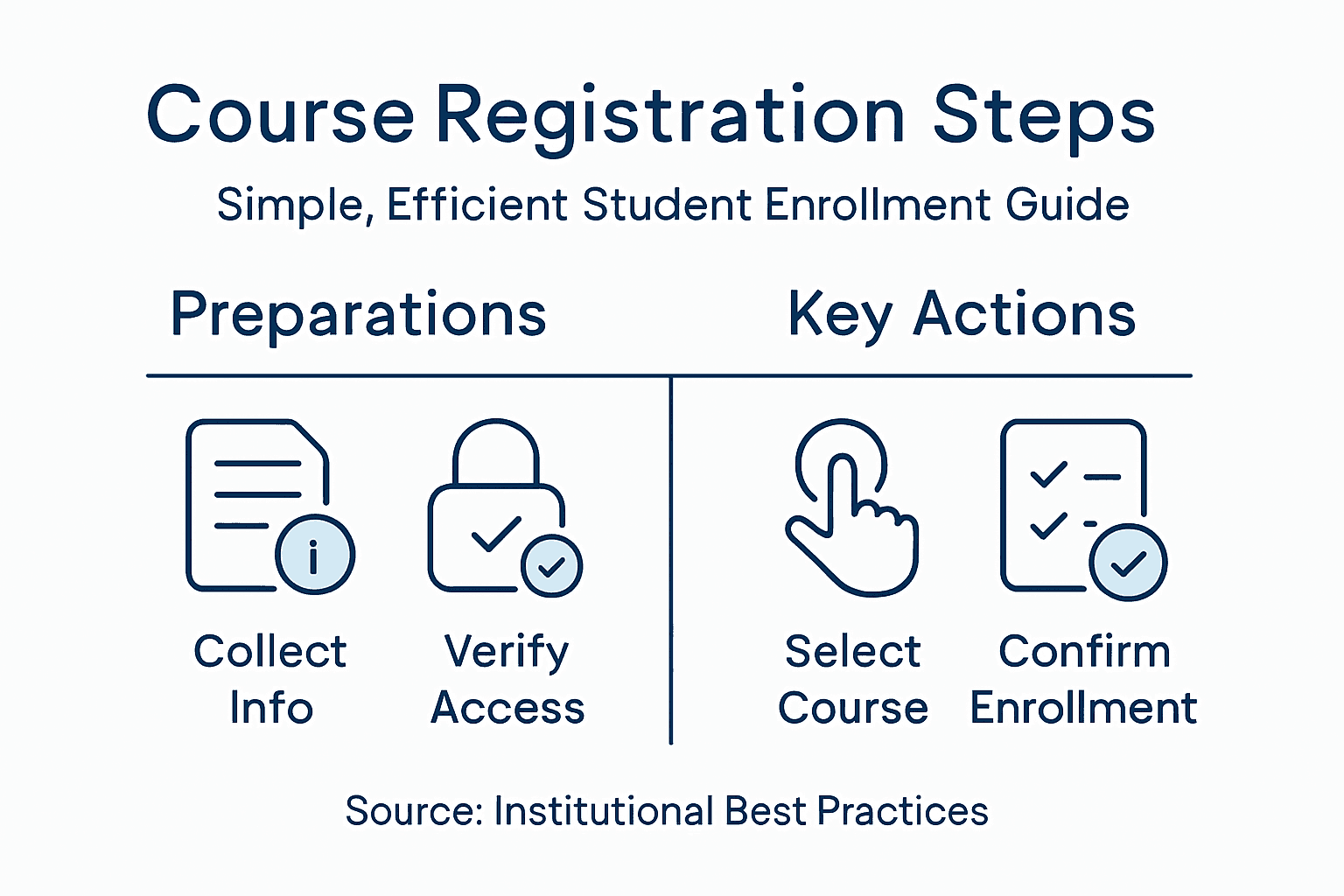
Course registration represents a critical administrative procedure that enables participants to enroll in educational programs and access learning resources. At its core, course registration involves systematic steps for documenting participant information, confirming eligibility, and securing program participation.
The registration process typically encompasses several fundamental components that ensure smooth organizational and administrative workflows:
- Personal Information Collection: Gathering essential participant details like name, contact information, and professional credentials
- Program Verification: Confirming participant eligibility for specific courses or educational tracks
- Payment Processing: Managing financial transactions associated with course enrollment
- Credential Documentation: Recording participant qualifications and tracking compliance requirements
- Access Provisioning: Generating unique identifiers or login credentials for course materials
Successful course registration requires precision and adherence to institutional protocols. Structured registration periods define participation windows, establishing clear guidelines for when and how individuals can enroll in specific educational programs.
For professional development and continuing education contexts, registration serves multiple strategic purposes beyond mere administrative tracking. It enables organizations to:
- Monitor participant demographics
- Manage classroom or platform capacity
- Ensure compliance with professional certification requirements
- Generate accurate reporting for accreditation purposes
Registration Complexity Factors
Multiple variables influence the registration process complexity, including:
- Institutional requirements
- Professional certification standards
- Technology infrastructure
- Participant verification protocols
Pro tip: Develop a standardized registration workflow that balances administrative efficiency with participant user experience, leveraging technology to streamline data collection and validation processes.
Key Steps in Course Registration Systems
Course registration systems have evolved dramatically, transforming traditional administrative processes into sophisticated digital platforms. Online course registration technologies now enable seamless interactions between students, faculty, and administrative staff, dramatically reducing processing time and potential errors.
Here is a comparison of traditional vs. modern course registration processes:
| Criteria | Traditional Registration | Modern Digital Registration |
|---|---|---|
| Processing Speed | Manual and time-consuming | Real-time and instant |
| Error Rate | Higher due to manual entry | Lower with automated validation |
| Accessibility | In-person or paper-based | Online, 24/7 access |
| User Experience | Often confusing and lengthy | Intuitive, user-friendly |
| Data Reporting | Limited analytics and reporting | Comprehensive, real-time insights |
The core steps in modern course registration systems typically include:
- User Authentication: Verifying participant identity and access permissions
- Course Catalog Navigation: Providing searchable and filterable course listings
- Course Selection: Enabling participants to choose and add desired courses
- Prerequisite Validation: Automatically checking course eligibility requirements
- Enrollment Confirmation: Processing registration and generating unique participant identifiers
Enhanced registration systems leverage adaptive development methodologies to create more intelligent and user-friendly platforms. These advanced systems focus on several critical components:
- Real-time capacity management
- Automated credit unit tracking
- Comprehensive error prevention mechanisms
- Dynamic scheduling capabilities
System Design Considerations
Successful course registration platforms must balance multiple technical and user experience requirements:
- Scalability for different institutional sizes
- Robust security protocols
- Intuitive user interface design
- Comprehensive reporting capabilities
- Integration with existing institutional systems
A well-designed course registration system is not just a technological tool, but a strategic asset that can significantly enhance institutional efficiency and participant satisfaction.
Pro tip: Implement a phased rollout strategy when introducing a new course registration system, allowing incremental testing and minimizing potential disruptions to existing administrative workflows.
Technology Tools for Registration Management
Registration management technologies have revolutionized how organizations handle complex enrollment processes. Event management platforms now integrate comprehensive registration solutions that streamline administrative workflows and enhance participant experiences across multiple domains.
Modern registration management tools typically offer a range of sophisticated features:
- Automated Workflow Capabilities: Reducing manual data entry and processing time
- Real-Time Reporting: Generating instant insights into registration metrics
- Secure Authentication: Implementing multi-factor verification protocols
- Customizable Registration Interfaces: Allowing tailored experiences for different user groups
- Integrated Communication Tools: Enabling seamless participant notifications
Academic research management software supports critical administrative functions by providing robust technological infrastructure. These advanced systems focus on several key technological capabilities:
- Comprehensive compliance tracking
- Dynamic scheduling management
- Scalable participant database integration
- Automated approval workflows
Key Technology Integration Considerations

Successful registration management technologies must address multiple critical requirements:
Below is a summary of technology integration considerations for registration management tools:
| Consideration | Impact on Operations | Importance Level |
|---|---|---|
| Data Security | Protects participant information | Critical |
| System Compatibility | Ensures seamless workflows | High |
| Customizability | Supports unique institutional needs | Medium |
| Analytics Capabilities | Enables informed decision-making | High |
| Cross-platform Access | Improves user convenience | Important |
- Compatibility with existing institutional systems
- High-level data security and privacy protection
- Flexible configuration options
- Cross-platform accessibility
- Advanced analytics and reporting capabilities
Technology transforms registration from a bureaucratic process into a strategic organizational asset, enabling more intelligent and responsive management.
Pro tip: Select registration management tools that offer modular design, allowing incremental implementation and seamless future upgrades without disrupting existing workflows.
Common Pitfalls and How to Avoid Them
Course registration processes are fraught with potential challenges that can significantly disrupt participant experiences. Registration systems encounter multiple critical obstacles that require strategic planning and proactive management.
The most frequent pitfalls in course registration include:
- Limited Course Availability: Creating bottlenecks and participant frustration
- Incomplete Data Submission: Causing processing delays and potential rejections
- Complex Authentication Processes: Discouraging potential participants
- Ineffective Communication Workflows: Leading to misunderstandings and missed opportunities
- Inadequate Technical Support: Leaving participants without resolution paths
Online registration challenges demand comprehensive solution strategies that address both technological and human factors. Organizations can mitigate these risks through several targeted approaches:
- Implement dynamic, user-friendly registration interfaces
- Develop clear, step-by-step guidance materials
- Create robust technical support channels
- Use conditional logic to simplify form completion
Mitigation Strategies
Successful registration management requires addressing potential obstacles systematically:
- Conducting thorough user experience testing
- Providing multiple registration support channels
- Developing clear, accessible help documentation
- Creating flexible alternative registration pathways
- Implementing real-time error detection mechanisms
Effective registration systems transform potential friction points into opportunities for enhanced participant engagement and institutional efficiency.
Pro tip: Design registration workflows with built-in adaptive features that anticipate and automatically resolve common user input errors, reducing manual intervention and improving overall participant satisfaction.
Maximizing Registration Outcomes for Product Specification
Product specification strategies require a systematic approach to registration that transforms participant interactions into valuable business intelligence. Effective registration systems leverage predictive analytics to convert enrollment data into strategic insights that drive product development and marketing initiatives.
Key strategies for maximizing registration outcomes include:
- Comprehensive Data Collection: Gathering detailed participant information
- Targeted Segmentation: Categorizing registrants by professional profile
- Behavioral Tracking: Monitoring engagement patterns and preferences
- Qualification Verification: Ensuring registrant relevance and expertise
- Performance Metrics: Establishing clear outcome measurement criteria
Data-driven goal setting enables precise product specification alignment by creating sophisticated participant tracking mechanisms. Organizations can implement several strategic approaches:
- Develop granular participant profiling protocols
- Create multi-dimensional engagement scoring systems
- Design adaptive registration pathways
- Implement real-time analytics dashboards
Strategic Registration Optimization
Successful product specification requires holistic registration management:
- Continuous performance monitoring
- Dynamic participant feedback integration
- Predictive demand forecasting
- Personalized communication strategies
- Iterative refinement of specification criteria
Registration is not merely an administrative task but a strategic opportunity to gather actionable intelligence that directly influences product development and market positioning.
Pro tip: Implement a continuous learning approach in your registration process, treating each interaction as an opportunity to refine your understanding of participant needs and market dynamics.
Streamline Your Course Registration and Boost Educational Impact with CEU Builder
The article highlights the complexities and critical steps involved in creating efficient course registration systems that enhance participant engagement and institutional outcomes. Challenges like compliance tracking, user authentication, and real-time reporting require robust solutions that transform registration from a basic administrative task into a strategic advantage. If you are aiming to build accredited continuing education that drives meaningful specifications and revenue, addressing these pain points with expert support is key.
CEU Builder specializes in developing IDCEC-accredited courses designed to do more than just fulfill compliance. Our approach integrates strategic course design with streamlined workflows that ensure 100% first-pass accreditation success. By leveraging tailored tools and proven methodology, we help you take control of registration efficiency, course delivery, and participant impact. For deeper insights on building compliant and effective education programs, explore our Compliance & Accreditation – CEU Builder resources, or for broader strategic guidance, visit General – CEU Builder.

Ready to turn your continuing education courses into powerful specification engines? Visit CEU Builder today to learn how our expert services and platform solutions accelerate course approval while maximizing your market influence. Act now to avoid costly registration pitfalls and position your brand as a trusted industry leader.
Frequently Asked Questions
What is the course registration process?
The course registration process involves systematic steps including personal information collection, program verification, payment processing, credential documentation, and access provisioning to enroll participants in educational programs.
How can institutions improve their course registration systems?
Institutions can enhance course registration systems by implementing modern technology platforms that automate workflows, reduce errors, and provide a user-friendly interface, improving both administrative efficiency and participant satisfaction.
What are common challenges in the course registration process?
Common challenges include limited course availability, incomplete data submissions, complex authentication processes, ineffective communication workflows, and inadequate technical support, all of which can disrupt participant experiences.
How can organizations maximize registration outcomes?
Organizations can maximize registration outcomes by collecting detailed participant data, segmenting registrants effectively, tracking engagement patterns, and utilizing predictive analytics to inform product development and marketing strategies.
Recommended
- What Is Course Registration and Why It Matters
- One-Page Event Packet You Can Reuse – CEU Builder
- Portal Essentials: Schedule an Event & Get a Class Code – CEU Builder
- From Approval to Delivery: Operational Steps – CEU Builder
- Come si struttura un corso online efficace e riconosciuto – Recupero Anni Scolastici e Diploma Online
