

7 Key Advantages of Direct Accreditation for CEU Success
Getting your continuing education course approved by IDCEC can feel like an overwhelming process for manufacturers. Every missed requirement or slow response can set back your timeline and put your opportunity to reach design professionals at risk. You want your courses to do more than just tick compliance boxes—they need to power real results for your brand and product specifications.
This list gathers the most practical benefits you can gain from mastering IDCEC course accreditation, from quicker approvals to stronger trust among architects. You will discover actionable strategies that help you avoid costly mistakes, showcase your expertise, and generate new business through valuable education. Get ready to learn how each step can give you a competitive edge in the world of professional design education.
Table of Contents
- Faster Approval Timelines For CEU Courses
- Guaranteed Compliance With IDCEC Standards
- Full Creative Control Over Course Content
- Improved Brand Authority Among Architects
- Higher Specification Rates From Engaged Learners
- Reduced Risk Of Costly Accreditation Failures
- Actionable Data And Long-Term Platform Value
Quick Summary
| Takeaway | Explanation |
|---|---|
| 1. Streamline Approval Processes | Prepare thorough documentation and understand IDCEC requirements to expedite course approvals. |
| 2. Ensure Compliance | Adhere strictly to IDCEC standards with precise learning objectives and expert content validation to maintain credibility. |
| 3. Leverage Creative Freedom | Design engaging courses with customized content to enhance brand narrative and marketing effectiveness. |
| 4. Build Brand Authority | Create educational content that addresses real challenges to transform perception from seller to trusted resource. |
| 5. Utilize Actionable Data Insights | Collect data on course performance to inform targeted educational strategies and drive business outcomes. |
1. Faster Approval Timelines for CEU Courses
Navigating the complex world of continuing education course approvals can feel like an endless bureaucratic maze. But what if you could dramatically reduce your IDCEC accreditation timeline from months to mere weeks?
The key to expediting your CEU course approval lies in understanding and strategically approaching the accreditation process. Organizations like the AAPC highlight consistent communication as a critical factor in accelerating course approvals. By implementing a structured, proactive approach manufacturers can significantly compress their approval timelines.
Here are the core strategies for achieving faster CEU course approvals:
- Prepare Comprehensive Documentation: Ensure all required materials are meticulously organized before submission
- Understand IDCEC Requirements: Develop deep familiarity with specific accreditation guidelines
- Create Clear Learning Objectives: Craft precise learning outcomes that align perfectly with IDCEC standards
- Use Systematic Review Processes: Implement internal quality checks before external review
- Leverage Expert Guidance: Consider working with specialized accreditation support services
The difference between a 6-month approval process and a 4-week approval can mean capturing market opportunities before competitors.
Successful manufacturers recognize that speed in course accreditation translates directly to market advantage. By reducing bureaucratic friction manufacturers can quickly transform educational content into powerful specification tools.
Pro tip: Develop a standardized internal checklist matching IDCEC requirements to streamline your review process and minimize potential submission errors.
2. Guaranteed Compliance with IDCEC Standards
In the complex landscape of continuing education manufacturing identifying compliance is like navigating a labyrinth where one wrong step can invalidate months of effort. Interior design continuing education requires precise adherence to strict professional standards.
The IDCEC serves as the critical gatekeeper ensuring that course providers meet rigorous guidelines for educational quality and professional relevance. Their centralized registry establishes comprehensive standards that protect the integrity of design professional credentials.
Key elements of guaranteed IDCEC compliance include:
- Precise Learning Objectives: Crafting educational content that directly matches IDCEC requirements
- Comprehensive Documentation: Maintaining thorough records of course development and delivery
- Expert Content Validation: Ensuring materials are reviewed by industry professionals
- Transparent Reporting: Creating clear mechanisms for tracking and verifying continuing education credits
- Ongoing Quality Control: Implementing systematic review processes
Compliance is not just a checkbox it is a commitment to maintaining the highest professional standards in design education.
Manufacturers who prioritize compliance transform continuing education from an administrative burden into a strategic opportunity. By understanding and executing IDCEC standards precisely manufacturers can create courses that not only meet regulatory requirements but also provide genuine value to design professionals.
Pro tip: Develop an internal compliance checklist that mirrors IDCEC standards to ensure every course meets professional education requirements before submission.
3. Full Creative Control Over Course Content
Continuing education courses have long been held hostage by rigid templates and generic content that fails to truly engage design professionals. Imagine transforming your CEU from a mundane compliance exercise into a powerful marketing and specification tool.
The IACET continuing education standards empower providers with remarkable flexibility in course design while maintaining rigorous quality benchmarks. This means you can craft content that not only meets professional requirements but also strategically positions your brand.
Key advantages of full creative control include:
- Strategic Narrative Development: Design courses that tell your brand’s unique story
- Technical Depth Customization: Create content that showcases your product’s specific advantages
- Visual Design Freedom: Build slide decks that reflect your brand identity
- Learning Objective Precision: Align educational goals with specification strategies
- Multimedia Integration: Incorporate various content formats beyond traditional presentations
Creative control transforms continuing education from a regulatory requirement into a strategic business asset.
Manufacturers can now design educational experiences that directly drive product specification. Instead of generic content manufacturers can develop courses that seamlessly integrate product knowledge technical insights and design professional needs.
Pro tip: Develop a storytelling framework that weaves your product’s unique value proposition into educational content while maintaining academic integrity and learning objectives.
4. Improved Brand Authority Among Architects
In the competitive world of design and specification brand authority can mean the difference between being overlooked or being the go-to solution for architects. Continuing education offers a strategic pathway to elevate your manufacturing brand from vendor to trusted educational resource.
The IACET accreditation framework provides manufacturers a powerful mechanism to demonstrate credibility and expertise within the architectural community. By developing high-quality educational content manufacturers can transform their brand perception from mere product sellers to authoritative knowledge providers.
Key strategies for building brand authority include:
- Consistent Educational Content: Develop a series of interconnected courses that showcase deep industry expertise
- Technically Rigorous Materials: Create content that goes beyond surface-level product descriptions
- Genuine Problem-Solving Approach: Design courses addressing real architectural challenges
- Transparent Learning Objectives: Clearly communicate the value architects will gain
- Professional Presentation: Invest in high-quality visual design and instructional methodology
Brand authority is built not through advertising but through demonstrating genuine understanding of professional challenges.
Architects seek partners who educate not just sell. By positioning your brand as a source of valuable professional knowledge you create a powerful competitive differentiation that extends far beyond traditional marketing approaches.
Pro tip: Develop a multi-course educational strategy that creates a comprehensive narrative about your brand’s unique perspective and technical expertise.
5. Higher Specification Rates from Engaged Learners
Beyond mere course completion architects seek transformative learning experiences that directly impact their professional practice. Engaging continuing education courses have become the new currency of specification influence.
Research on community engaged learning reveals that active learning programs dramatically increase both academic and professional outcomes. When architects encounter courses that provide meaningful professional insights they are significantly more likely to specify products associated with that educational experience.
Key strategies for creating highly engaging learning experiences include:
- Interactive Content Design: Develop courses that require active participant involvement
- Real-World Problem Solving: Create scenarios that mirror actual design challenges
- Technical Depth with Practical Application: Balance theoretical knowledge with actionable insights
- Multi-Modal Learning Approaches: Incorporate visual diagrams case studies and interactive elements
- Direct Professional Value Demonstration: Show clear connections between course content and specification decisions
Engagement is not about entertainment it is about creating profound professional learning experiences.
Architects specify products from manufacturers who demonstrate genuine understanding of their complex professional landscape. By crafting courses that respect their intelligence and address their specific challenges manufacturers can transform continuing education from a compliance requirement into a powerful specification tool.
Pro tip: Design course assessments that require architects to apply learned concepts directly to potential project scenarios increasing knowledge retention and specification likelihood.
6. Reduced Risk of Costly Accreditation Failures
Continuing education course development feels like navigating a minefield where one misstep can cost thousands of dollars and months of wasted effort. Understanding how to systematically reduce accreditation risks is not just smart it is essential for manufacturers investing in professional education.
Research highlights that systematic self-assessment prevents costly failures by enabling organizations to proactively identify and address potential compliance gaps before external review.
Strategies to minimize accreditation risks include:
- Comprehensive Documentation: Maintain meticulous records of course development process
- Early Compliance Verification: Conduct internal reviews against IDCEC standards before submission
- Expert Consultation: Engage specialists familiar with accreditation requirements
- Systematic Content Validation: Develop robust internal quality control mechanisms
- Continuous Learning: Stay updated on evolving educational standards and requirements
Preventing an accreditation failure is exponentially cheaper than recovering from one.
Successful manufacturers treat course accreditation as a strategic process not a bureaucratic obstacle. By implementing systematic review approaches manufacturers can transform potential roadblocks into opportunities for demonstrating professional excellence.
Pro tip: Create a detailed compliance checklist mapped directly to IDCEC requirements and review it methodically before course submission to catch potential issues early.
7. Actionable Data and Long-Term Platform Value
In the world of continuing education manufacturers have traditionally been left in the dark about their course performance. What if you could transform your CEU program from a compliance checkbox into a strategic business intelligence engine?
The ability to measure meaningful course metrics shifts continuing education from an administrative burden to a powerful demand generation tool. By capturing granular data about architect engagement manufacturers can create increasingly targeted educational experiences.
Key data tracking capabilities include:
- Architect Completion Tracking: Monitor who completes courses and their professional details
- Specification Correlation: Link course completions to actual project specifications
- Engagement Depth Analysis: Understand how architects interact with course content
- Learning Behavior Insights: Identify topics driving highest engagement
- Geographic and Sector Performance: Analyze course effectiveness across different markets
Data transforms continuing education from a one-way broadcast into a strategic conversation with design professionals.
Long-term platform value emerges when manufacturers treat CEU courses as living assets that continuously generate business intelligence. Each course becomes a data collection mechanism providing insights far beyond traditional marketing channels.
Pro tip: Configure your learning management system to capture comprehensive metadata about course participants enabling nuanced tracking of educational impact and specification potential.
Below is a comprehensive table summarizing the key strategies, methods, and outcomes discussed in the article related to improving continuing education course development and accreditation processes.
| Key Areas | Strategies and Methods | Impacts and Benefits |
|---|---|---|
| Faster CEU Course Approvals | Prepare comprehensive documentation, understand IDCEC guidelines, and implement systematic reviews. | Significantly reduces approval timelines, enhancing market readiness. |
| Guaranteed Compliance | Develop precise objectives, utilize expert validation, and maintain quality control. | Ensures alignment with IDCEC standards, preventing costly failures. |
| Creative Control | Design unique narratives, incorporate brand identity, and maintain technical depth. | Positions courses as strategic assets for brand differentiation. |
| Increased Brand Authority | Create rigorous materials and develop a genuine problem-solving approach. | Builds credibility and trust within the architectural community. |
| Higher Specification Rates | Introduce interactive content and real-world scenarios. | Leads to higher product specifications due to impactful learning experiences. |
| Reduced Accreditation Risks | Conduct internal compliance checks and engage experts. | Prevents prolonged approval delays and associated costs. |
| Actionable Data Insights | Track detailed course engagement metrics and geographic performance. | Provides strategic intelligence for improving future educational offerings. |
Accelerate Your CEU Success with Proven Accreditation Expertise
The challenge of navigating IDCEC accreditation smoothly and quickly is a familiar obstacle for many manufacturers. This article highlights the critical pain points of slow approvals, costly failures, and the struggle to turn continuing education into a strategic advantage rather than a regulatory headache. Whether your team faces delays, compliance uncertainties, or content restrictions, embracing a structured and expert-driven approach can transform these challenges into competitive strengths.
At CEU Builder, we specialize in delivering fast, guaranteed accreditation results while positioning your courses to drive specification and revenue growth. Our industry-focused expertise ensures your content meets strict Compliance & Accreditation standards without sacrificing creative control or strategic purpose. With our proven CEU Strategy & Best Practices and data-driven development methods, manufacturers gain lasting brand authority and measurable business outcomes.
Don’t let slow accreditation processes or compliance risks stall your growth. Explore how our comprehensive solutions can turn your continuing education courses into powerful specification tools. Learn more about accelerating your CEU journey at CEU Builder.
Looking for a faster, risk-free path to CEU accreditation that actually advances your business goals? Discover expert guidance and industry-leading results with CEU Builder today.
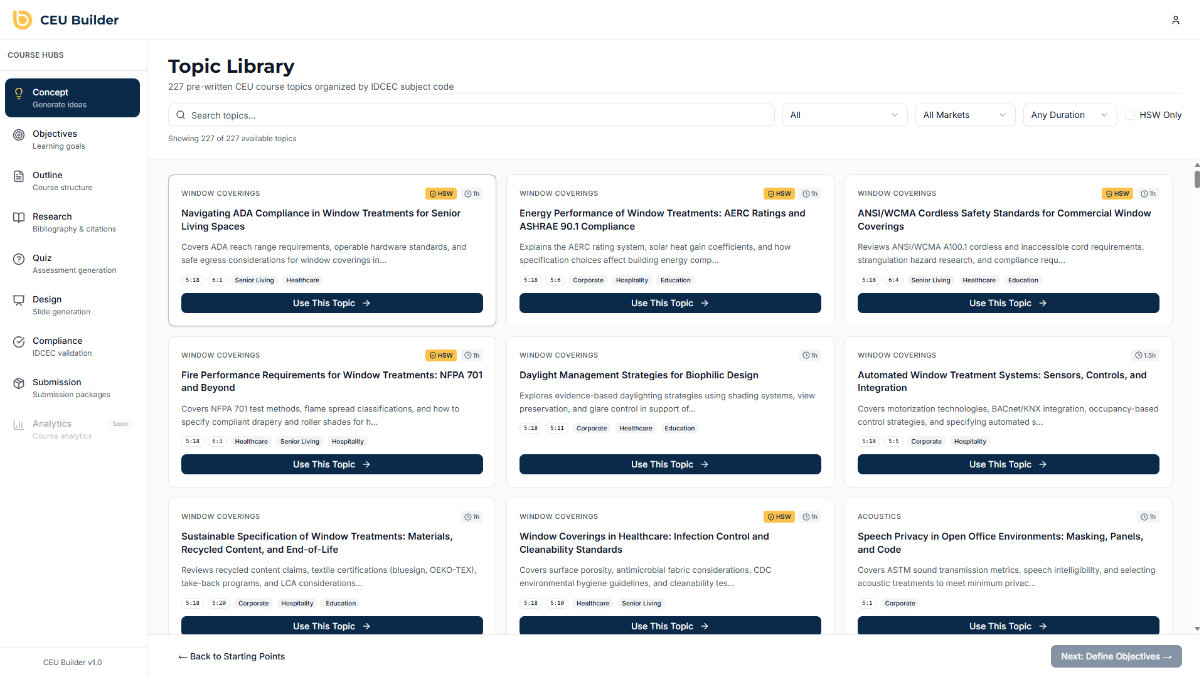
Ready to shorten your pathway to IDCEC approval and elevate your brand authority? Visit our Compliance & Accreditation page now and take the first step toward a successful CEU program built for demand generation and growth.
Frequently Asked Questions
What are the main benefits of direct accreditation for CEU courses?
Direct accreditation streamlines the approval process for CEU courses, reducing timelines and enhancing compliance. To capitalize on this, ensure you thoroughly understand the accreditation guidelines specific to your course offerings.
How can I expedite the accreditation process for my CEU courses?
You can expedite the accreditation process by preparing comprehensive documentation and aligning your course content with the required standards. Organize your materials beforehand to potentially cut approval times from months to just a few weeks.
What steps should I take to ensure compliance with IDCEC standards?
To ensure compliance, familiarize yourself with the IDCEC accreditation requirements and maintain comprehensive records of course development. Create a checklist that matches these requirements to improve your submission success rate.
How can engaging course content lead to higher specification rates?
Engaging course content can significantly influence specification rates because architects are more likely to consider products after completing courses that provide valuable insights. Focus on integrating real-world problem-solving scenarios to enhance engagement.
What actions can I take to improve my brand’s authority among architects through CEU courses?
To build brand authority, develop a consistent series of high-quality courses that showcase your expertise. Concentrate on creating educational materials that address real architectural challenges and demonstrate your knowledge of the industry.
How can data tracking improve the long-term value of my CEU program?
Implementing data tracking allows you to analyze course performance and architect engagement, turning your CEU program into a valuable business intelligence tool. Set up systems to monitor course completions and correlate them with specification trends to optimize future content.
Recommended
- 7 Essential Tips for CEU Accreditation Success
- Accreditation Management: Driving Successful CEU Programs
- CEU Approval Process: Ensuring Fast, Reliable Accreditation
- CEU Course Approval: How It Drives Specification
- Come si accreditano i corsi online: guida completa Italia – Recupero Anni Scolastici e Diploma Online
