

Course Content Compliance: Why Accreditation Matters

Finding clarity in compliance standards can feel daunting for Marketing Directors at hospitality furniture manufacturers aiming to develop CEU courses for North American architects. The credibility of your educational content hinges on meeting measurable requirements from respected bodies like IDCEC and the U.S. Department of Education. Understanding specific frameworks, such as the Professional Standards Framework, helps ensure your courses are legitimate and valuable. This guide explains how recognized standards drive trust among architects and increase your chances for specification requests.
Table of Contents
- Defining Course Content Compliance Standards
- Core Accreditation Requirements Explained
- IDCEC and Related Regulatory Bodies Overview
- Common Compliance Risks and Pitfalls to Avoid
- Ensuring Approval and Maximizing Impact
Key Takeaways
| Point | Details |
|---|---|
| Course Content Compliance | Ensuring your educational material meets specific standards builds credibility and trust among architects. |
| Accreditation Requirements | Understanding and meeting core accreditation requirements is essential for course approval and ensuring perceived educational value. |
| Documentation is Crucial | Detailed documentation throughout the development process is necessary to verify compliance and avoid costly revisions. |
| Continuous Improvement | Regularly updating your course based on feedback and industry changes enhances its impact and maintains accreditation standards. |
Defining Course Content Compliance Standards
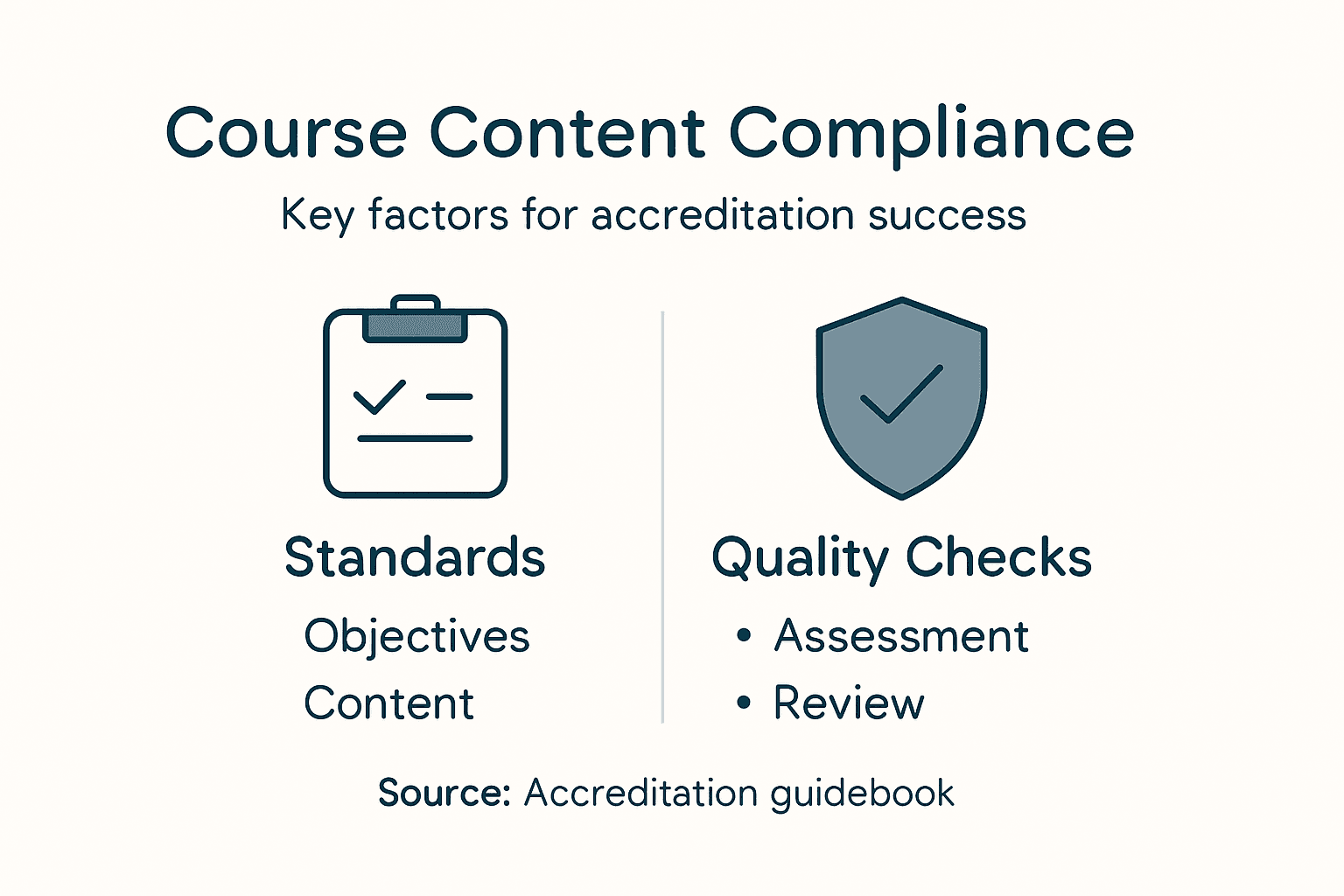
Course content compliance means your educational material meets specific, measurable standards before it reaches learners. For hospitality manufacturers offering continuing education, this isn’t just about ticking boxes—it’s about building credibility with architects who depend on accurate, professionally developed content.
Compliance standards define what makes a course legitimate and valuable. They cover everything from learning objectives to assessment quality to instructor qualifications. When your course meets these standards, architects trust it more. They’re more likely to complete it and more likely to specify your products afterward.
What Standards Actually Cover
Effective compliance standards address several core areas:
- Learning objectives that clearly state what participants will understand after completion
- Content accuracy verified against current industry knowledge and best practices
- Assessment methods that genuinely test whether learning happened
- Instructor expertise appropriate to the subject matter being taught
- Accessibility features enabling participation across diverse learner needs
- Documentation proving the course was delivered as described
These elements work together. A course with clear learning objectives but weak assessments won’t verify that architects actually learned anything. A course with expert instructors but inaccessible design excludes participants unnecessarily.
Industry Standards for Higher Education
Two major frameworks guide compliance standards in higher education and professional development. The Council for the Advancement of Standards provides functional area standards that institutions use for self-assessment and program effectiveness evaluation. These standards emphasize diversity, equity, and inclusion—principles that strengthen course design for broader architect audiences.
The Professional Standards Framework offers another comprehensive approach, covering professional values, core knowledge, and activity areas relevant to course delivery. This framework helps educators plan development and evidence their teaching quality, ensuring content meets defined compliance standards across different contexts.
Both frameworks recognize that compliance isn’t one-size-fits-all. Your hospitality course has different requirements than a construction safety course, which differs from a materials specification course. Standards must be specific enough to ensure quality but flexible enough to apply across varied subjects.
Why Manufacturers Should Care About Standards
When you build courses to recognized compliance standards, several things happen. Architects recognize the rigor and take the content more seriously. Your sales team can confidently reference the course’s educational legitimacy. Accreditation bodies view your submissions more favorably because the foundation is solid from the start.
Non-compliant courses often get rejected during accreditation review. That rejection wastes months and forces rebuilds from scratch. Building to standards the first time prevents that expensive failure.
Compliance standards aren’t restrictions—they’re the foundation that makes your educational investment valuable and marketable.
Pro tip: Document how your course meets each standard as you develop it, rather than trying to map compliance afterward. This catches gaps early and accelerates your accreditation review.
Core Accreditation Requirements Explained
Accreditation requirements exist to ensure courses meet consistent quality standards. For hospitality manufacturers, understanding these requirements isn’t academic—it directly affects whether your course gets approved and whether architects will trust it enough to complete it.
Core accreditation requirements vary by accrediting body, but they share common themes. They address what you teach, who teaches it, how you measure learning, and how you continuously improve. The goal is simple: verify that courses deliver legitimate educational value, not disguised marketing.

The Main Requirement Categories
Accreditation bodies focus on several core areas:
- Self-assessment documentation proving your course meets standards before external review
- Learning objectives clearly stating what participants will achieve
- Content accuracy verified against current industry practices and knowledge
- Assessment methods that genuinely test participant understanding
- Instructor qualifications demonstrating subject matter expertise
- Continuous improvement processes showing how you’ll enhance the course over time
Each requirement serves a purpose. Self-assessment forces you to think critically about your course before submitting. Clear learning objectives help architects understand what they’ll actually learn. Valid assessments ensure credits mean something.
Institutional Requirements
Accreditation in the United States involves both non-governmental entities and government agencies ensuring institutions meet quality standards. Core institutional requirements include documented evidence of governance, financial stability, and demonstrated student achievement against defined criteria.
For course-level accreditation, you’ll need to show institutional stability and credibility. This means basic business documentation: proof of registration, financial viability, and organizational structure. Accrediting bodies want assurance that your company exists, operates legitimately, and can deliver courses consistently.
Beyond institutional basics, peer review and external validation require qualified professionals to evaluate your content. This peer review process examines whether your learning objectives are realistic, your content is accurate, and your assessment actually measures what you claim to teach.
The Documentation Burden
Accreditation requires detailed documentation at every stage. You’ll need evidence that your learning objectives align with course content, that your content comes from credible sources, and that your assessments test the objectives you defined.
This documentation requirement frustrates many manufacturers. It feels bureaucratic. But the documentation serves your interests. It forces clarity about what your course actually teaches, preventing vague claims that won’t survive scrutiny.
Accreditation requirements aren’t obstacles—they’re documentation that your course delivers real value to practicing professionals.
What Changes With Accreditation Body
IDCEC (the accrediting body for hospitality continuing education) has specific requirements that differ from other accrediting bodies. They focus on learning objectives that meet professional standards, content that serves practicing architects and designers, and assessments that measure genuine competency.
Understanding your specific accreditor’s requirements is critical. Generic compliance efforts often miss the details that trigger rejections.
Pro tip: Review your accreditor’s submission guidelines line-by-line before developing content, then map each requirement to specific course elements. This prevents expensive revision cycles during review.
IDCEC and Related Regulatory Bodies Overview
IDCEC stands for the Interior Design Continuing Education Council. It’s the accrediting body that matters most for hospitality manufacturers offering courses to architects and interior designers. Understanding what IDCEC does—and how it differs from other regulatory bodies—is essential before you develop any course.
IDCEC isn’t the only regulatory body in continuing education, but it’s the one your architect audience respects most. When architects see an IDCEC-accredited course, they know the content has been vetted by professionals who understand their industry.
What IDCEC Actually Does
IDCEC accredits continuing education courses for interior designers and related professionals. The council sets standards for course content, verifies that learning objectives are realistic, and ensures assessments actually measure what instructors claim to teach.
IDCEC operates within a broader regulatory framework. The U.S. Department of Education recognizes specialized accrediting bodies like IDCEC to ensure they maintain reliability through regular reviews and compliance with federal standards.
This federal recognition matters because it gives IDCEC authority. When your course gets IDCEC approval, architects know it meets federal standards, not just one organization’s preferences.
The Broader Regulatory Ecosystem
IDCEC exists within a complex system of oversight. Different organizations play distinct roles:
- Regulators (like state licensing boards) enforce professional standards and protect public interest
- Standards developers create consensus-based quality benchmarks for education
- Accrediting bodies (like IDCEC) evaluate whether providers meet those standards through peer review
These three groups work together to ensure continuing education providers meet rigorous standards. IDCEC’s role is specifically to evaluate your course against quality standards and recommend whether architects should trust it.
Why IDCEC Matters for Manufacturers
Architects need continuing education credits annually. IDCEC accreditation signals that your course fulfills that requirement legitimately. Without IDCEC approval, architects can’t count your course toward their professional licensing requirements.
This creates powerful incentive alignment. You want architects to complete your course and specify your products. Architects want legitimate credits that satisfy their professional obligations. IDCEC accreditation makes that exchange possible.
Other Related Bodies
Other accrediting organizations serve different professional groups. AIA (American Institute of Architects) recognizes certain continuing education providers. HSW (Health, Safety, Welfare) is a specific category of IDCEC courses addressing public health and safety topics.
Your accreditation needs depend on your target audience. If you’re reaching interior designers, IDCEC is essential. If you’re reaching architects primarily, you may need AIA recognition too.
Here’s a comparison of major accrediting bodies relevant for hospitality course providers:
| Accrediting Body | Primary Audience | Focus Areas | Unique Requirement |
|---|---|---|---|
| IDCEC | Interior designers, architects | Content accuracy, assessment rigor | CE credit eligibility for designers |
| AIA | Licensed architects | Health, safety, welfare, ethics | Must support AIA learning units |
| HSW | Broad design professionals | Health, safety, welfare topics | Content must address public welfare |
IDCEC accreditation is the credential that tells architects your course is worth their time and meets professional standards.
Pro tip: Verify which accreditation your target audience actually requires before developing your course. Don’t assume IDCEC is enough without confirming your specific architect audience needs it.
Common Compliance Risks and Pitfalls to Avoid
Most course rejections don’t happen because manufacturers lack good intentions. They happen because courses violate specific compliance requirements that accreditors watch closely. Understanding these pitfalls before development saves months of revision and frustration.
Compliance failures are preventable. They follow predictable patterns that experienced course developers recognize early. Catch these issues during development, and your accreditation review becomes routine.
Vague Learning Objectives
Vague learning objectives top the list of compliance rejections. Many manufacturers write objectives like “participants will understand acoustic performance” or “learn about sustainability.” These are too broad and unmeasurable.
IDCEC demands specific, measurable objectives. Examples: “participants will identify three acoustic materials appropriate for hospitality environments and explain their performance ratings.” This objective is specific enough that you can write an exam question testing whether architects actually learned it.
Vague objectives make assessment impossible. Architects complete your course but can’t demonstrate competency. Accreditors see this as failing to deliver legitimate education.
Failing to Verify Content Accuracy
Your course must reflect current industry knowledge and best practices. If you cite outdated standards, reference non-existent products, or make unsubstantiated claims, accreditors will catch it.
Many common accreditation risks include failure to demonstrate institutional quality and educational effectiveness. Manufacturers sometimes cut corners by using old content or untested claims because it’s faster and cheaper.
This backfires. Accreditors require current bibliographies, verifiable sources, and content reviewed by subject matter experts. Using outdated or unverified information triggers rejection requests.
Weak Assessment Design
Your exam questions must actually test the learning objectives you defined. Many manufacturers write questions that are too easy, too vague, or don’t connect to content.
Weak assessments signal that you don’t care whether architects actually learned anything. Accreditors view this as compromising educational integrity.
Inadequate Documentation
You must document everything: where content comes from, how you verified accuracy, who reviewed it, and how assessment connects to objectives. Many manufacturers skip this documentation to save time.
Accreditors require integrated risk management approaches that include thorough documentation. Missing documentation looks like you’re hiding something.
Common Pitfalls to Prevent
Avoid these specific mistakes:
- Assuming your product knowledge counts as educational authority without external sources
- Writing learning objectives from your perspective rather than learner perspective
- Creating exam questions that test reading comprehension rather than competency
- Failing to cite every claim in your content bibliography
- Skipping the review process because you’re confident in your content
- Not matching assessment difficulty to learning objective complexity
Compliance failures aren’t about rules—they’re about proving your course delivers genuine education, not disguised marketing.
Pro tip: Have someone unfamiliar with your product review your learning objectives and exam questions. If they can’t understand what architects should learn or answer questions without your product knowledge, your accreditor won’t approve them.
Key compliance risks and their business impact are summarized below:
| Risk Area | Example Consequence | Business Impact |
|---|---|---|
| Vague objectives | Course rejection | Delayed product promotion |
| Outdated content | Fails peer review | Damaged credibility |
| Weak assessment design | Non-approval | Lost accreditation fees |
| Poor documentation | Lengthy revision cycles | Increased staff costs |
Ensuring Approval and Maximizing Impact
Getting your course approved is only half the battle. The real value comes from designing the course so it delivers outcomes that matter: architect completions, specification requests, and sustained business impact.
Approval and impact aren’t separate goals. They’re connected. Courses designed with impact in mind actually sail through accreditation more smoothly because they meet compliance standards naturally while solving real architect problems.
Build for Approval From the Start
The path to approval begins before you write your first slide. You need rigorous preparation, transparent documentation, and continuous self-assessment throughout development.
Many manufacturers treat compliance as an afterthought. They build the course, then scramble to document it for accreditation. This backwards approach creates friction and delays.
Instead, build compliance into every development decision. Define learning objectives first. Choose content that directly supports those objectives. Design assessments that measure them. Document sources as you go. This way, when you submit for accreditation, you’re simply formalizing work you’ve already done.
Focus on Learning Outcomes That Matter
Your course shouldn’t teach architects about your products. It should teach architects how to solve design problems—and then show how your products solve those problems.
This distinction matters tremendously for approval. Accreditors reject courses that exist mainly to promote products. They approve courses that educate professionals about topics they need to understand.
When your learning objectives address genuine professional challenges, you create approval-worthy content that also drives specifications. Architects complete the course because they learned something valuable. Then they specify your products because your course demonstrated expertise.
Leverage Continuous Improvement
Maximizing accreditation impact involves continuous improvement practices that go beyond initial approval. Track completion data. Monitor which sections architects find most valuable. Watch which learning objectives generate the highest assessment scores.
Use this data to strengthen your course over time. Update content when industry standards change. Refine assessments based on what architects struggle with. Expand sections that generate the most engagement.
This continuous improvement approach keeps your course current and impactful. It also demonstrates to accreditors that you’re committed to quality beyond initial submission.
Measure Real Business Impact
Approval metrics (first-pass accreditation, fast timelines) matter. But business metrics matter more. Track what happens after architects complete your course.
Measure these outcomes:
- Completion rates across different architect segments
- Time-to-specification from course completion to project specification
- Specification volume from architects who took the course
- Sales conversation quality referencing course content
- Competitive win rates in projects where architects took the course
These metrics show whether your course investment generates real returns. They guide decisions about which topics to develop next.
Approval is the credential. Impact is the revenue. Design for both simultaneously.
Create a Sustainable Process
One course is nice. A portfolio of courses is powerful. Design your first course with portfolio growth in mind. Use consistent templates, similar assessment approaches, and aligned learning objective structures.
This consistency accelerates future course development. Your second course takes half the time of your first. Your third takes half that. By course five, development time becomes negligible.
Pro tip: Submit your first course for IDCEC approval while simultaneously planning your second and third courses. This keeps your pipeline full and maintains momentum with your architect audience.
Accelerate Your Course Content Compliance and Accreditation Success
Navigating the complex world of course content compliance and accreditation can feel overwhelming. The article highlights common challenges like vague learning objectives, weak assessment design, and documentation burdens that cause costly delays and accreditation failures. If your hospitality manufacturing team struggles with these compliance hurdles or wants to confidently meet IDCEC requirements without months of risk and revision, help is available.
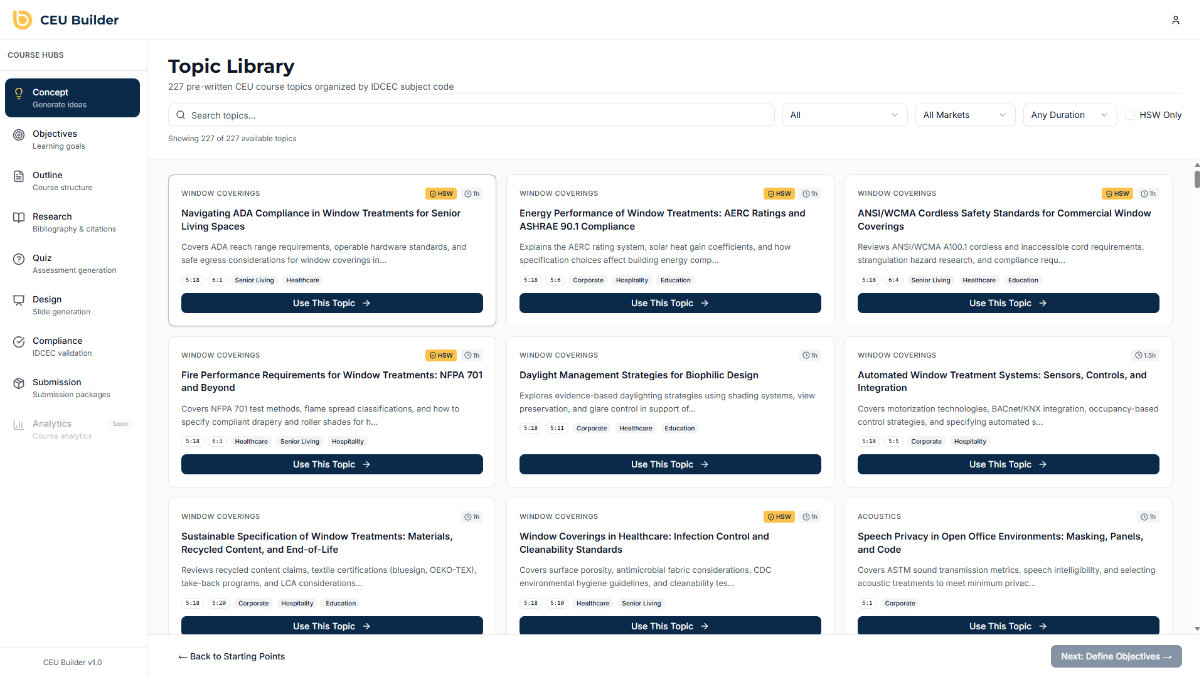
CEU Builder specializes in transforming these compliance challenges into a smooth 4-6 week process with a 100% first-pass approval rate. Our approach ensures your courses meet IDCEC standards from the start by reverse-engineering accreditation criteria, crafting precise learning objectives, and building rigorous assessments that truly measure architect learning. Whether you prefer a fully done-for-you course build or a platform with AI-powered compliance tools for internal teams, CEU Builder empowers you to deliver accredited courses that architects trust and complete.
Ready to shift course content compliance from a barrier to a competitive advantage? Visit CEU Builder to explore our Done-For-You Service and Platform + AI + Training options designed specifically for hospitality manufacturers facing accreditation challenges.
Create courses that not only pass accreditation but open doors to specification opportunities and sustained business impact.
Act now and accelerate your continuing education strategy with a trusted partner who makes accreditation approval predictable and fast.
Frequently Asked Questions
What is course content compliance?
Course content compliance refers to the adherence of educational material to specific, measurable standards, ensuring the quality and legitimacy of the course before it reaches learners.
Why is accreditation important for continuing education courses?
Accreditation is crucial as it verifies that the courses meet established quality standards, builds credibility with professionals, and ensures that participants receive legitimate educational value that counts toward their qualifications.
What are the common pitfalls in course compliance that can lead to accreditation rejection?
Common pitfalls include vague learning objectives, outdated content, weak assessment design, and inadequate documentation, all of which can compromise the perceived value of the course and lead to rejection by accreditation bodies.
How can manufacturers ensure their courses meet compliance standards?
Manufacturers can ensure compliance by clearly defining learning objectives, using accurate and current content, designing valid assessments, continuously improving based on feedback, and maintaining comprehensive documentation throughout the development process.
Recommended
