

CEU Registration: Unlocking Specification Influence

Building product manufacturers in the hospitality sector often face confusion around what actually turns an educational course into a trusted credential for American architects and designers. This matters because only documented and verified continuing education can influence specification decisions and build industry credibility. By mastering the core principles of CEU registration—including official record-keeping and accreditation standards—manufacturers gain a direct pathway to lasting recognition among top North American design professionals.
Table of Contents
- Defining CEU Registration And Core Concepts
- Types Of CEU Providers And Distinctions
- CEU Registration Process And Key Requirements
- Accreditation Standards And Compliance Challenges
- Strategic Benefits, Risks, And Common Pitfalls
Key Takeaways
| Point | Details |
|---|---|
| Importance of CEU Registration | CEU registration is essential for validating and documenting continuing education for design professionals, transforming courses into recognized credentials. |
| Accredited Providers Matter | Choosing accredited providers ensures that your course credits are recognized nationwide, enhancing trust and credibility with architects. |
| Core Registration Steps | The CEU registration process includes documentation, verification, assessment, and awarding credits, which must be meticulously followed for successful accreditation. |
| Strategic Benefits and Risks | Proper CEU registration can lead to lead generation and enhanced authority, while mistakes can result in lost opportunities and failed accreditation efforts. |
Defining CEU Registration and Core Concepts
CEU registration is fundamentally about documenting and verifying that design professionals have completed structured continuing education. It’s the administrative backbone that turns course participation into recognized credentials.
At its core, CEU registration serves a critical function: it creates an official record that someone completed a specific educational program. Without registration, there’s no proof of completion. Without proof, there’s no credential.
The Continuing Education Unit (CEU) is the standardized measure used across the architecture and design professions. The CEU represents ten contact hours of structured participation in organized continuing education programs. This standardization matters because it ensures consistency across industries and jurisdictions.
Think of it this way: architects need to prove they’ve maintained their knowledge to keep their licenses valid. A CEU provides that proof in a universally recognized format.
How CEU Registration Works
CEU registration involves three distinct functions:
- Verification: Confirming that a participant actually completed the course
- Documentation: Creating an official record with dates, hours, and course title
- Credentialing: Awarding the CEU credit toward professional licensing requirements
When an architect takes your course, CEU registration documents the hours systematically, providing a credible way to quantify their professional development. This documentation becomes part of their continuing education transcript.
For hospitality manufacturers, this process matters because it legitimizes your educational content. An IDCEC-accredited course with proper registration carries weight with design professionals. They trust the credential.

Registration also creates valuable data for your business. You capture names, contact information, course topics, and completion dates. This intelligence feeds your lead generation strategy and helps you understand which architects engaged with which content.
Core Concepts Every Manufacturer Should Know
IDCEC accreditation is the key credential that enables CEU registration. Without IDCEC approval, your course generates no CEUs and carries minimal influence with architects.
Contact hours directly translate to CEU value. A 45-minute course equals 0.75 CEUs. A 90-minute course equals 1.5 CEUs. Architects think in terms of credit hours needed to maintain licensure, so understanding this conversion is essential.
Learning objectives must be specific and measurable. IDCEC requires that participants can demonstrate they learned what your course promised to teach. Vague objectives fail accreditation review.
Compliance documentation includes speaker credentials, bibliography, learning objectives, and exam questions. Every element gets evaluated during registration.
The registration process itself varies based on your provider status. IDCEC-registered providers can submit courses directly. Non-registered providers must work through an intermediary.
Proper CEU registration transforms your course from educational content into a credential that architects need. Without it, you have training material. With it, you have influence.
Pro tip: Plan your course topic around what architects actively search for and need to learn, not what you wish they knew. CEU registration requires that learning objectives align with documented architect demand, making research critical before development begins.
Types of CEU Providers and Distinctions
Not all CEU providers are created equal. The provider you choose determines whether your course gets recognized by architects nationwide or sits in a filing cabinet gathering dust.
The fundamental distinction splits providers into two categories: accredited and unaccredited. Accredited providers meet rigorous standards for course quality, instructor qualifications, and administrative processes. Unaccredited providers have no oversight, and their CEUs carry minimal weight.
For hospitality manufacturers, this distinction matters enormously. An architect won’t travel to your trade show or take your course if the CEU credit isn’t recognized. You need an accredited provider, period.
The Main Provider Types
Accredited organizations include professional associations, educational institutions, and corporate training programs that have undergone formal accreditation review. These providers meet stringent standards ensuring their CEUs transfer across state lines and professional contexts.
State-approved programs operate under regional regulatory frameworks. They may be accredited or have state-specific approval that limits recognition outside their jurisdiction. A course approved in California might not be recognized in New York.
University-level providers typically hold institutional accreditation but may not have specialized CEU accreditation. Their courses exist within academic structures rather than professional continuing education contexts.
To clarify the main types of CEU providers, here is a side-by-side comparison of their key characteristics:
| Provider Type | Recognition Scope | Typical Cost | CEU Portability |
|---|---|---|---|
| Accredited Provider | National, Professional | Higher | Recognized nationwide |
| State-Approved Program | Regional, Variable | Moderate | Limited to specific states |
| Unaccredited Provider | None | Low | Not accepted by licensing bodies |
IDCEC specifically is the accreditation body for architects, interior designers, and related design professionals. IDCEC-accredited providers must adhere to stringent standards for course content, learning objectives, and assessment mechanisms.
Why Provider Type Determines Your Success
Manufacturers working with unaccredited providers create courses that generate zero business impact. Architects see no value because the credits don’t count toward their licensing requirements.
Accredited providers solve this problem. They’ve already navigated complex compliance requirements. They understand what architects need. They’ve built relationships with regulatory bodies.
The provider type also affects your timeline and cost. Unaccredited providers might build your course quickly but cheaply. It won’t get approved. Accredited providers take longer but guarantee results.
Consider these distinctions:
- Accredited providers: Higher cost, longer timelines, guaranteed recognition, nationwide portability
- State-approved programs: Variable cost, moderate timelines, regional recognition only
- Unaccredited providers: Low cost, fast timelines, zero recognition, wasted investment
Your course is only valuable if architects trust the credential behind it. Provider accreditation is everything.
What Accreditation Actually Means
Accreditation isn’t just a badge. It represents a commitment to standards. Accredited providers undergo regular audits. They document everything. They maintain compliance year-round.
When you partner with an accredited provider, you’re borrowing their institutional credibility. Your course benefits from their reputation and their compliance infrastructure.
This matters because architects research providers before taking courses. They want assurance the credits will actually count. Accreditation provides that assurance.
The cost difference between accredited and unaccredited providers typically ranges from 20-40% higher for accreditation. That premium pays for compliance, auditing, and recognized institutional credibility.
Pro tip: Verify that any CEU provider you consider actually maintains current accreditation status through IACET or IDCEC rather than relying on past credentials. Accreditation requires annual renewal, and lapsed status means your course won’t be recognized.
CEU Registration Process and Key Requirements
The registration process is where your course transforms from educational content into a recognized credential. Skip this step or handle it incorrectly, and architects won’t receive credit for completing your program.
Think of registration as the official stamp that makes everything count. It’s the difference between a learning experience and a credential that matters.
The Core Registration Steps
CEU registration begins with documentation. You must capture participant information, attendance hours, and course completion dates. This data forms the foundation of everything that follows.
Next comes verification. Your provider confirms that participants actually completed the course requirements. This might involve exam scores, attendance logs, or evaluation submissions.
Then assessment happens. Participants complete course evaluations and demonstrate they learned the material through exams or other assessment mechanisms.
Finally comes awarding. The provider officially issues CEUs and maintains permanent records. This is when architects can claim credit toward their licensing requirements.
Key Requirements for Successful Registration
Continuing education registration requires submitting proof of participation and completing evaluations through official provider portals. Accurate documentation matters enormously because IDCEC auditors review these records annually.
Your provider must maintain comprehensive records that comply with ANSI/IACET standards. This includes:
- Participant names and contact information
- Attendance documentation with specific dates and hours
- Completed evaluation forms from all participants
- Exam results showing participant comprehension
- Learning objective verification demonstrating participants met stated goals
- Speaker credentials confirming instructor qualifications
Accuracy is non-negotiable. A single error can trigger audit flags. Missing documentation can result in denied CEU credits and damaged credibility.
What Happens During Registration
When participants complete your course, they submit registration information through your provider’s system. The provider verifies they attended or completed the course based on your records.
Architects then receive certificates documenting their CEU credits. They can upload these certificates to their professional licensing portal to satisfy continuing education requirements.
Your provider maintains these records permanently. This creates an audit trail proving that credits were properly awarded and that your course met accreditation standards.
Why Registration Requirements Exist
These requirements protect architects. They ensure that CEU credits actually represent meaningful learning rather than rubber-stamp credentials. They verify that courses meet quality standards.
They also protect your manufacturer brand. When you register courses properly, you demonstrate commitment to quality and professionalism. Architects trust manufacturers who take registration seriously.
Proper registration transforms a course from marketing content into an industry credential. The details matter because architects verify that credits count before investing their time.
Common Registration Mistakes
Manufacturers often stumble when they:
- Fail to capture complete participant information
- Don’t document attendance accurately
- Skip evaluation collection
- Delay submission past accreditation deadlines
- Assume the provider handles everything without coordination
Each mistake delays credit issuance and frustrates architects who completed your course but can’t claim credit.
Pro tip: Establish a registration checklist before your course launches so you capture required data from day one rather than scrambling to collect missing information after completion.
Accreditation Standards and Compliance Challenges
Accreditation standards exist for a reason: they ensure that CEU courses actually deliver quality education rather than serving as marketing vehicles. But meeting those standards consistently is where manufacturers struggle.
The challenge isn’t understanding the standards themselves. It’s implementing them across your organization while maintaining course quality and business impact.
What Accreditation Standards Actually Require
IDCEC accreditation standards validate course quality through rigorous external review processes. These standards cover learning objectives, instructor qualifications, course content, assessment mechanisms, and documentation practices.
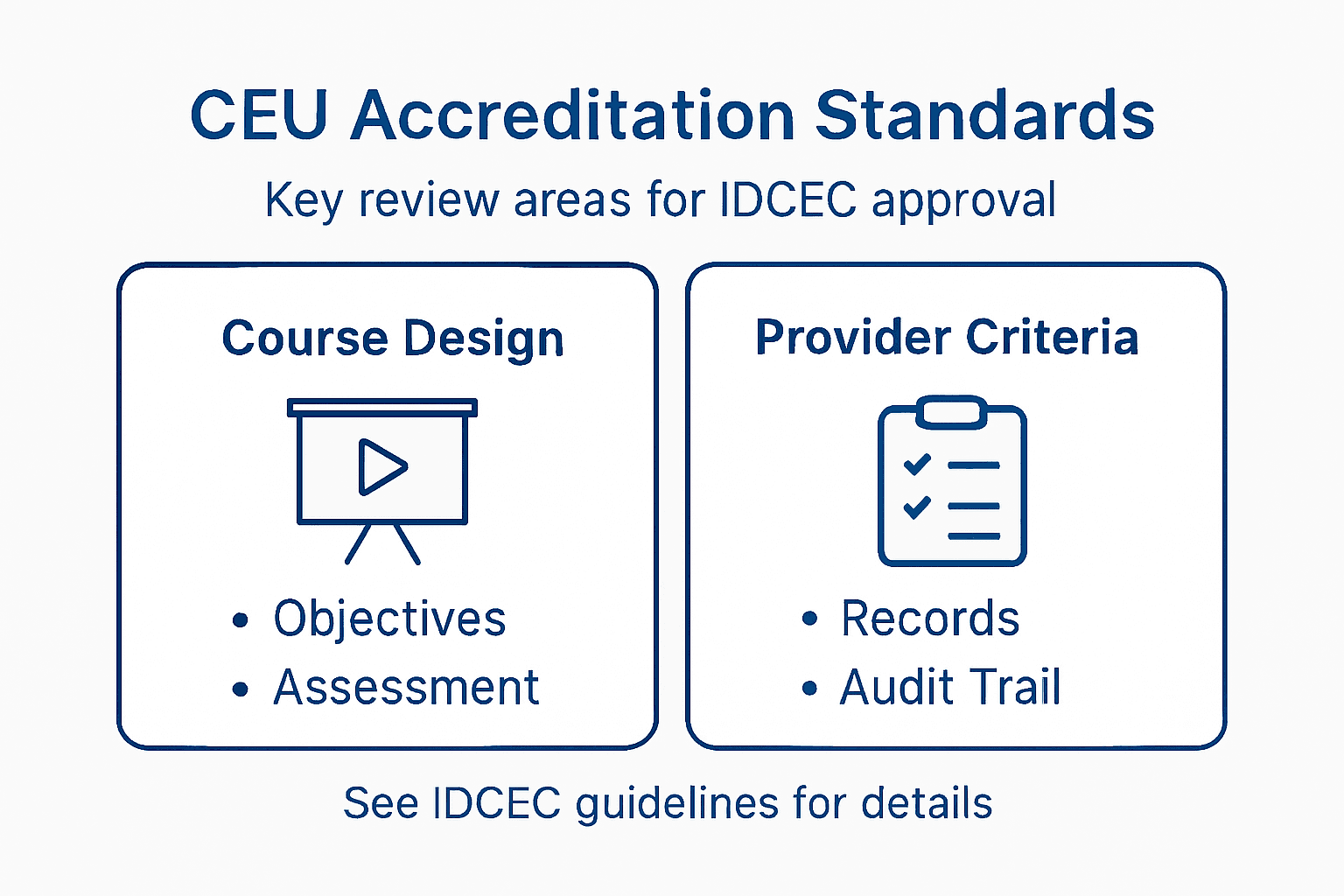
Think of standards as a checklist that ensures consistency. When an architect takes an IDCEC course from any provider, they know it meets the same quality threshold.
For manufacturers, this means your course must demonstrate:
- Clear, measurable learning objectives aligned with architect needs
- Qualified speakers with relevant industry expertise
- Content that teaches, not sells
- Assessment methods proving participants learned the material
- Complete documentation supporting every claim
Missing any element triggers rejection during accreditation review.
The Compliance Challenges Manufacturers Face
Institutions face significant accreditation hurdles including lack of clarity on standards, insufficient training, and inadequate record-keeping. For manufacturers new to continuing education, these challenges compound.
You’re operating in unfamiliar territory. IDCEC jargon feels foreign. Compliance requirements seem excessive. Your internal team lacks experience with accreditation processes.
Common compliance mistakes include:
- Creating learning objectives that sound good but lack specificity
- Hiring speakers with product knowledge but no teaching experience
- Designing content that focuses on product benefits rather than design challenges
- Skipping or incomplete documentation of course materials
- Failing to create rigorous assessment mechanisms
Each mistake delays approval and requires costly rebuilds.
Understanding Evolving Standards
Accreditation standards evolve. IDCEC updates requirements regularly based on profession changes and feedback. Staying current requires ongoing attention.
Many manufacturers build a course, get it approved, then assume it’s set forever. Reality is different. Standards change. Your course may need updates to maintain compliance.
This creates resource allocation challenges. Maintaining compliance requires dedicated attention, not occasional focus.
Documentation and Record-Keeping Complexities
Compliance challenges include documentation complexities and maintaining continuous improvement to meet accreditation criteria. Accreditors want evidence of everything.
You need documented learning objectives, speaker credentials, course outlines, bibliography sources, exam questions with answer keys, evaluation forms, and completion records. Missing documentation means audit flags.
This complexity discourages many manufacturers from pursuing CEU development. The administrative burden feels excessive compared to traditional marketing.
Accreditation standards protect architects and legitimize your course. They’re not bureaucratic obstacles. They’re evidence that your educational content actually delivers value.
Overcoming Compliance Challenges
Institutions overcome accreditation challenges through comprehensive education, organizational commitment, and proactive process management. For manufacturers, this means:
- Investing time upfront to understand requirements thoroughly
- Hiring experienced partners who navigate IDCEC requirements daily
- Building documentation into your process from the start
- Allocating dedicated resources for ongoing compliance
Doing this yourself is possible. It’s also time-consuming and risky. Partner providers have built systematic approaches that reduce mistakes and accelerate approval.
Pro tip: Before investing in course development, request samples of previously approved courses from your provider. Reviewing accredited examples reveals exactly how standards translate into practical requirements for learning objectives, assessments, and documentation.
Strategic Benefits, Risks, and Common Pitfalls
CEU registration isn’t just an administrative task. It’s a strategic decision with real consequences for your business. Get it right and you unlock specification influence. Get it wrong and you’ve wasted resources with nothing to show.
Understanding the full picture—benefits, risks, and pitfalls—helps you make informed decisions about whether and how to pursue continuing education.
The Strategic Benefits
When executed properly, CEU registration delivers measurable business outcomes. You position your manufacturer as an industry expert rather than just another vendor competing on price.
Architects remember manufacturers who taught them something valuable. When they’re selecting products months later, that educational relationship creates preference. Preference drives specification.
Strategic benefits include:
- Direct lead generation from architects who completed your course
- Credibility and authority positioning in your market
- Extended engagement windows replacing brief sales calls
- Data revealing which architects care about which topics
- Competitive differentiation from manufacturers ignoring education
- Lifetime asset generating completions and specifications indefinitely
The ROI compounds over time. A course built in 2025 continues generating value in 2026, 2027, and beyond. Compare that to trade show booths that deliver value only during the event.
The Real Risks You Face
Strategic planning risks include misalignment with stakeholder needs, inadequate implementation, and failure to update strategies. For manufacturers pursuing CEU registration, these risks translate into specific challenges.
You might create a course that architects don’t actually want. You might build something so product-focused that it violates IDCEC standards. You might invest $10,000 only to have your course rejected for accreditation.
These aren’t theoretical risks. They happen regularly.
This table summarizes major benefits and risks of CEU registration for manufacturers:
| Strategic Benefit | How It Helps Business | Risk If Ignored |
|---|---|---|
| Lead Generation | Direct contact with architects | Lost opportunity, fewer leads |
| Enhanced Credibility | Builds industry authority | Perceived as less professional |
| Ongoing Market Influence | Sustained engagement | Course quickly becomes obsolete |
| Compliance with Licensing | Architects can use CEUs | Courses not considered valid |
Common Pitfalls Manufacturers Hit
Common pitfalls in strategy realization include lack of stakeholder engagement, overloading plans with too many initiatives, and neglecting capacity constraints. For CEU registration, this manifests as:
Topic Misalignment: Choosing course topics based on what you want architects to learn rather than what they actually need. Result: Low enrollment and minimal engagement.
Content That Sells: Creating courses that subtly or obviously pitch your products. IDCEC reviewers catch this instantly and reject the course. You’ve invested time and money in content you can’t use.
Underestimating Complexity: Assuming CEU development is simple or delegating to team members without relevant experience. You end up with courses that don’t meet accreditation standards.
One-and-Done Thinking: Building a single course, launching it, then assuming the work is complete. Effective CEU strategy requires ongoing development, updates, and measurement.
Insufficient Planning: Jumping into course development without understanding your market, your goals, or your resources. This leads to projects that consume time without delivering results.
How to Navigate These Successfully
Successful manufacturers approach CEU registration strategically. They research what architects actually search for and need. They invest in quality content designed to teach, not sell. They measure outcomes and adjust based on results.
They also recognize that CEU development isn’t their core competency. They partner with providers experienced in IDCEC accreditation and hospitality market dynamics.
Strategic CEU registration creates sustainable competitive advantage. Rushed, poorly planned programs waste resources without delivering results. The difference lies in intentional strategy and experienced execution.
Intentional strategy means defining clear goals upfront. Are you pursuing specification influence? Lead generation? Market authority? Your answer shapes everything that follows.
Experienced execution means partnering with providers who understand both IDCEC requirements and hospitality manufacturing dynamics. They help you avoid pitfalls that waste time and money.
Pro tip: Start with a single high-quality course aligned with architect search behavior rather than launching multiple mediocre courses. Prove your concept, measure outcomes, then scale with confidence based on demonstrated results.
Turn CEU Registration Challenges into Lasting Specification Influence
Navigating the complex CEU registration process is a critical challenge for hospitality manufacturers who want to build credibility and drive product specifications. This article highlights key pain points such as accreditation hurdles, compliance documentation, and aligning course content with architect needs. At CEU Builder, we understand these obstacles and transform continuing education from a compliance burden into a powerful demand generation engine that positions your brand as an industry authority.
With our proven approach, including a 100 percent first-pass IDCEC accreditation rate and strategic course design focused on architect search behavior, you can avoid costly delays and engage architects effectively. Whether you choose our comprehensive done-for-you service or leverage our platform tools, we provide everything needed to accelerate CEU registration and maximize your specification influence.
Ready to move beyond compliance theater and build educational assets that generate measurable results? Explore our expert insights and solutions at General – CEU Builder and discover how data drives strategy at Data & Analytics in CEUs – CEU Builder.

Start unlocking the true value of CEU registration today with CEU Builder. Visit https://ceubuilder.net/ to learn more and take the first step toward transforming your continuing education strategy.
Frequently Asked Questions
What is CEU registration?
CEU registration involves documenting and verifying that design professionals have completed structured continuing education, creating an official record of their educational accomplishments and providing credentials that can be used toward professional licensing requirements.
Why is IDCEC accreditation important for CEU registration?
IDCEC accreditation ensures that the courses meet rigorous standards for quality and are recognized by architects and design professionals for continuing education credits, making them valid for maintaining licensure.
What are the core components of the CEU registration process?
The core components include verification of course completion, documentation of attendance and course details, assessment of learning through evaluations, and finally, awarding CEU credits to the participants.
How can CEU registration benefit manufacturers?
CEU registration can enhance a manufacturer’s credibility, generate leads from architects, extend their market influence, and provide a long-term asset for ongoing marketing efforts and engagement with design professionals.
Recommended
- Manufacturers Are Ditching Attendance Metrics – CEU Builder
- IDCEC vs AIA Credits: Which CEU Path Drives More Specs for Manufacturers? – CEU Builder
- CEU Course Approval: How It Drives Specification
- Turn Neuro-Inclusive Design CEUs Into Specifications in 5 Steps – CEU Builder
- How to Design Event Signage for Maximum Impact –
- Aluminium Kozijn Certificeringen: Complete Gids Nederland & België
