

Why Continuing Education Matters for Manufacturers

Finding ways to stand out with architects can feel frustrating when every manufacturer is competing for attention. For Marketing Directors at North American hospitality furniture companies, meaningful engagement is more important than ever for building lasting specification preference. Continuing education offers a proven path, but only when programs are credible, relevant, and structured for real impact on decisions, not just compliance. Discover how a strategic approach to CEU implementation sets your brand apart and delivers results you can track.
Table of Contents
- Continuing Education Defined And Common Myths
- Types Of Continuing Education Programs In Hospitality
- Key Requirements And Accreditation Standards
- Business Impact Of Education On Product Specification
- Risks, Pitfalls, And ROI Calculations For Manufacturers
Key Takeaways
| Point | Details |
|---|---|
| Importance of Continuing Education | Continuing education is essential for professionals as it helps meet licensing requirements while providing measurable, accredited learning outcomes. |
| Accreditation Matters | Courses must be IDCEC-approved to be valuable to architects, ensuring they meet specific accreditation standards. |
| Investment in Quality | Developing effective continuing education requires proper research, instructional design, and an understanding of architects’ needs to avoid costly pitfalls. |
| Measurable Outcomes | Tracking completion rates and subsequent specifications is crucial for measuring the return on investment and ensuring strategic alignment with product goals. |
Continuing Education Defined and Common Myths
Continuing education encompasses formal learning opportunities like workshops, online courses, professional certificates, and specialized training designed for adults who have already completed their initial education. For manufacturers, this means structured programs that go far beyond compliance boxes checked once yearly.
The definition matters because it shapes how you invest. Continuing education isn’t passive consumption of content. It’s purposeful, accredited learning with measurable outcomes and recognized credentials.
What Continuing Education Actually Includes
Continuing education takes many forms beyond what most manufacturers assume:
- Online courses with formal instruction and assessments
- Live workshops and seminars at industry conferences
- Professional certificates from accredited institutions
- Specialized training programs addressing specific skill gaps
- Degree courses for advanced professional development
- Institutional courses delivered through university extensions
For your target audience of architects and designers, continuing education must meet rigorous accreditation standards to count toward their professional licensing requirements. That’s why IDCEC approval matters so much—it’s the credential that makes courses valuable to your prospects.
Five Common Myths About Continuing Education
Myth 1: It’s Just a Checkbox Requirement
Architects do pursue continuing education because licensing boards require it. But they seek meaningful education, not filler. They remember manufacturers who taught them something applicable to real projects. That distinction separates courses that generate business outcomes from courses that get completed and forgotten.
Myth 2: Credentials From Continuing Education Don’t Matter
This misses the mark entirely. Architects actively verify course accreditation before enrolling. They trust IDCEC-approved content because the accrediting body ensures quality standards. A course without proper accreditation gets ignored regardless of topic quality.
Myth 3: Creating Continuing Education is Quick and Easy
Many manufacturers underestimate the effort required. Proper instructional design, compliance with accreditation standards, and professional delivery require expertise most marketing teams lack. Rushing the process usually results in rejected accreditation applications and months of delays.
Myth 4: Your Product Information Works as Course Content
Product brochures and specification sheets aren’t continuing education. Architects need courses that teach concepts, applications, and decision-making criteria relevant to their work. Product mentions should support learning objectives, not become the learning objectives themselves.
Myth 5: You Need Expensive Specialized Staff
You don’t need to hire full-time instructional designers. Specialized providers handle the technical accreditation requirements while you focus on strategy and product expertise. This approach gets courses to market faster and more reliably than building internal capacity from scratch.
Continuing education succeeds when architects complete courses because they learned something valuable, not because they needed credits.
Pro tip: Start by identifying what architects actually search for and need to know about your product category, then build continuing education around those topics rather than forcing your product information into educational formats.
Types of Continuing Education Programs in Hospitality
Hospitality manufacturers have multiple continuing education formats to choose from when building architect engagement strategies. Each format serves different learning preferences and business objectives. Understanding these options helps you select the right programs for your target audience.
Architects and designers need education that fits their schedules and learning styles. Some prefer intensive workshops, while others want self-paced online courses they can complete between projects. The strongest educational strategies combine multiple formats to reach the widest audience.
Core Continuing Education Formats
Hospitality continuing education typically takes these forms:
- Live workshops and seminars at industry conferences or in-person events
- Online courses with self-paced learning and flexible completion timelines
- Professional certificates in specialized hospitality design topics
- Webinars and virtual presentations delivered synchronously with recording access
- Specialized training programs addressing specific skill gaps in hospitality design
- Degree programs or advanced credentials for career advancement
Your target audience values workforce development programs that teach practical skills applicable to real projects. This means programs focusing on process optimization, specification criteria, and design decision-making rather than generic industry overviews.
Program Focus Areas for Hospitality
Continuing education in hospitality manufacturing typically centers on these competencies:
- Material selection and durability standards for high-traffic environments
- Acoustic performance and noise control in hotel and restaurant spaces
- Compliance with hospitality-specific building codes and safety regulations
- Sustainable design practices and environmental certifications
- Cost-effective specification strategies for large projects
- Integration of furniture and fixtures into complex hospitality layouts
Architects search for manufacturing skill development that teaches them how to specify products correctly. They need to understand what makes materials suitable for hospitality applications, how to evaluate quality standards, and what technical specifications matter most for their projects.
Live Versus Self-Paced Programming
Live programs create engagement and immediate interaction. Architects can ask questions, see demonstrations, and build relationships with product experts. However, they require scheduling coordination and limit reach to attendees in specific locations or time zones.
Self-paced online courses offer flexibility. Architects complete them whenever convenient, often during slower project periods. This format reaches broader audiences but requires exceptional instructional design to maintain engagement without live interaction.

The most effective strategies use both. Live workshops generate excitement and specification requests immediately, while online courses provide evergreen lead generation between events.
Here is a comparison of live versus self-paced continuing education for architects and designers:
| Factor | Live Workshops | Self-Paced Online Courses |
|---|---|---|
| Flexibility | Fixed schedule | Complete anytime |
| Audience Reach | Limited by location/time | Global and scalable |
| Engagement Level | Direct interaction | Requires strong course design |
| Follow-up Potential | Immediate connections | Ongoing, data-driven marketing |
| Cost to Manufacturer | Event/travel costs | Higher setup, low delivery cost |
Professional continuing education succeeds when architects remember what they learned six months later when facing actual specification decisions.
Pro tip: Start with one live workshop at a major hospitality conference to test your topic and messaging, then convert that successful program into a self-paced online course for ongoing reach.
Key Requirements and Accreditation Standards
Accreditation isn’t bureaucratic overhead. It’s the credential that makes your continuing education valuable to architects and designers. Without proper accreditation, your course gets ignored regardless of content quality.
IDCEC accreditation specifically matters for your target audience. Architects need credits that count toward their professional licensing requirements. A course lacking proper accreditation won’t fulfill those requirements, making it worthless to them regardless of how well-designed it is.
Understanding IDCEC Accreditation
IDCEC is the International Continuing Education and Development Council. This body approves continuing education courses for design professionals including architects, engineers, and interior designers.
IDCEC accreditation requires:
- Clear learning objectives aligned with measurable competencies
- Content structure that progresses logically from foundational to advanced concepts
- Assessment mechanisms testing whether learners achieved the stated objectives
- Qualified instructors with demonstrated expertise in the subject matter
- Documentation proving the course meets accreditation standards
- Evaluation processes gathering feedback and measuring program effectiveness
The ANSI/IACET standard framework provides the quality benchmarks that IDCEC uses when reviewing submissions. Understanding these standards helps you build courses that get approved on the first attempt rather than facing rejection and costly revisions.
What IDCEC Actually Reviews
IDCEC reviewers examine specific elements before approving any course:
Learning Objectives: These must be specific, measurable, and achievable within the course timeframe. Vague objectives like “understand acoustic principles” fail review. Specific objectives like “select acoustic materials meeting hospitality noise standards” pass.
Content Accuracy: Information must be current, technically correct, and sourced from authoritative references. Outdated standards or unsupported claims trigger rejection.
Speaker Qualifications: Instructors must have documented expertise and credibility in their subject areas. This doesn’t require advanced degrees but does require demonstrated knowledge.
Assessment Quality: Exam questions must test whether learners actually achieved the learning objectives. Questions should require application of concepts, not just memorization of facts.
Accreditation Versus Compliance
Many manufacturers confuse accreditation with basic compliance. Compliance means following minimum requirements. Accreditation means exceeding those requirements and proving quality through rigorous review.
Industry-recognized certification programs demonstrate how standards drive credibility. Manufacturers investing in proper accreditation create competitive advantages through educational credibility that casual compliance-only approaches cannot match.
Accreditation approval on your first submission means you built the course right from the beginning, not that you got lucky.
Pro tip: Before developing any course, review the IDCEC submission requirements and build compliance checkpoints into your development process rather than treating accreditation as a final approval step.
Business Impact of Education on Product Specification
Continuing education directly drives product specifications. When architects complete your course, they understand your products better and specify them more confidently into projects. This isn’t theoretical—it’s measurable business impact.
Specification happens during design phases when architects decide which products solve their project needs. If your manufacturer isn’t top-of-mind at that moment, competitors win. Education puts you there when decisions are made.
How Education Influences Specification Decisions
Architects specify products they understand and trust. They need to know:
- Which materials perform best in specific hospitality environments
- How products meet building codes and safety standards
- What technical specifications matter for their specific application
- Why your products represent the best value for their projects
Continuing education teaches all of this. When architects take your course about acoustic performance in hospitality spaces, they learn specification criteria that favor acoustic solutions. Months later, when designing a hotel with acoustic challenges, they remember what you taught and specify your products.
The Timing Advantage
Project specification happens in predictable phases. Architects research and gather information early, make selection decisions mid-project, and implement specifications during construction. Education must reach them during the research phase, six to twelve months before specifications are finalized.
Traditional sales outreach happens too late—after specifications are already determined. Effective product requirements processes show that early education about options significantly improves decision-making quality and specification accuracy.
Measurable Business Outcomes
Education drives specification through several mechanisms:
- Direct Requests: Architects email asking about products they learned about in your course
- Specification Inclusion: Designers reference course content when writing project specifications
- Preference Formation: Architects remember your brand as the expert on specific topics
- Sales Acceleration: Sales conversations are shorter because prospects already understand the category
- Higher Margins: Architects specified based on value, not just price
Educational workforce investments demonstrate that skilled professionals make better specification decisions, reducing errors and accelerating approval processes.
Converting Education to Specifications
Not every course completion converts to specification. But strategic courses targeting high-value applications create predictable specification pipelines.
Example: A course about sustainable seating specifications reaches 150 architects annually. If two percent specify your seating into projects after taking the course, that’s three specifications. In hospitality projects, each specification often represents $50,000 to $200,000 in product value. One course covers its development cost within months.
Education creates specification preference because architects remember what they learned when facing actual design decisions.
Pro tip: Track which architects complete your courses and which ones later include your products in project specifications, then use that data to refine your course topics and marketing strategy for maximum ROI.
Risks, Pitfalls, and ROI Calculations for Manufacturers
Continuing education requires upfront investment. But if you build strategically, the return arrives quickly and compounds over time. Understanding risks and calculating realistic ROI prevents poor decisions.
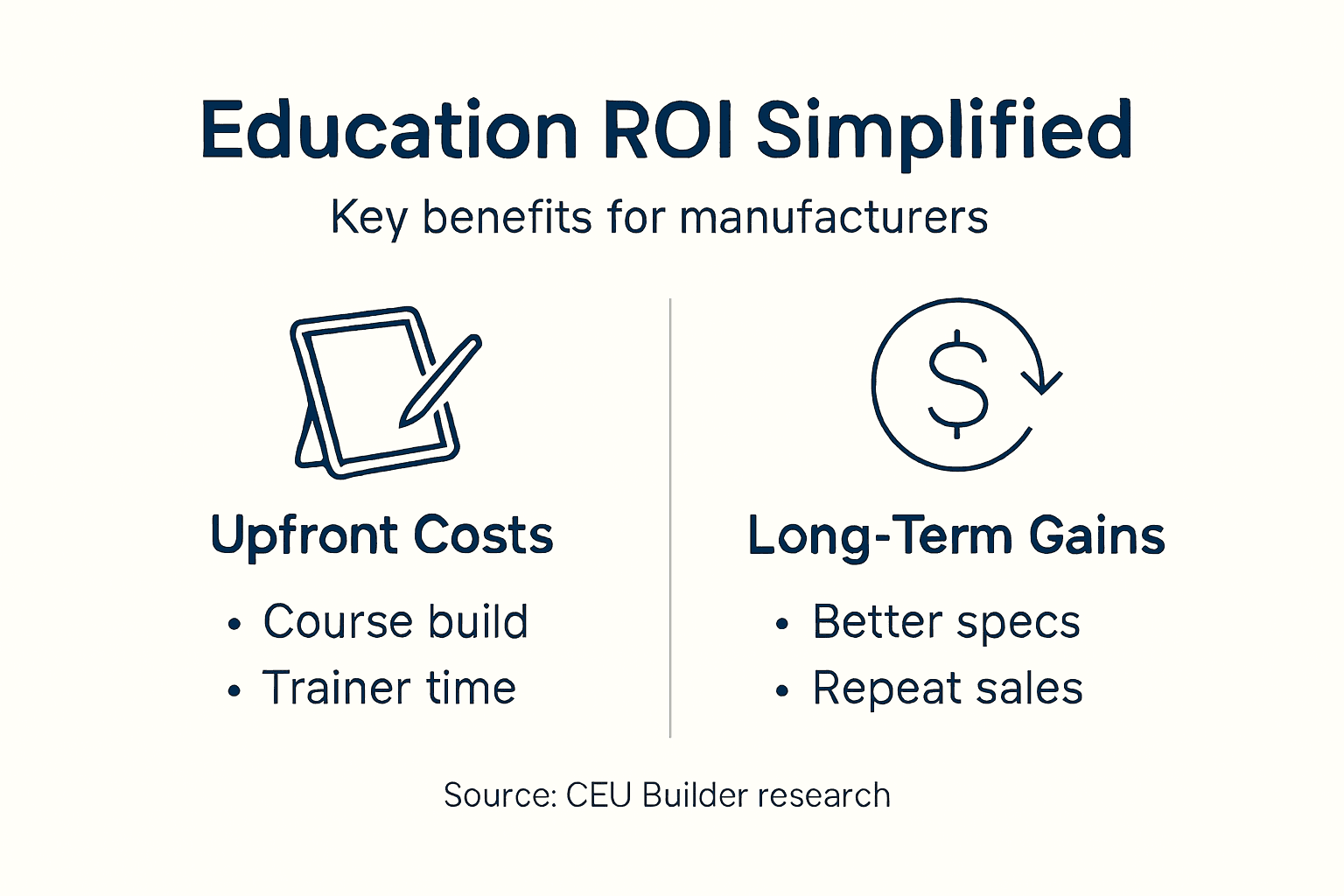
Many manufacturers skip continuing education entirely because they assume it costs too much or generates no measurable return. Others invest poorly and see no results. The difference is strategy and measurement.
Common Pitfalls That Waste Money
Manufacturers fail with continuing education in predictable ways:
Below is a summary of common pitfalls and how to avoid them when developing continuing education courses:
| Common Pitfall | Business Impact | Strategic Solution |
|---|---|---|
| Irrelevant course topics | Low enrollment, wasted effort | Research real architect needs |
| No program accreditation | Course ignored by audience | Obtain IDCEC or relevant approval |
| Poor course design | Dropouts, low learning retention | Use expert instructional design |
| Lack of promotion | Few or no participants | Build multi-channel awareness plan |
| No performance tracking | Can’t measure ROI | Track completions and specifications |
- Building courses nobody wants: Creating content around your products instead of architect needs wastes development costs on courses with low completion rates
- Launching without accreditation: Unaccredited courses get ignored because architects need credits for licensing requirements
- Poor instructional design: Boring delivery or confusing content kills engagement even if the topic matters
- No promotion strategy: Excellent courses nobody knows about generate zero specifications and revenue
- One-and-done approach: Building a single course creates no competitive advantage or scalable lead generation
- Ignoring completion data: Not tracking which architects complete courses means you can’t follow up or measure results
Real ROI Calculation
Proper ROI evaluation frameworks require defining what success looks like before you build anything. Success isn’t completion counts. Success is specifications.
Here’s realistic math: A $10,000 course reaches 200 architects in year one. If two percent specify your products after taking the course, that’s four specifications. In hospitality projects, average product packages exceed $100,000. Four specifications create $400,000 in revenue from a $10,000 investment. That’s 40x return in year one.
Year two, the same course costs nothing to deliver but continues generating completions and specifications. The ROI improves to 80x or higher because the development cost was one-time.
Measurement and Tracking
You can’t optimize what you don’t measure. Robust evaluation frameworks require tracking specific metrics:
- Completion rates: How many enrolled architects actually finish the course
- Assessment scores: Whether learners understood the material
- Lead generation: Which architects who completed the course contacted your sales team
- Specification outcomes: Which completed courses led to actual product specifications
- Revenue attribution: How much specification revenue traces back to educational touchpoints
Without this data, you’re guessing. With it, you know exactly which course topics and formats generate the highest ROI.
Risk Mitigation
The biggest risk is investing in the wrong course topic. Validate demand before building. Research what architects search for. Survey your target audience. Test the topic at a conference workshop before committing to full course development.
Accreditation failure is another risk. But CEU Builder’s 100% first-pass approval rate eliminates this. Proper development process prevents rejections that waste months and money.
Real ROI arrives when your continuing education strategy focuses on architect needs, not product promotion.
Pro tip: Calculate your realistic ROI based on your average hospitality project value and expected specification conversion rate before deciding how much to invest in continuing education development.
Unlock the Power of Continuing Education to Drive Product Specification
The article highlights a crucial challenge manufacturers face: continuing education is no longer just a compliance checkbox but a strategic business tool to influence architects and designers in their specification decisions. If your team struggles with navigating the complexity of IDCEC accreditation or crafting courses that genuinely engage and convert architects who control multi-million dollar hospitality projects, you are not alone. The key pain points include lengthy development cycles, risk of accreditation failures, and courses that do not connect with real architect needs.
At CEU Builder, we transform these challenges into fast, reliable opportunities to generate demand and long-term revenue. Our 100% first-pass IDCEC accreditation guarantee paired with a streamlined done-for-you process compresses course development from months to weeks. By deeply researching what architects actually search for and building courses around those critical topics, we help you deliver educational content that architects trust and remember. This approach creates specification preference that directly translates to measurable business impact.
Ready to move beyond compliance theater? Discover how our tailored continuing education solutions save you time and resources while maximizing your influence on product specifications. Learn more about our done-for-you services or explore the platform + AI + training option designed for teams with internal expertise.
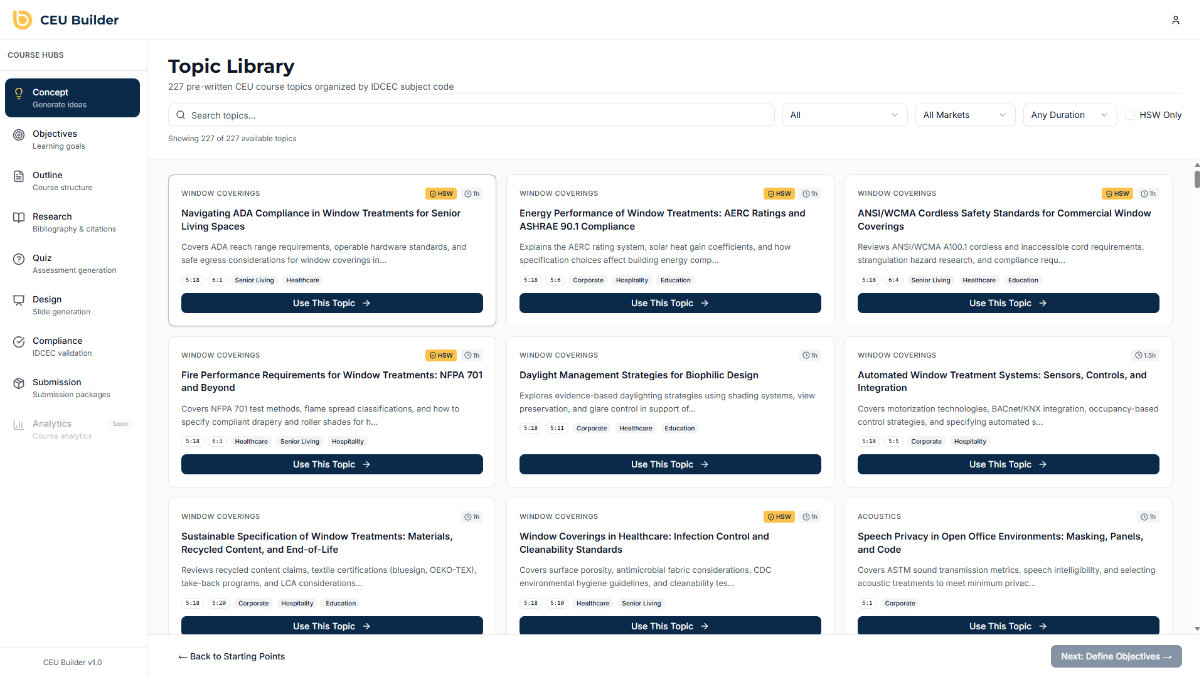
Stop waiting and start positioning your brand as the educational authority architects rely on. Visit CEU Builder now and get the process started to turn continuing education into your most powerful specification tool.
Frequently Asked Questions
What is continuing education for manufacturers?
Continuing education for manufacturers includes structured learning opportunities such as workshops, online courses, and professional certificates designed to enhance the skills of industry professionals beyond their initial education.
Why is accreditation important for continuing education programs?
Accreditation is crucial because it ensures that the courses meet quality standards recognized by professional licensing boards, making the education valuable and relevant for architects and designers in their ongoing professional development.
How can continuing education impact product specification decisions?
Continuing education directly influences product specification by ensuring that architects and designers are well-informed about a manufacturer’s products, thus increasing the likelihood that they will specify those products in their projects based on a solid understanding of their applications and benefits.
What are the common pitfalls to avoid when developing continuing education courses?
Common pitfalls include creating irrelevant course topics, failing to obtain necessary accreditation, poor course design that doesn’t engage learners, a lack of promotion leading to low enrollment, and not tracking performance metrics to measure the course’s effectiveness.
Recommended
