

Continuing Education Compliance Workflow for Hospitality Brands
Every American hospitality furniture manufacturer knows that a single compliance misstep can mean costly delays or lost accreditation opportunities. With IDCEC setting rigorous expectations, the pressure is on to manage every detail while keeping course content both current and compelling. This guide outlines a proven, step-by-step approach to establishing internal readiness and strategic documentation, giving your team greater control and confidence as you prepare for continuing education success.
Table of Contents
- Step 1: Establish Internal Readiness And Gather Content Assets
- Step 2: Align Course Development With IDCEC Requirements
- Step 3: Build And Structure Content For Accreditation Success
- Step 4: Submit Courses And Track Approval Progress
- Step 5: Verify Compliance And Implement Ongoing Monitoring
Quick Summary
| Key Insight | Explanation |
|---|---|
| 1. Conduct an Internal Audit | Assess current operational capabilities and compliance readiness to prepare for course development and accreditation. |
| 2. Align with IDCEC Standards | Ensure your course content is educationally valuable, non-proprietary, and meets IDCEC’s criteria for accreditation. |
| 3. Develop Engaging Learning Content | Create clear, measurable learning objectives and engaging materials that effectively translate technical knowledge into practical applications for design professionals. |
| 4. Submit for Accreditation Diligently | Follow detailed submission requirements and track the progress of your course application to address any feedback promptly. |
| 5. Implement Ongoing Compliance Monitoring | Establish a system for tracking course performance and compliance metrics to ensure continuous improvement and adherence to accreditation standards. |
Step 1: Establish Internal Readiness and Gather Content Assets
In this step, you’ll prepare your organization for a smooth continuing education compliance process by identifying key internal resources and documenting your current capabilities. The goal is to create a comprehensive foundation that positions your brand for successful course development and IDCEC accreditation.
Begin by conducting a thorough internal audit to assess compliance readiness. This involves gathering critical documentation and understanding your current operational landscape. Key assets to collect include:
- Existing training materials from previous educational initiatives
- Technical product documentation that demonstrates expertise
- Professional certifications held by team members
- Case studies and project portfolios showcasing design insights
- Regulatory compliance records demonstrating current industry knowledge
Your internal content gathering should focus on materials that highlight your brand’s unique perspective and technical depth. Review these assets through the lens of potential learning objectives: What specialized knowledge can your team authentically teach design professionals? What unique insights emerge from your product development and specification experience?
Successful continuing education courses transform technical information into compelling learning experiences that architects actually want to consume.
Collaborate closely with your product managers, technical experts, and marketing team to compile a comprehensive content inventory. Each team member brings a different perspective that can enrich your educational materials. Product managers understand technical specifications, technical experts can break down complex concepts, and marketing professionals know how to structure information engagingly.
Here’s a summary of how different team roles contribute to content inventory creation:
| Role | Key Contribution | Business Impact |
|---|---|---|
| Product Manager | Provides technical specs and product insights | Ensures technical accuracy and relevance |
| Technical Expert | Breaks down complex concepts | Improves content clarity for learners |
| Marketing Professional | Structures information engagingly | Increases learner engagement and retention |
Documenting your internal resources isn’t just about gathering materials—it’s about creating a strategic inventory that will streamline your course development process. By taking a systematic approach to content collection, you’ll reduce development time and increase the likelihood of first-pass IDCEC accreditation.
Pro tip: Create a centralized digital repository for all potential course content to ensure easy access and collaboration across teams.
Step 2: Align Course Development with IDCEC Requirements
In this critical step, you’ll transform your internal content into a meticulously crafted continuing education course that meets IDCEC’s rigorous standards. Your goal is to create an educational experience that not only passes accreditation but provides genuine value to design professionals.
Carefully review the IDCEC Training Manual guidelines to ensure your course meets all requirements. Successful alignment demands attention to several key elements:
- Ensure non-proprietary content that provides objective, educational value
- Incorporate health, safety, and welfare (HSW) criteria where applicable
- Calculate CEU credits accurately based on instructional hours
- Select an appropriate course delivery method (in-person or distance learning)
Your course development must transcend simple product promotion. The IDCEC prioritizes educational integrity, which means creating content that genuinely informs and educates design professionals about broader industry concepts, technical insights, and professional practices.
Effective continuing education courses bridge technical knowledge with practical design applications, transforming information into actionable professional insights.
Break down complex technical information into digestible learning modules that connect directly to design professionals’ real-world challenges. Focus on explaining how your technical expertise solves specific design problems, rather than simply describing product features. This approach demonstrates your brand’s thought leadership while maintaining the educational objectivity IDCEC requires.
Consider collaborating with subject matter experts who can help translate your technical knowledge into compelling educational content. Their perspective can help you craft learning objectives that are both technically precise and pedagogically engaging.
Pro tip: Create a detailed content outline that maps each section to specific IDCEC learning objectives, ensuring comprehensive coverage and compliance.
Step 3: Build and Structure Content for Accreditation Success
In this pivotal stage, you’ll transform your collected assets into a meticulously crafted continuing education course that meets rigorous accreditation standards. Your objective is to create an educational experience that demonstrates genuine learning value and professional relevance.
Focus on continuous improvement strategies that elevate your course beyond basic compliance. Developing high-quality educational content requires strategic attention to several critical elements:
- Define clear learning objectives that connect directly to professional development
- Develop measurable learning outcomes for each course module
- Create engaging, non-promotional content that provides genuine educational value
- Design assessment mechanisms to validate participant comprehension
- Build flexible content structures that accommodate different learning styles
Your content development should prioritize depth and practical applicability. Design each module to solve real-world design challenges, demonstrating how technical knowledge translates into professional problem-solving skills. This approach transforms your course from a simple compliance requirement into a valuable learning experience.
Exceptional continuing education courses bridge theoretical knowledge with practical application, creating meaningful professional development opportunities.
Structure your content with precision, ensuring each section flows logically and builds upon previous learning. Break complex technical concepts into digestible segments, using clear language and practical examples that resonate with design professionals. Include visual aids, case studies, and real-world scenarios to enhance understanding and engagement.

Consider incorporating interactive elements like knowledge checks, scenario-based questions, and reflective exercises that encourage active learning and reinforce key concepts. These strategies not only improve learning retention but also demonstrate a commitment to meaningful educational experiences.
Pro tip: Develop a comprehensive content matrix that maps learning objectives to specific module content, ensuring thorough coverage and systematic knowledge progression.
Step 4: Submit Courses and Track Approval Progress
In this critical phase, you’ll navigate the complex landscape of course submission and monitoring, transforming your meticulously developed content into an officially recognized continuing education offering. Your mission is to successfully submit your course while maintaining precise oversight of the approval process.
Carefully review the course provider submission requirements to ensure a smooth application. Successful submission involves several strategic steps:
- Register as an official course provider with IDCEC
- Prepare comprehensive documentation including course materials
- Complete detailed application forms
- Submit instructor qualification documentation
- Pay necessary application processing fees
Your submission must demonstrate professionalism and attention to detail. IDCEC reviewers scrutinize every aspect of your application, looking for clear evidence of educational value, technical accuracy, and compliance with professional development standards.
Meticulous documentation and transparent communication are the keys to navigating the accreditation review process successfully.
Track your application progress using the provider dashboard, monitoring each review stage carefully. Be prepared to respond quickly to any feedback or additional information requests. This proactive approach demonstrates your commitment to meeting professional educational standards and increases the likelihood of first-pass approval.
Each interaction with the accreditation body is an opportunity to showcase your brand’s expertise and dedication to meaningful professional development. Maintain clear, professional communication and be ready to provide supplementary information that reinforces the educational value of your course.
Pro tip: Create a dedicated submission tracking spreadsheet that logs every document submitted, communication exchanged, and follow-up action required during the approval process.
Step 5: Verify Compliance and Implement Ongoing Monitoring
In this final stage, you’ll establish a robust system for maintaining continuous compliance and tracking the long-term performance of your continuing education courses. Your goal is to create a proactive monitoring framework that ensures sustained IDCEC accreditation and ongoing educational quality.
Implement digital compliance monitoring strategies that automate and streamline your verification processes. Effective ongoing monitoring involves several critical components:
- Track course completion rates systematically
- Monitor participant feedback and evaluation scores
- Review learning outcome achievement periodically
- Conduct regular content relevance assessments
- Maintain updated instructor qualifications
- Perform annual content review and refresh
Your compliance verification should be dynamic and responsive. Treat this process not as a bureaucratic requirement but as an opportunity to continuously improve your educational offerings and demonstrate your commitment to professional development.
Proactive compliance monitoring transforms regulatory requirements from administrative burdens into strategic opportunities for educational excellence.
Establish clear accountability by designating a specific team member responsible for tracking compliance metrics. This individual should have direct access to course performance data, participant insights, and accreditation requirements. Regular reporting and transparent documentation will help you stay ahead of potential compliance issues.
Consider developing a comprehensive dashboard that provides real-time insights into course performance, participant engagement, and compliance status. This approach allows for rapid identification of trends, immediate corrective actions, and strategic course improvements.
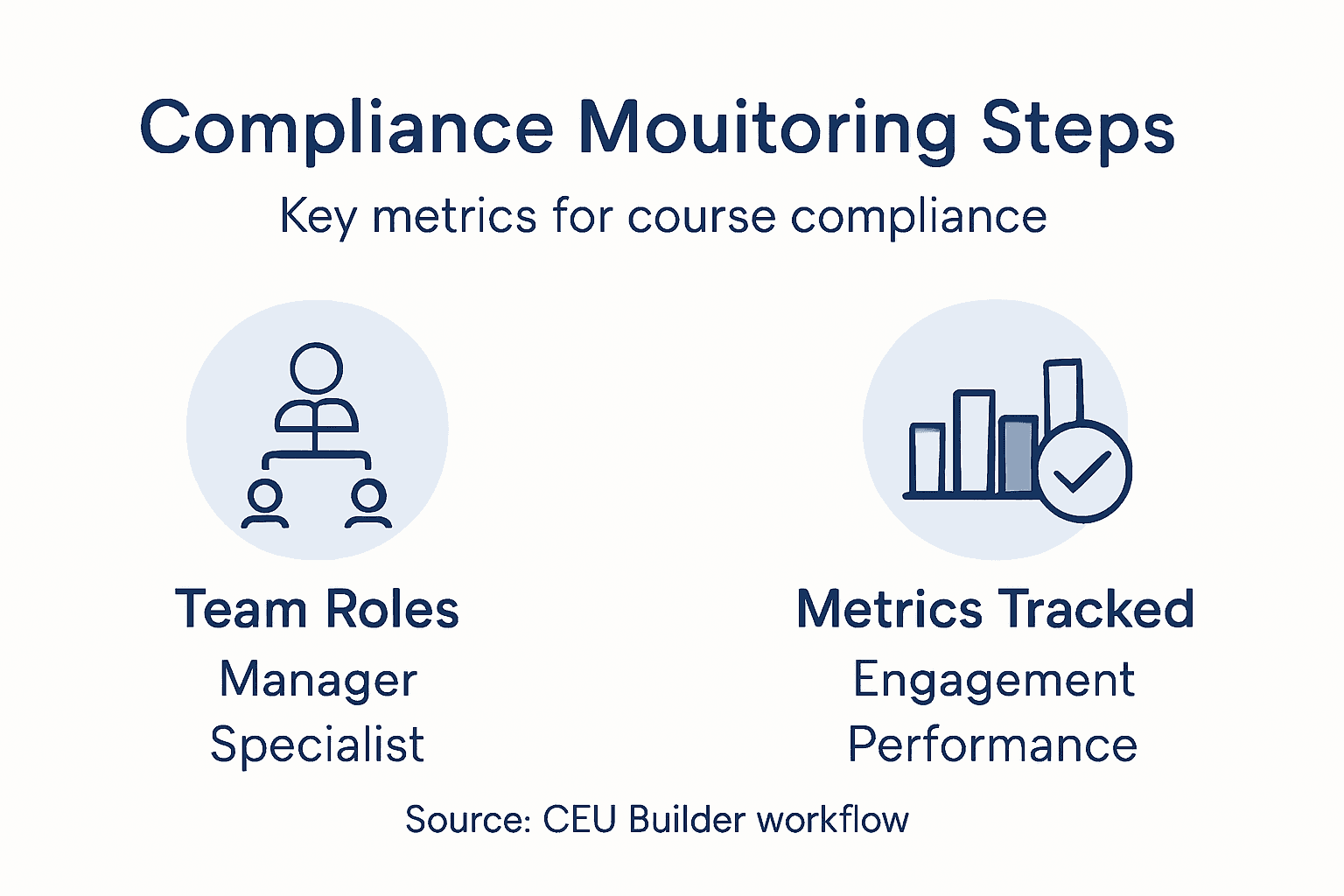
This table outlines critical compliance metrics to monitor for ongoing educational success:
| Compliance Metric | Monitoring Frequency | Strategic Value |
|---|---|---|
| Course Completion Rate | Monthly | Tracks program effectiveness |
| Participant Feedback | After each session | Identifies improvement areas |
| Content Relevance Assessment | Annually | Keeps material current and useful |
| Instructor Qualifications | Yearly | Ensures credibility and compliance |
Pro tip: Create an automated quarterly compliance review process that generates comprehensive reports tracking key performance indicators and highlighting any necessary content or procedural adjustments.
Streamline Your Continuing Education Compliance with CEU Builder
Navigating the complex workflow of continuing education compliance for hospitality brands requires more than just assembling content and submitting courses. The challenge lies in creating engaging, non-promotional educational experiences that align perfectly with IDCEC standards while saving valuable time and internal resources. This article highlights the pain points many hospitality manufacturers face — from internal readiness and content structuring to tracking approval progress and ongoing compliance monitoring.
CEU Builder specializes in turning these challenges into strategic advantages. Our proven approach ensures a 100% first-pass IDCEC accreditation rate, eliminating costly delays and rework. Whether you need full-service course development or tools to accelerate your internal process, our solutions help you craft courses that educate design professionals and drive specifications. Discover how CEU Builder’s expertise in Compliance & Accreditation and Pipeline & Revenue Growth can transform continuing education from a compliance burden into a powerful demand generation engine.
Are you ready to simplify your continuing education compliance workflow and deliver accredited courses that truly impact your business?
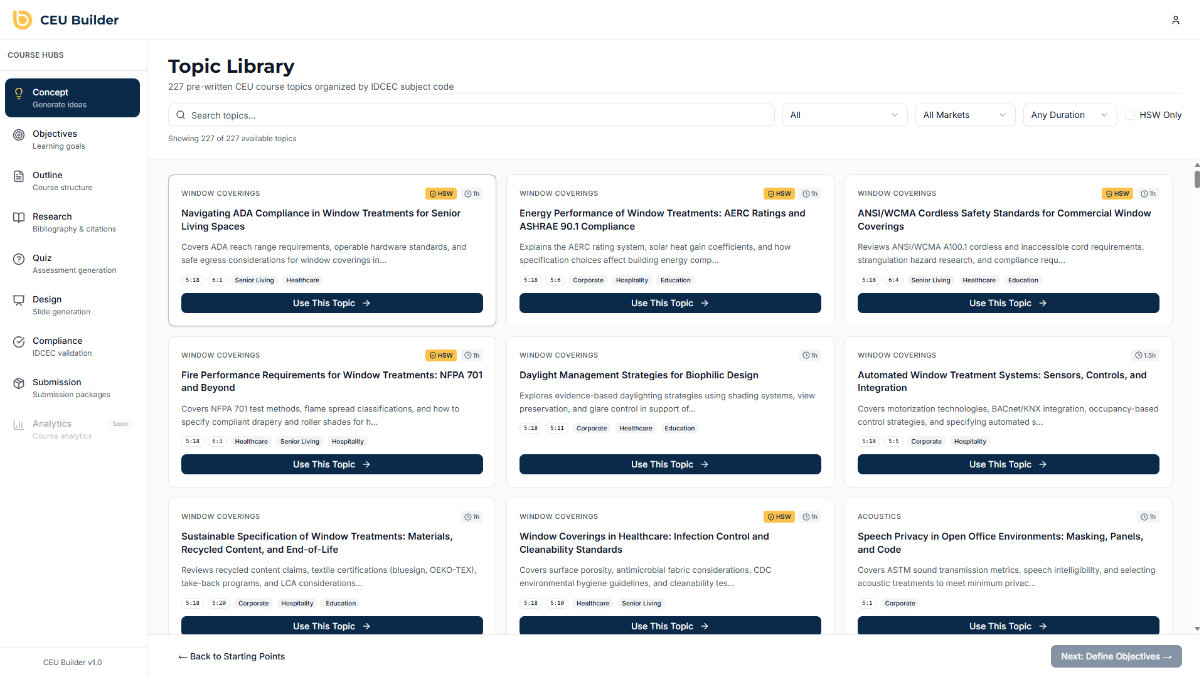
Explore how CEU Builder can help you build accredited courses quickly and confidently. Visit CEU Builder today to learn more and take the next step toward accelerating your education strategy.
Frequently Asked Questions
How do I assess my hospitality brand’s compliance readiness for continuing education?
To assess your compliance readiness, conduct a thorough internal audit that gathers critical documentation and reviews your current operational landscape. Collect existing training materials, technical documentation, and professional certifications held by your team to establish your baseline capabilities.
What steps should I take to align my continuing education course with IDCEC requirements?
To align your course with IDCEC requirements, carefully review their Training Manual guidelines and ensure your content is non-proprietary, objective, and meets health, safety, and welfare (HSW) criteria. Clearly outline learning objectives and select an appropriate course delivery method.
How can I structure my continuing education content to meet accreditation standards?
Structure your course content by defining clear learning objectives and measurable outcomes for each module. Break down complex information into digestible segments, using engaging, non-promotional content that provides real educational value.
What documentation is necessary for submitting my continuing education course for IDCEC approval?
When submitting your course for IDCEC approval, prepare comprehensive documentation that includes course materials, detailed application forms, and instructor qualification documentation. Ensure that you register as an official course provider and pay any necessary processing fees.
How can I track the approval progress of my continuing education course?
To track the approval progress, use the provider dashboard to monitor each review stage of your submission. Be proactive and ready to respond quickly to any feedback or requests for additional information to enhance your chances of first-pass approval.
What ongoing monitoring strategies can ensure continued compliance after course accreditation?
Implement ongoing monitoring strategies that include tracking course completion rates, participant feedback, and content relevance. Conduct regular assessments and maintain updated instructor qualifications to ensure continuous compliance and educational quality.
Recommended
