

7 Essential Continuing Education Tips for Hospitality Marketers
Trying to make your continuing education courses stand out for architects and hospitality professionals can feel complicated. With industry standards always evolving and new trends constantly emerging, it’s easy for educational content to get overlooked. You want your courses to be more than checkboxes. You want them to be valuable resources that professionals actually seek out and use in their real work. This list gives you practical strategies that address what architects genuinely need, how you can connect your topics to real search behaviors, and ways to speed up accreditation without sacrificing quality. Get ready to discover actionable insights that will help your courses deliver real impact, attract the right audience, and drive measurable outcomes for your business.
Table of Contents
- Understand What Architects Value in Course Content
- Align CEU Topics with Actual Search Behavior
- Streamline Accreditation for Fast Market Entry
- Connect Product Features to Design Challenges
- Leverage Data to Optimize Course Impact
- Promote Courses with Strategic Sales Integration
- Track Outcomes to Drive Continuous Improvement
Quick Summary
| Takeaway | Explanation |
|---|---|
| 1. Focus on Relevant Content | Architects prefer courses with practical applications that directly address their design challenges and professional needs. |
| 2. Align With Search Behavior | CEU topics should match current trends and search behaviors in the architecture and hospitality sectors to remain engaging. |
| 3. Streamline Accreditation | A strategic approach to accreditation can expedite course approval, making it easier to bring valuable education to market quickly. |
| 4. Connect Products to Solutions | Educators should showcase how product features solve specific design problems rather than merely listing specifications. |
| 5. Leverage Data for Improvement | Regularly analyze participant data to refine courses, ensuring they meet evolving needs and enhance engagement effectively. |
1. Understand What Architects Value in Course Content
Successful continuing education content for architects isn’t just about meeting credit requirements – it’s about delivering meaningful professional insights. Architects are seeking courses that go far beyond basic compliance and genuinely enhance their design capabilities.
When creating continuing education materials for architects, it’s critical to understand their core professional priorities. According to research from the National Council of Architectural Registration Boards (NCARB), architects prioritize education that addresses several key areas:
- Health and safety fundamentals
- Building code updates
- Emerging materials science
- Advanced building systems knowledge
- Accessibility design principles
- Construction methodology innovations
Architects want courses that translate directly into improved professional practice, not generic content that feels disconnected from real design challenges.
The most compelling continuing education programs provide practical insights into current architectural practice challenges. This means moving beyond theoretical discussions and offering concrete, applicable knowledge that architects can immediately implement in their design work.
Successful course content should demonstrate deep understanding of architects’ professional ecosystem. This involves presenting information through multiple engagement formats – including online courses, webinars, interactive sessions, and networking opportunities. The goal is creating an educational experience that feels like a valuable professional resource, not a mandatory checkbox.
Key elements that make continuing education compelling include:
- Real-world case studies
- Technical depth with practical applications
- Insights from industry experts
- Clear connections to current design challenges
- Opportunities for professional skill enhancement
Pro tip: Focus on creating course content that architects would voluntarily choose to attend, even if continuing education credits weren’t required.
2. Align CEU Topics with Actual Search Behavior
In the rapidly evolving hospitality landscape, continuing education isn’t just about checking a compliance box – it’s about staying ahead of industry transformations. Your CEU content must reflect the actual search behaviors and emerging trends that architects and designers are actively exploring.
Digital competencies in hospitality have become increasingly critical, driving the need for continuing education that speaks directly to contemporary professional challenges. This means going beyond traditional topic selection and diving deep into what truly matters to design professionals.
The most effective CEU programs align with current industry interests and technological shifts:
- Digital transformation strategies
- Workforce mobility trends
- Sustainability practices
- Risk management innovations
- Advanced technological integration
Smart marketers understand that relevance trumps generic content every single time.
To effectively align CEU topics with actual search behavior, manufacturers must become strategic researchers. This involves analyzing:
- Google search trends in hospitality design
- Professional forum discussions
- Recent architectural conference themes
- Industry publication content
- Social media professional group conversations
By mapping your continuing education content to these real-world information pathways, you transform educational materials from mandatory requirements into genuine professional resources. The goal is creating courses that architects would choose to take even without credit requirements.
Research consistently demonstrates that CEU programs most likely to engage design professionals are those that address cutting-edge industry challenges. This means moving beyond surface-level information and providing deep, actionable insights that professionals can immediately apply in their work.
Pro tip: Conduct quarterly keyword research to ensure your CEU topics remain dynamically aligned with current architectural and design professional search behaviors.
3. Streamline Accreditation for Fast Market Entry
In the competitive world of continuing education, speed can be your most strategic advantage. The difference between launching a successful CEU program and getting lost in bureaucratic delays often comes down to understanding the accreditation process.
Navigating the accreditation landscape requires strategic preparation that goes beyond mere compliance. Successful hospitality marketers recognize that a methodical approach can dramatically reduce time to market and increase program effectiveness.
Key strategies for accelerating the accreditation process include:
- Early criteria alignment
- Comprehensive documentation
- Proactive communication
- Systematic review preparation
- Technical standards mastery
The goal isn’t just approval – it’s rapid, smooth market entry that positions your educational content as authoritative.
Most manufacturers waste months struggling with accreditation because they approach it as a reactive process. Instead treat it as a strategic business initiative. This means:
- Understanding exact requirements before content creation
- Building compliance into initial course design
- Preparing comprehensive supporting documentation
- Anticipating potential reviewer questions
- Creating a transparent submission package
The International Centre of Excellence highlights several critical factors that influence swift accreditation:
- Institutional reputation
- Clear governance structures
- Curriculum relevance
- Faculty competency demonstration
- Evidence of continuous improvement
Successful marketers view accreditation not as an obstacle but as an opportunity to demonstrate professional excellence. By investing time in meticulous preparation, you transform a potentially frustrating process into a competitive advantage.
Pro tip: Develop a standardized internal checklist that maps directly to accreditation requirements to ensure consistent, rapid course development and approval.
4. Connect Product Features to Design Challenges
Successful hospitality marketers understand that architects don’t buy products – they solve design challenges. Your continuing education content must transform technical specifications into strategic solutions that directly address real-world hospitality design problems.
Advanced technologies bridge design constraints by enabling more innovative and customer-centric approaches. This means moving beyond traditional product presentations to demonstrate how your specific features resolve critical design challenges.
The most effective CEU courses go beyond surface-level descriptions and dive deep into practical applications:
- Functional performance analysis
- Operational efficiency insights
- Customer experience enhancement
- Sustainability integration
- Technological adaptability
Great product education doesn’t sell features – it solves problems architects actually face.
To effectively connect product features to design challenges, manufacturers must adopt a design thinking methodology that involves:
- Deep empathy with design professionals
- Understanding project-specific constraints
- Demonstrating measurable performance improvements
- Providing quantifiable design solutions
- Illustrating real-world implementation strategies
Successful product presentations in continuing education require more than technical specifications. They demand a holistic approach that shows how your product:
- Reduces installation complexity
- Enhances spatial functionality
- Improves long-term operational performance
- Supports sustainability goals
- Meets evolving hospitality design standards
Architects are seeking partners who understand their complex design ecosystem. Your CEU content should position your products as strategic solutions that go beyond mere transactions and become integral components of innovative design approaches.
Pro tip: Map each product feature to a specific design challenge architects routinely encounter, creating a clear narrative of problem-solution in your continuing education materials.
5. Leverage Data to Optimize Course Impact
Continuing education isn’t a guessing game – it’s a strategic science powered by data. Smart hospitality marketers are transforming their CEU programs from static content delivery into dynamic, insights-driven experiences that architects actually want.
The landscape of big data analytics in education is revolutionizing how we understand and deliver learning experiences. By systematically analyzing participant data, you can create courses that are not just informative but precisely targeted to design professionals’ evolving needs.
Data-driven continuing education strategies focus on multiple critical dimensions:
- Learner participation metrics
- Course completion rates
- Knowledge retention analysis
- Geographic market insights
- Professional development trends
Not all data points are created equal. Focus on insights that drive meaningful engagement and specification opportunities.
To effectively leverage data in your CEU strategy, manufacturers must implement a comprehensive tracking and analysis approach:
- Establish baseline performance metrics
- Track granular engagement data
- Conduct periodic content relevance assessments
- Implement iterative course improvements
- Correlate course completions with specification outcomes
Successful data optimization involves understanding key performance indicators that go beyond simple completion numbers:
- Architect demographic insights
- Geographic specification trends
- Content interaction depth
- Post-course specification rates
- Long-term professional impact
The most advanced hospitality marketers view their continuing education content as a dynamic, evolving asset. By treating each course as a data collection opportunity, you transform educational materials from static resources into strategic business intelligence platforms.
Pro tip: Invest in a robust learning management system that provides comprehensive analytics, enabling you to track not just who completed your course, but how deeply they engaged with the content.
6. Promote Courses with Strategic Sales Integration
Continuing education isn’t just an academic exercise – it’s a powerful sales acceleration tool for hospitality manufacturers. The most successful CEU programs seamlessly bridge educational value with strategic sales objectives.
Manufacturers can transform marketing and sales strategies by treating continuing education as a precision lead generation platform. This approach moves beyond traditional course promotion into a sophisticated engagement mechanism.
Strategic course promotion involves multiple interconnected tactics:
- Targeted audience segmentation
- Personalized messaging
- Multi-channel distribution
- Sales team alignment
- Performance tracking
Effective CEU marketing turns educational content into a strategic revenue generation engine.
Successful integration requires a systematic approach:
- Develop comprehensive learner personas
- Create tailored course messaging
- Design cross-channel promotion strategies
- Train sales teams on course positioning
- Implement robust tracking mechanisms
Key promotional strategies that drive sales integration include:
- Embedding sales qualifying questions in course materials
- Creating follow-up sequences for course completers
- Developing sales-enablement content from course insights
- Tracking specification rates from educational interactions
- Building automated nurture campaigns
The most advanced hospitality marketers view continuing education as more than compliance – it’s a sophisticated demand generation tool that creates meaningful connections with architects and designers.
Pro tip: Design your course registration process to capture rich lead intelligence that your sales team can leverage for targeted follow-up and specification conversations.
7. Track Outcomes to Drive Continuous Improvement
Continuing education isn’t a static product – it’s a living, evolving system that demands constant refinement and strategic measurement. The most successful hospitality marketers treat their CEU programs like precision instruments, continuously calibrating for maximum impact.
Implementing systematic improvement cycles transforms continuing education from a compliance requirement into a strategic business intelligence tool. This approach goes beyond surface-level metrics to understand the deeper implications of your educational content.
Comprehensive outcome tracking involves multiple sophisticated dimensions:
- Specification conversion rates
- Architect engagement levels
- Knowledge retention measurements
- Long-term professional impact
- Revenue attribution
Measuring outcomes isn’t about collecting data – it’s about uncovering actionable insights that drive meaningful business transformation.
Effective outcome tracking requires a structured approach:
- Establish baseline performance metrics
- Design comprehensive tracking mechanisms
- Implement regular review cycles
- Create iterative improvement processes
- Connect educational outcomes to business goals
Key performance indicators that matter most include:
- Percentage of course completers who specify products
- Time between course completion and first specification
- Depth of architect engagement with course materials
- Repeat course enrollment rates
- Cross-course specification patterns
The Plan-Do-Check-Act cycle provides a robust framework for continuous educational refinement. This means treating each course as an opportunity for systematic learning and improvement, not just a one-time content delivery mechanism.
Pro tip: Develop a quarterly review process that goes beyond vanity metrics, focusing on how your continuing education content directly influences architect specification behaviors.
Below is a comprehensive table summarizing the main strategies and considerations discussed throughout the article on creating impactful continuing education programs for architects.
| Topic | Key Points | Recommendations |
|---|---|---|
| Value in Course Content | Architects seek insights that enhance professional capabilities and practical application. | Focus on real-world case studies and actionable technical knowledge. |
| Aligning Topics | Relevance is key; topics should match industry trends and search behaviors. | Conduct regular keyword research and analysis of professional forums and publications. |
| Accreditation Process | Advancing through approval requires preparation and compliance-focused design. | Develop internal checklists aligned with accreditation requirements. |
| Product Features in Design Challenges | Architects seek solutions, not just products. Highlight problem-solving features. | Map features to design constraints using real-world application examples. |
| Leveraging Data Analytics | Understand architecture professionals through insightful metrics. | Adopt a robust learning management system for detailed engagement tracking. |
| Strategic Course Promotion | Link educational offerings with sales and distribution objectives. | Segment audiences for targeted marketing and train sales teams to integrate courses into pitches. |
| Continuous Improvement | Treat courses as evolving programs to refine based on outcomes. | Establish quarterly reviews to optimize content impact and align courses with organizational goals. |
Elevate Your Hospitality Marketing with Strategic Continuing Education
Hospitality marketers face the urgent challenge of turning continuing education from a simple compliance task into a dynamic demand generation tool. This article highlights key pain points such as aligning course topics with architect search behavior, speeding up accreditation, and connecting product features to real design challenges. These goals are essential for manufacturers that want to achieve measurable specification lift and position their brand as a trusted design partner.
At CEU Builder, we transform continuing education into a competitive advantage through expert IDCEC-accredited course creation that guarantees first-pass approval. Our specialized approach addresses your exact needs by combining deep industry research, seamless compliance management, and strategic sales integration to maximize your hospitality brand’s impact. Discover how to build courses architects want to engage with and convert those engagements into lasting specification wins.
Ready to stop playing compliance theater and start driving meaningful results? Explore our Compliance & Accreditation – CEU Builder services to fast-track your course approval and tap into architect search behaviors. See how our General – CEU Builder solutions provide a full spectrum of offerings tailored for hospitality manufacturers.
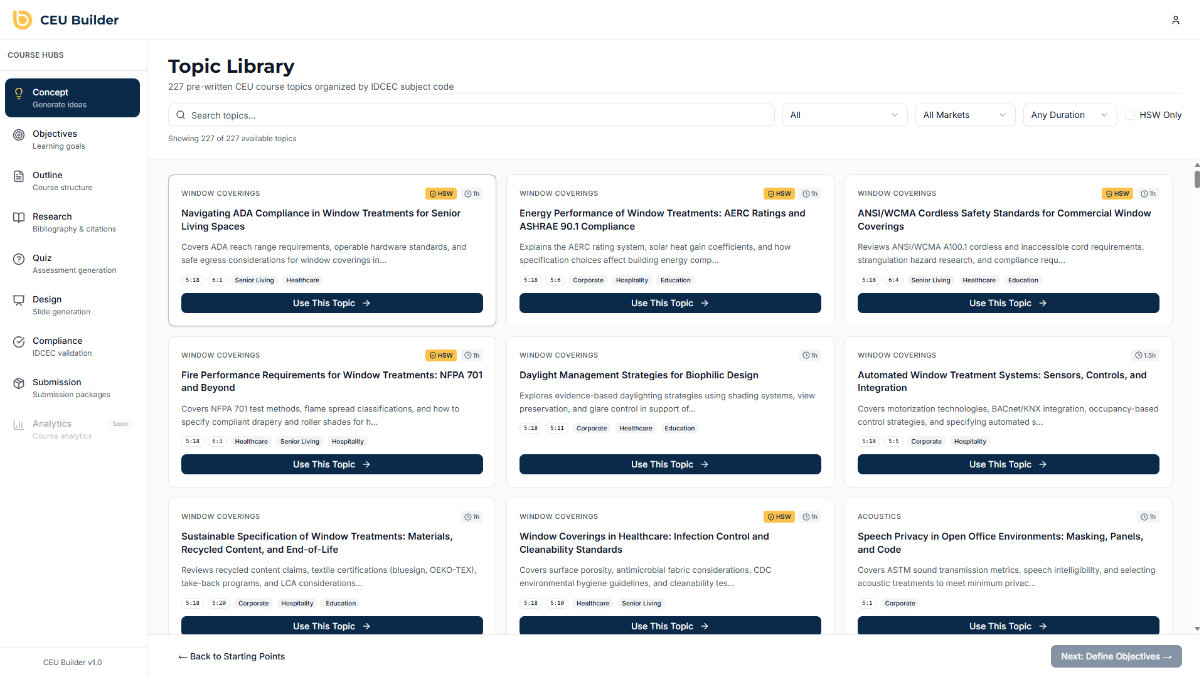
Take the next step to transform your continuing education strategy today. Visit CEU Builder to learn more about our done-for-you courses, platform options, and expert support that put you ahead in hospitality marketing now.
Frequently Asked Questions
What are the key components of compelling continuing education for hospitality marketers?
Successful continuing education for hospitality marketers should include real-world case studies, insights from industry experts, and practical applications. Focus on delivering information that directly addresses current design challenges and enhances professional skills.
How can I align my continuing education topics with what architects are actually searching for?
To align your topics effectively, conduct keyword research and analyze industry trends on platforms like professional forums and social media. Adjust your course offerings based on what design professionals are actively exploring to ensure relevance.
What strategies can streamline the accreditation process for my continuing education programs?
Prepare early by understanding the exact accreditation requirements and incorporating compliance into your course design. Create comprehensive documentation and a transparent submission package to lower approval times and ensure a smooth market entry.
How can I integrate sales goals into my continuing education marketing strategy?
Develop tailored messaging and align with your sales team to promote courses effectively as lead generation tools. By capturing detailed learner insights during registration, you can facilitate targeted follow-up, ultimately driving specifications.
What metrics should I track to measure the impact of my continuing education programs?
Focus on specification conversion rates, architect engagement levels, and knowledge retention measurements to assess your program’s success. Implement a structured approach to data collection and regularly review outcomes for actionable insights to drive improvement.
Recommended
